
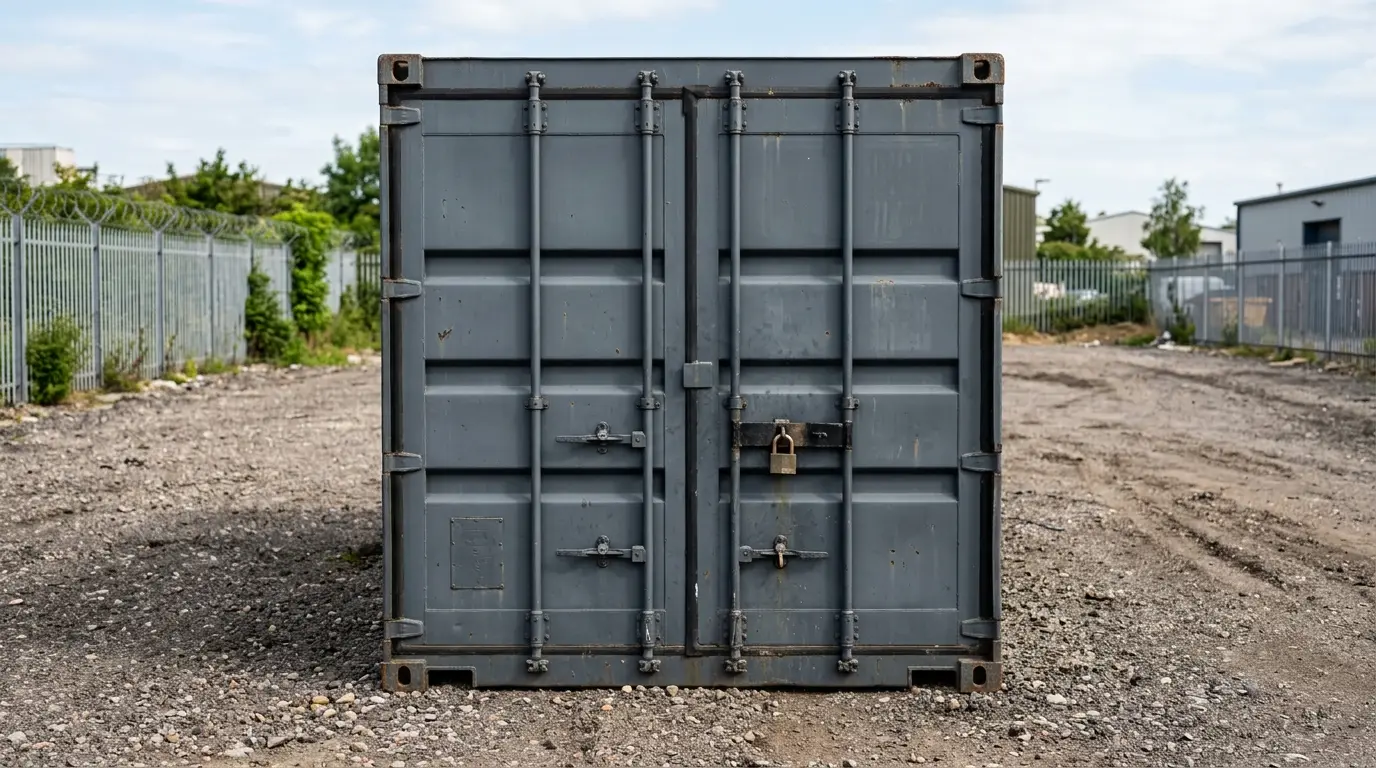
Why containers are often unprotected
Many owners assume that a container is somehow “included” – under the building insurance, the household contents policy or a commercial policy. In practice, that is frequently not the case. The reason lies in how these contracts are structured:
- Building insurance covers the building described in the policy and its permanently connected components. A free-standing container is usually neither, and therefore typically not automatically included.
- Household contents insurance covers movable property inside the insured home. A container in the garden, on a parking area or on a construction site normally lies outside that insured location; clauses on “cover away from home” or outbuildings are narrowly limited.
- Commercial policies almost always refer to a specifically named insured location. A mobile container that changes site only fits that logic if expressly included.
Add the risk profile: containers often stand unattended, outdoors, on poorly visible plots – ideal conditions for break-ins, vandalism and storm damage. Without expressly agreed cover, you carry the loss yourself.
What can be insured
Three levels should be considered separately. A contract covering one level says nothing about the others.
| Level | Typical perils | Note |
|---|---|---|
| The container itself (structure) | Fire, storm, vandalism, wilful damage, theft of the entire container, transport damage | Document value and age; for used containers the current value is often well below the purchase price |
| Contents (goods, tools, electronics, furniture, files) | Burglary, fire, escape of water, storm, moisture and frost damage | Usually the larger economic item; hard to prove without an inventory list |
| Liability risks (damage to third parties) | Tipping over, falling parts, injuries on the site, damage to neighbouring property or vehicles | Concerns owners and users alike, including duties to keep the site safe |
Remember: “the container is insured” is not a meaningful statement until it is clear which of the three levels is meant. In many claims the contents cost more than the shell.
Possible policies at a glance
Which policy fits depends on whether the container is used privately or commercially, whether it stands permanently or on a construction site, and what is stored inside.
| Policy | Typically covers | Note |
|---|---|---|
| Commercial contents insurance | Business equipment, goods and stock against fire, burglary, escape of water, storm/hail | The insured location must expressly include the container; observe security requirements |
| Electronics / machinery insurance | Technical devices, construction machinery, tools – often including operating errors and theft | Useful for high-value equipment in storage or site containers; frequently written as all-risks cover |
| Construction all-risks insurance | Unforeseen damage to the construction works during the build, sometimes site facilities | Whether containers count as insured site facilities is a matter of contract – clarify expressly |
| Public / commercial liability | Injury and property damage to third parties arising from operations or from siting the container | Does not cover your own container or your own contents |
| Transport insurance | Damage during delivery, repositioning and collection (crane, loading, journey) | Important during transport; check whether the haulier provides cover and how their liability is capped |
| Private household contents insurance | Household goods at the insured home; outbuildings and away-from-home cover only to a limited extent | Usually insufficient for containers – inclusion only by express agreement |
Details on scope, sums insured and preconditions appear solely in the respective policy wording. The table is rough orientation, not a promise of cover.
Typical exclusions and pitfalls
Most disputes arise not because no policy existed, but because of conditions in the small print:
- Theft without signs of forced entry: Many wordings require burglary, meaning visible traces of force. If an unlocked container is emptied, or a lock is defeated without damage, the payout may be reduced or refused.
- Insufficient security: There are often duties regarding locking, lock type or lighting. Failing to meet them can lead to reduced settlement.
- Gross negligence: Some tariffs waive the objection, others reduce the payout in line with the degree of fault.
- Storm damage depends on wind force: In many wordings, storm is only insured from a defined wind strength.
- Flood, backwater, earthquake: Often covered only as an add-on module, not in basic cover.
- Frost and moisture damage: Damage from condensation, mould or frozen pipes is frequently excluded or tied to precautionary duties (heating, draining).
- Change of location: If the container is moved without informing the insurer, the insured location may no longer match.
What insurers expect
Insurers reward demonstrable diligence – and often require it expressly:
- Proper securing: High-quality locking, lock box, protected positioning (doors facing a wall), lighting or monitoring where appropriate. See Securing a container.
- A documented inventory list: What is in the container, in what quantity, at what value? Photos, invoices and serial numbers make claims handling far easier.
- A clear location statement: Address or plot, siting situation, access protection. For changing locations the policy must expressly allow it.
- Maintenance and condition: A watertight roof, working door seals and rust protection are also an argument in a claim.
Special points for rented containers
With rented containers, responsibilities shift – but the risk does not shift automatically:
- The lessor usually insures the container as an asset (the structure), often with their own excess. That does not necessarily protect you from claims.
- The hirer regularly bears a duty of care: to treat the container properly, secure it and return it in the agreed condition. Damage from a breach can be attributed to them.
- The contents are practically never insured through the lessor. Tools, materials and equipment are the hirer’s responsibility.
- Excess and liability waivers are often set out in the contract – some providers offer a liability reduction for a surcharge.
Which contract points to check is described in Renting a container: the process. For sanitary and welfare units, operating and maintenance questions come on top, see Sanitary containers.
Cost range – rough orders of magnitude
Premiums depend on the sum insured, location, use, security, excess and claims history. The following are very rough approximate ranges, not quotes and not reliable market prices.
| Cover | Rough order of magnitude (approx., per year) | Main price drivers |
|---|---|---|
| Low-value contents (stored goods, simple fit-out) | low to mid two-digit up to low three-digit range | Sum insured, location risk |
| Tools and equipment in a site container | mid to high three-digit range | Replacement value of the equipment, theft risk, security |
| The container as an asset (structure) | depends on current value, usually a small share of the sum insured | Age, condition, list of insured perils |
| Liability module (commercial) | usually part of an existing commercial liability policy | Type of business, turnover, limit of indemnity |
Price figures are non-binding orders of magnitude. Only individual quotes and the concluded insurance contract are binding.
Checklist before taking out cover
- Review what exists: Which contracts are already in place, and what is defined there as the insured location and list of perils?
- Name the gaps: Container, contents, liability – answer separately for each level whether cover exists.
- Establish values: Maintain an inventory list with purchase values, photos and receipts.
- Select perils: Fire, burglary, storm, vandalism, natural hazards – decide deliberately what is included.
- Read the duties: Clarify requirements on locking, security, location and notification before signing.
- Calculate the excess: A higher excess lowers the premium but increases exposure on small claims.
- Settle relocation: For mobile use, expressly agree that changing locations remain covered.
- Compare offers: Compare not just the premium but scope, exclusions and indemnity limits.
Important note
This article contains general information and does not constitute legal or insurance advice. Whether and to what extent a loss is covered depends solely on the relevant insurance contract, including its policy wording, duties and exclusions. The policies, perils and cost figures named here are deliberately general and vary by provider, tariff and individual case; the price ranges are non-binding orders of magnitude. Binding information is given only by your insurer, an insurance broker or another qualified expert. For legal questions – for example on liability within a rental relationship – please consult a lawyer.
Conclusion
A container is rarely insured automatically. Anyone who wants protection has to agree it expressly – distinguishing between structure, contents and liability. Economically, the contents usually matter most: tools, equipment and goods often far exceed the value of the shell. Two things decide how a claim is settled, and both must be done before the loss: a solid inventory list and security that matches the agreed duties. With rented containers, read the contract closely – the duty of care and the excess regularly land with the hirer. Clarifying this in advance avoids the classic surprise: a policy exists, but not for the case that actually occurred.