
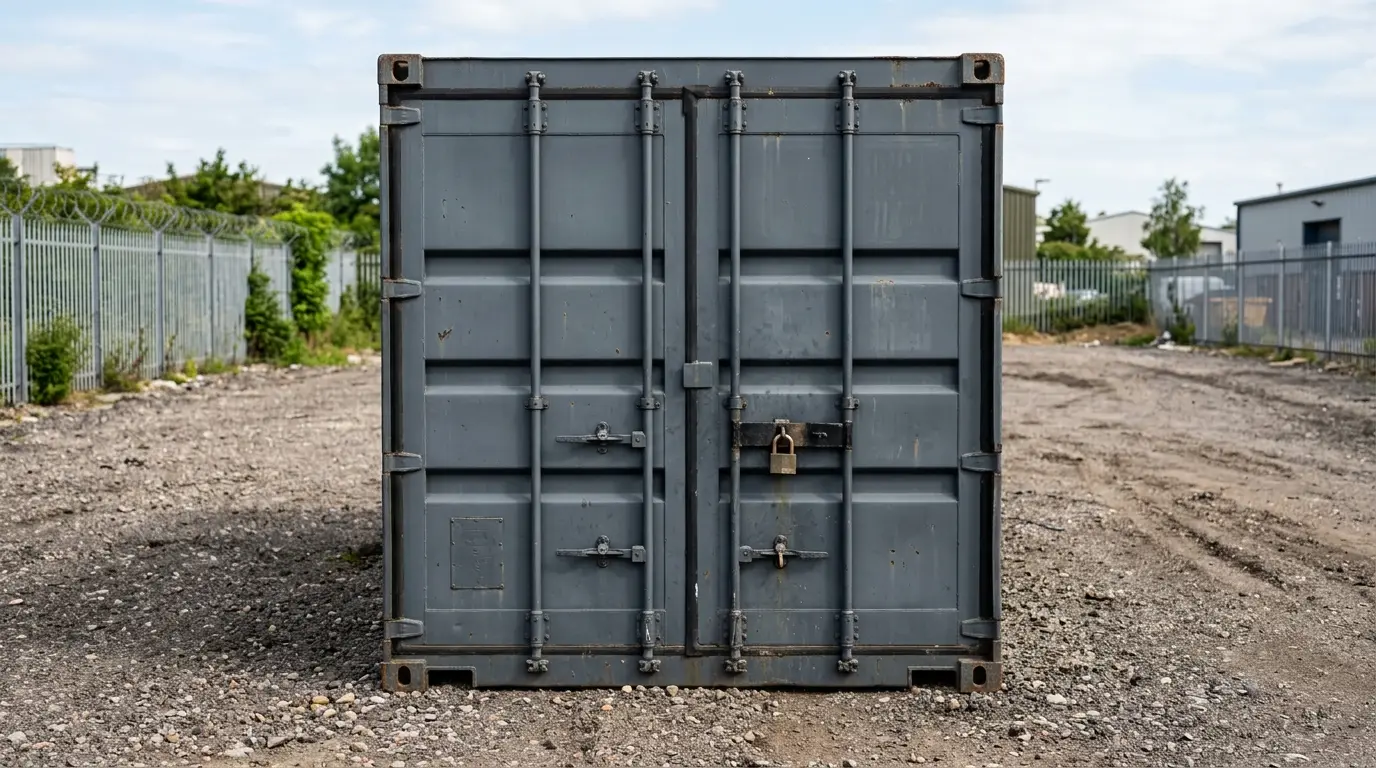
A shipping container is made of 2 to 3 millimetre thick Corten steel and can hardly be forced open with simple tools. Walls and roof are practically uninteresting to thieves – too much effort, too much noise. The real weak point is the doors and their locking mechanism. Anyone who focuses protection here secures both container and contents most effectively. This guide shows which mechanical, structural and electronic measures are worthwhile and roughly what they cost.
Understanding risks and weak points
Before investing in locks and technology, it pays to take a sober look at the typical points of attack.
The door locking mechanism. Standard containers are locked with four vertical locking bars (cam locks) operated by handles. These handles are the preferred point of attack: if the padlock is destroyed or the locking gear is levered open, the doors are free. Many handles can be secured with a simple bolt or pin – if this is missing, the locking mechanism can even be released without tools.
The exposed padlock. A normal padlock with a visible shackle is cut through in seconds with bolt cutters. Visibility here is a disadvantage, not an advantage.
The location. Containers often stand in remote spots – on construction sites, storage yards or at the edge of a property. Lack of lighting, no view from the road and no neighbours give offenders time and quiet to work. A poorly chosen location renders even good locks ineffective.
The value of the contents. Tools, machines, copper and fuel are popular targets. Anyone who knows valuable goods are inside will invest more effort. Discretion is therefore a form of protection in itself.
Mechanical security: the first line of defence
Mechanics are the foundation of any container security. They delay and deter – and time is a thief’s greatest enemy.
Lockbox / lock case. The lock case is a welded-on or pre-fitted steel box that fully encloses and conceals the padlock. Bolt cutters and angle grinders can no longer reach the shackle. Many newer containers already have a lockbox from the factory; retrofitting almost always pays off.
Hardened padlock / discus lock. The lock case should hold a padlock without an exposed shackle. A discus lock (round or disc lock) offers hardly any surface for bolt cutters, because the shackle sits almost entirely inside the housing. Look for hardened steel and a high protection rating.
Container lock / cross-bar lock. The cross-bar sits across both door handles and blocks their rotation. Even if a lock falls, the locking gear stays mechanically jammed. The cross-bar is clearly visible and therefore also acts as a deterrent.
Bolt securing of the locking gear. The turning handles of the locking bars can be secured against rotation with a hardened bolt or a security screw. This inexpensive measure prevents tool-free release and complements lockbox and cross-bar.
| Measure | Protective effect | approx. cost |
|---|---|---|
| Lockbox / lock case (retrofit) | Conceals the lock, protects against bolt cutters and grinder | approx. €30–80 |
| Hardened discus / padlock | Hardly any surface for bolt cutters | approx. €20–60 |
| Container lock / cross-bar lock | Blocks both door handles, strong deterrent | approx. €60–150 |
| Bolt securing of door handles | Prevents tool-free release | approx. €10–30 |
| Lighting with motion sensor | Removes cover, deters | approx. €20–100 |
| Alarm system (standalone) | Reports opening, deters | approx. €40–200 |
| GPS tracker | Location tracking after theft | approx. €30–150 plus subscription |
| Trail camera / video surveillance | Evidence, deterrence | approx. €60–300 |
The strongest effect comes from combining measures: lockbox with discus lock plus cross-bar plus secured handles. Each layer costs the offender time, and most give up before they get through.
Location and visibility
Structural and organisational measures often cost nothing and yet have a strong effect.
Face the doors to a wall or to each other. Position the container so that the doors face a solid wall, a fence or another container. With two containers, the door sides can be placed against each other so they block one another – neither can then be opened. Doors facing a building or the property boundary make any access difficult.
Good lighting. Motion-controlled lights remove an offender’s cover. A suddenly flaring light has a strong psychological effect and makes the container visible to neighbours or passers-by. Solar-powered floodlights are quick to fit even without a power connection.
Visibility instead of hiding. A container visible from the road or from occupied buildings is targeted less often. High hedges and screens protect privacy, but they also give the thief cover.
Electronic security
Technology does not replace mechanics but usefully complements it – above all for alerting and tracking.
Alarm system. Standalone, battery-powered alarm systems with a door or vibration sensor sound a loud siren when opened. Models with a mobile module additionally send a notification to your smartphone. For remote locations, wireless, battery-operated systems are practical since no power connection is needed.
GPS tracker. A hidden GPS tracker does not help prevent theft but aids recovery – especially when a whole container or valuable machines are hauled away. Most trackers require an inexpensive data subscription.
Camera / video surveillance. Visible cameras deter, recordings secure evidence. Off-grid trail cameras with motion triggering and mobile sending are well suited to sites without infrastructure. Observe data protection rules: film only your own premises where possible.
Organisational measures
Store nothing valuable in plain sight. What cannot be seen from outside is less tempting. Stow high-value goods to the rear and out of sight when the doors are open.
Keep an inventory list. An up-to-date list with photos, serial numbers and values speeds up reporting to police and insurer in the event of a loss and improves the chances of recovery.
Check your insurance. Clarify whether container and contents are covered by a contents, construction or business policy. Note the required security standards – many insurers require specific locks or alarms as a condition for payment. Document your security measures.
For more on correct placement, see our guides on choosing a location and on foundations.
Conclusion
The container itself is robust – it is mainly the doors that need protecting. The most effective strategy is a combination of mechanical layers: a lockbox with a hardened discus lock, a cross-bar over both handles and a bolt securing the locking gear. Together this basic setup usually costs under €250 and reliably deters opportunistic offenders. Combined with a smart location with doors facing a wall, good lighting and, where needed, alarm, GPS and camera, a layered protection concept emerges. Anyone who also stores discreetly, keeps an inventory list and checks insurance cover is well prepared for an emergency. Security does not come from a single measure, but from the interplay of many small hurdles that rob the offender of time and quiet.