
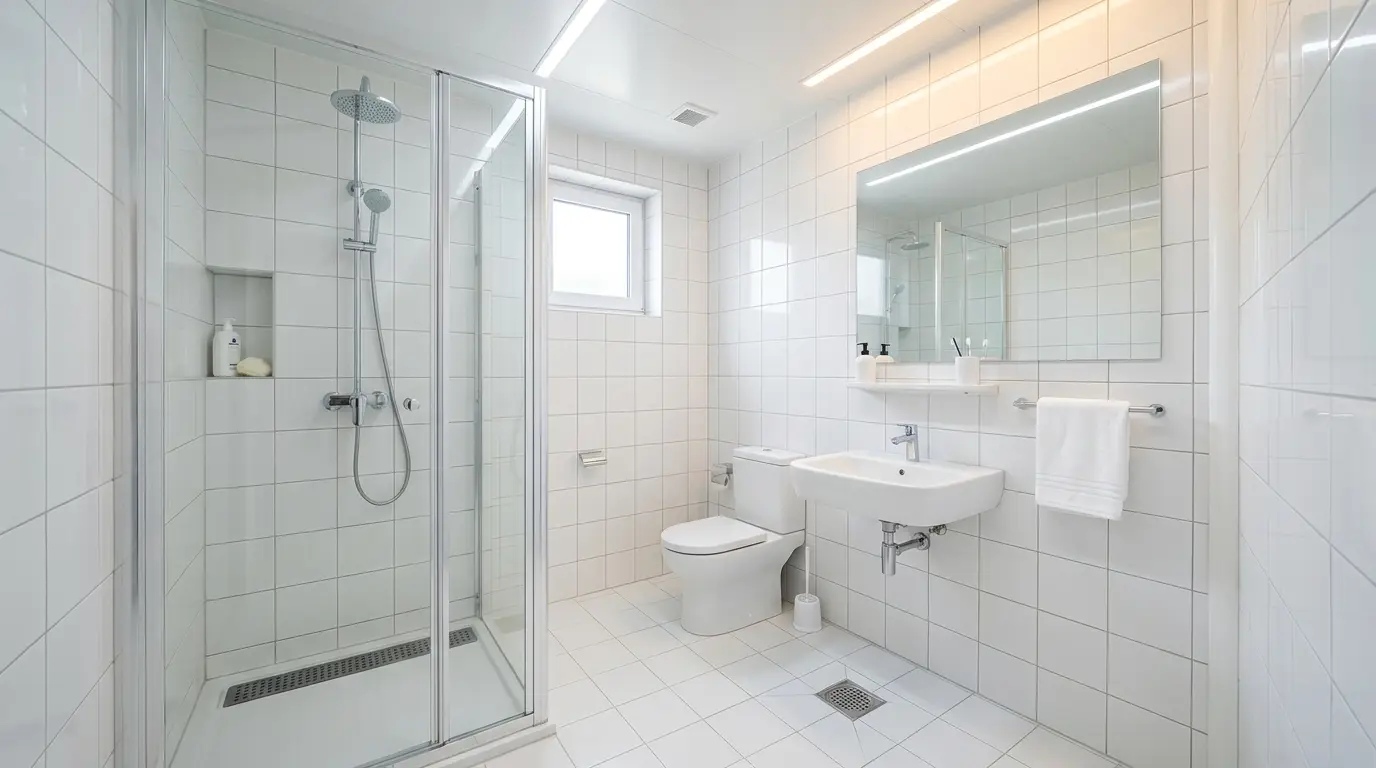
Sanitary containers are the least conspicuous and at the same time most discussed container category. Nobody plans a project around them, but every project fails without them. They are more complex than storage or office containers because they need water, waste water, power and heat at once – and because hygiene, frost protection and cleaning must be organised during operation. Thinking about this early saves expensive improvisation.
What sanitary containers are used for
The classic setting is the construction site. As soon as several workers are on site for more than a day, toilets and washing facilities are needed; on shell buildings and earthworks there simply are none.
At events – festivals, sports fixtures, markets – the issue is short-term peak load. Throughput, robustness and fast cleaning matter more than comfort. Compared with simple cabins, sanitary containers offer more capacity, running water and far better acceptance among visitors.
During refurbishment they bridge the loss of existing bathrooms: a shower container in the yard replaces the indoor installation for a few weeks. And in temporary extensions – emergency accommodation, school annexes, staff housing, clinics – they form the sanitary core of a modular installation, often combined with living containers.
Variants at a glance
Sanitary containers are highly configurable. In practice a handful of standard layouts have become established, mostly on 10-, 20- or 30-foot modules.
| Variant | Typical equipment | Typical application |
|---|---|---|
| Toilet container | 2 – 6 WC cubicles, sometimes urinals, wash trough or individual basins, mirrors | Construction site, event, public area |
| Shower container | 2 – 6 shower cubicles with anteroom, shelves, hooks, floor drain, water heater | Refurbishment, sports facility, accommodation, camp |
| Combined WC + shower | 1 – 2 toilets, 1 – 2 showers, washbasins, shared anteroom | Small sites, residential modules, holiday camps |
| Separate female / male | Two separate entrances, mirrored layout, sometimes additional urinals | Larger sites, businesses, accommodation |
| Accessible version | Larger cubicle, turning circle, support rails, wheelchair-accessible basin, alarm, ramp | Public use, events, administration |
| Container with tank | Integrated fresh and waste water tanks, pump, self-sufficient operation | Sites without connections, events, short deployments |
| Container with fixed connection | Direct link to drinking water and sewer, no tank changes | Longer standing times, modular installations, serviced sites |
There are also special forms: washroom containers without toilets, units with an integrated washing machine and dryer, and combined modules uniting a sanitary area and a common room. For combinations with other container types, see Container application examples.
Connections and building services
The technical hook-up drives cost and effort far more strongly than the interior fittings do.
Fresh water. Either via a site or building water connection with a backflow preventer, or via an integrated tank. Tank solutions are flexible but require regular refilling; a 1,000-litre tank often lasts only a few days when ten people use a shower container.
Waste water. The ideal case is a sewer connection, with a lifting station if the sewer sits higher than the container outlet. Alternatively a waste tank collects the effluent and is emptied by tanker; disposal intervals and costs are the item most often overlooked in budgeting. Grey and black water must not soak away uncontrolled.
Power. A CEE connection is standard, usually 16 or 32 amps depending on water heating. An electric instantaneous heater for a shower quickly draws 18 to 27 kilowatts – more than many site distribution boards deliver. Where power is short, storage solutions are more practical.
Water heating. Three principles compete:
| Principle | Advantage | Disadvantage |
|---|---|---|
| Electric instantaneous heater | Compact, unlimited quantity, no warm-up | Requires high connected load |
| Storage cylinder / boiler | Low connected load, inexpensive | Limited quantity, heat-up time, space required |
| Gas instantaneous heater | Independent of the grid, high output | Cylinder logistics, flue routing, stricter inspection duties |
Ventilation. Damp rooms without windows need mechanical extraction, ideally with run-on. Without it, moisture settles on cold surfaces and the container smells musty within weeks.
Frost protection and trace heating. The most critical point in winter. Supply lines, traps, cisterns, tanks and external pipework are all at risk. Common measures are self-regulating trace heating tape, keeping the container at roughly five to ten degrees, insulated supply lines and a means of draining down for longer shutdowns.
Practical note: a frozen sanitary container is rarely obvious at once. The damage only shows during the thaw, when burst pipes release water. Frost protection is therefore not a comfort question but a damage-prevention one.
Hygiene and cleaning
A sanitary container is only as good as its cleaning. Unlike storage or office containers, day-to-day operation decides whether people accept it.
The following orders of magnitude have proven useful as guidance for cleaning intervals:
| Use | People | Cleaning interval |
|---|---|---|
| Construction site, ongoing | 10 – 20 | 2 – 3 × per week |
| Construction site, large unit | over 30 | daily |
| Event | fluctuating, high | several times a day, attendant on site |
| Accommodation / residential module | permanent residents | daily to several times a week |
| Refurbishment cover | 1 – 2 households | weekly or self-cleaning |
Responsibilities belong in writing. With rented containers, cleaning is usually a chargeable extra, not part of the base price. If handled internally, fixed responsibilities are needed – “everyone tidies up after themselves” does not work in practice.
Consumables include toilet paper, soap, paper towels or hand dryers, disinfectant, bin liners and sanitary bins. Anyone who fails to organise restocking soon has a functional but unusable container.
Requirements on construction sites
For construction sites in Germany, the Workplace Ordinance (ArbStättV) and its associated technical rules – in particular ASR A4.1 on sanitary rooms – provide the framework. They contain guidance values for the number of toilets per employee, for washing and changing facilities, and for equipment and accessibility.
As rough orientation it is often cited that one toilet suffices for up to around nine employees, with further units added as headcount rises; that facilities must be reachable within a reasonable distance of the workplace; and that separate areas are to be provided where women and men are employed at the same time. For longer standing times, requirements for heating, lighting and ventilation are added.
Not legal advice: these notes serve orientation only and do not replace a legal review. What applies is the current state of the rules, the specific risk assessment and the requirements of the responsible authority or employers’ liability insurance association.
Rental and purchase prices
Important note: all figures are rough approximate ranges (as of 2026) for orientation. Actual prices depend on equipment, region, rental period, connection situation and market conditions. They are neither a price guarantee nor an offer.
| Variant | Used purchase approx. | New purchase approx. | Rental per month approx. |
|---|---|---|---|
| Toilet container, small (10 ft) | €5,000 – 9,000 | €11,000 – 18,000 | €200 – 400 |
| Toilet container, 20 ft | €7,000 – 13,000 | €15,000 – 26,000 | €280 – 550 |
| Shower container, 20 ft | €8,000 – 15,000 | €17,000 – 30,000 | €320 – 650 |
| Combined WC + shower, 20 ft | €9,000 – 16,000 | €19,000 – 32,000 | €350 – 700 |
| Accessible version | €10,000 – 18,000 | €22,000 – 38,000 | €400 – 800 |
| Tank version | Surcharge €1,500 – 4,000 | Surcharge €2,000 – 6,000 | Surcharge €60 – 150 |
Ancillary costs weigh more heavily with sanitary containers than with other types:
| Item | Approx. magnitude | Note |
|---|---|---|
| Delivery / collection | €300 – 900 per trip | Distance-dependent, crane possibly extra |
| Water / waste water / power hook-up | €400 – 2,500 | Heavily dependent on pipe runs and lifting station |
| Cleaning service | €40 – 120 per visit | Depending on size and interval |
| Tank emptying | €150 – 400 per collection | Depending on volume and disposal route |
| Winter package / frost protection | €300 – 1,200 | Trace heating, insulation, tempering |
| Final cleaning on return | €150 – 500 | Often a flat rate in the rental contract |
For short deployments renting is almost always more economical, because maintenance, inspection and repairs sit with the lessor. Beyond about two years and with permanent demand, buying can be cheaper, provided operator duties are covered internally. See Buy or rent?.
Installation and winter operation
Sanitary containers need load-bearing, level ground. Being out of level matters more here than with other containers, because floor drains and shower trays depend on a defined fall – if the container sits wrong, water pools in the cubicle instead of running off. Precisely surveyed point foundations under the corner castings are mandatory; see Container foundation.
Access should be safe underfoot: on construction sites a step or short platform is usual, for accessible use a ramp with a shallow gradient and firm surface. Position the container for short walking distances while keeping it out of traffic and crane areas.
For winter operation the rules are: lay supply lines frost-safe or fit trace heating, keep the container tempered continuously rather than only when occupied, insulate external tanks, and drain the whole system down for longer shutdowns such as the Christmas break. An empty container cannot freeze and burst.
Checklist
- How many people use the facility at the same time, and what is the female / male ratio?
- Is accessible provision required?
- Are connections for water, sewer and power available – or is a tank solution needed?
- Is the available electrical capacity sufficient for the planned water heating?
- Who cleans at what interval, and is that contractually agreed?
- Who restocks consumables?
- Is operation planned through the winter, and is frost protection budgeted?
- Is the ground load-bearing and precisely level?
- Have disposal intervals and costs been calculated?
Conclusion
Sanitary containers are technically the most demanding standard container category, because they require water, waste water, power and heat at once and because their value depends on day-to-day operation. The decision is rarely made on the module itself, but on three questions: which connections are available on site, who handles cleaning and restocking, and will it run through the winter? Anyone who settles these points before ordering ends up with an installation that simply works – and with sanitary facilities that is the only measure that counts.