

Anyone renting or buying a container quickly runs into labels such as “20 ft”, “40 ft HC” or “5-metre module”. But what do these terms actually mean in centimetres and kilograms? This guide brings together the standardised dimensions of the most common shipping and site containers – with external sizes, usable internal sizes, door openings, weights and volumes.
Shipping containers to ISO standard
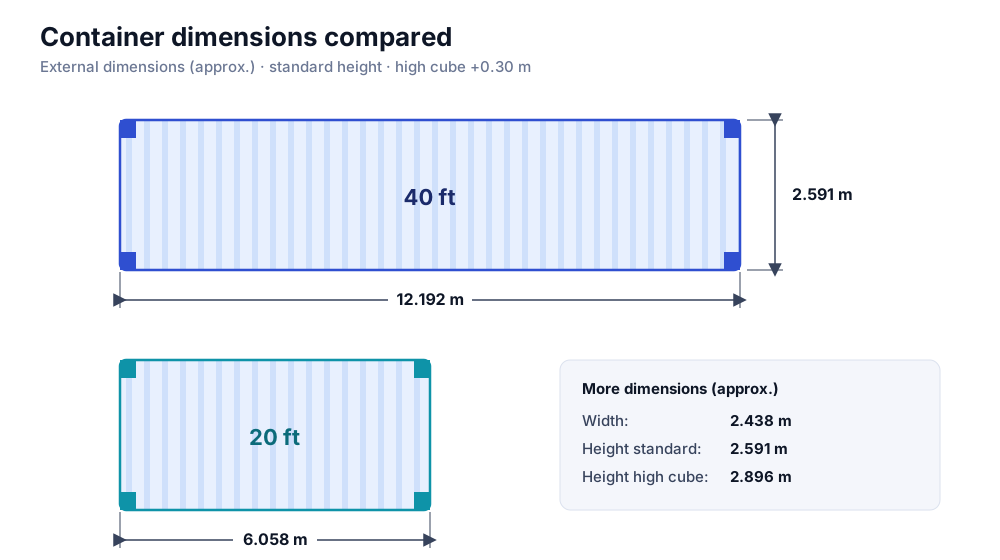
Shipping containers are standardised internationally. The ISO standard fixes external dimensions and corner castings precisely, so that containers can be stacked, lashed and handled worldwide with the same cranes and vehicles. Length is traditionally given in feet: a 20 ft container is 6.058 m long on the outside, a 40 ft container exactly twice that plus a small gap.
The table below summarises the main standard types. The internal dimensions, door openings and weights are approximate values, as they vary slightly depending on manufacturer, build year and condition.
| Type | External L × W × H | Internal approx. L × W × H | Door opening approx. W × H | Tare weight approx. | Payload approx. | Volume approx. |
|---|---|---|---|---|---|---|
| 10 ft | 2.991 × 2.438 × 2.591 m | 2.83 × 2.35 × 2.39 m | 2.34 × 2.28 m | 1,300 kg | 8,000 kg | 16 m³ |
| 20 ft standard | 6.058 × 2.438 × 2.591 m | 5.90 × 2.35 × 2.39 m | 2.34 × 2.28 m | 2,200–2,300 kg | 28,000 kg | 33 m³ |
| 20 ft high cube | 6.058 × 2.438 × 2.896 m | 5.90 × 2.35 × 2.70 m | 2.34 × 2.58 m | approx. 2,400 kg | 28,000 kg | 37 m³ |
| 30 ft (rare) | 9.125 × 2.438 × 2.591 m | approx. 8.93 × 2.35 × 2.39 m | 2.34 × 2.28 m | approx. 3,000 kg | approx. 27,000 kg | 50 m³ |
| 40 ft standard | 12.192 × 2.438 × 2.591 m | 12.03 × 2.35 × 2.39 m | 2.34 × 2.28 m | 3,700–3,800 kg | 26,500 kg | 67 m³ |
| 40 ft high cube | 12.192 × 2.438 × 2.896 m | 12.03 × 2.35 × 2.70 m | 2.34 × 2.58 m | 3,900–4,000 kg | 26,500 kg | 76 m³ |
| 45 ft high cube | 13.716 × 2.438 × 2.896 m | 13.56 × 2.35 × 2.70 m | 2.34 × 2.58 m | 4,800–5,000 kg | approx. 25,500 kg | 86 m³ |
The external dimensions are fixed exactly by the ISO standard and are identical worldwide. All internal dimensions, door openings, weights and volume figures, by contrast, are approximate values: they depend on manufacturer, build year, floor construction and condition, and can deviate by a few centimetres or several hundred kilograms. Beyond these basic types there are numerous special designs such as open-top, flat rack, refrigerated or tank containers, which deviate from the internal dimensions listed here.
10 ft: the small one for tight plots
At just under 3 m external length, the 10 ft container is the smallest common ISO size. It fits onto small plots, into backyards and front gardens and can still be moved by many standard skip-loader trucks. Typical uses: garden tools, hand tools, tyres, club equipment or a compact building-site store.
Advantages: small footprint, easy handling, low tare weight (approx. 1,300 kg), cheap transport. Disadvantages: comparatively expensive per cubic metre, low payload of only approx. 8,000 kg, rarer on the used market than 20 ft containers. What to watch: the price per m³ is well above that of a 20 ft container – if the available space allows it, the bigger brother is often the more economical choice.
20 ft standard: the standard size
The 20 ft container is the global reference size (one TEU) and the best compromise between volume, weight and handling. It is available everywhere, in every condition and at every price – new, used or as a one-trip container.
Advantages: high payload of approx. 28,000 kg, best availability, lowest price per unit, easy to deliver by truck and set down with a loading crane. Disadvantages: internal height of only approx. 2.39 m – after an insulated fit-out, little headroom remains. What to watch: delivery by skip loader needs roughly 12–15 m of straight approach plus manoeuvring space.
20 ft high cube: more headroom on a small footprint
The 20 ft high cube is 2.896 m tall externally instead of 2.591 m and offers around 2.70 m internally instead of 2.39 m. It is the first choice when headroom for a fit-out is needed on a small footprint – for a hobby room, workshop, sauna, tiny office or server room.
Advantages: around 4 m³ more volume on an identical footprint; after insulating floor and ceiling, roughly 2.40 m of room height remains. Disadvantages: slightly poorer availability than the standard, marginally more expensive, higher centre of gravity during transport. What to watch: the total height on the vehicle – check gateways, bridges and trees on the property beforehand.
30 ft: the special size
The 30 ft container is a genuine rarity. It was never built in large numbers and plays practically no role in sea freight. It is most likely to be found inland as a storage or special-purpose container.
Advantages: closes the gap between 20 and 40 ft when exactly that length is required. Disadvantages: hard to obtain, high prices, hardly any choice of condition or equipment, spare parts and door seals less readily available. What to watch: clarify availability and lead time before planning – two 20 ft containers are often the faster and cheaper solution.
40 ft standard: volume for light, bulky goods
At a good 12 m in length and around 67 m³, the 40 ft container offers twice the volume of a 20 ft container – but hardly any more payload. It is therefore the format for light, bulky and long goods: furniture, insulation materials, packaging, empties, long profiles or pipes.
Advantages: best price per cubic metre, a continuous length of over 12 m with no partition. Disadvantages: payload of only approx. 26,500 kg, large space requirement when siting, more demanding transport. What to watch: delivery needs approx. 25 m of straight approach and a load-bearing, level standing area; a skip loader can reach its limits in narrow residential streets.
40 ft high cube: the standard for fit-outs and living space
The 40 ft high cube is the de facto standard for container conversions and residential use. Its internal height of approx. 2.70 m leaves a room-suitable height of around 2.35–2.45 m after floor, wall and ceiling insulation have been fitted.
Advantages: around 76 m³ of volume, ideal proportions for living, office and studio conversions, very good availability, many off-the-shelf solutions available (windows, doors, insulation systems). Disadvantages: limited payload as with the 40 ft standard, large footprint, transport height to be considered. What to watch: for residential use, choose a container with an untreated or tested wooden floor, or replace the floor.
45 ft high cube: maximum length
At 13.716 m external length, the 45 ft high cube is the longest common shipping container and holds around 86 m³. In sea freight it is used mainly for voluminous consumer goods; on land as an especially large store or as the basis for long fit-out concepts.
Advantages: maximum volume per unit, greatest continuous internal length. Disadvantages: restricted road transportability – not every vehicle and not every access route is suitable, and special permits are sometimes required; lower availability and higher prices. What to watch: check the transport route, turning circle and standing area carefully in advance, and have the supplier confirm deliverability in writing.
Special sizes: pallet wide and mini containers
Alongside the classic ISO lengths there are two special forms that matter in practice:
- Pallet-wide containers: this design has an internal width of approx. 2.44 m instead of 2.35 m. That allows Euro pallets (1.20 × 0.80 m) to be placed side by side crosswise without wasting space – a 20 ft pallet wide holds 15 instead of 11 Euro pallets. The trade-off is thinner side walls; the external dimensions remain ISO-compliant. Common above all in European short-sea traffic.
- Mini containers of 6 and 8 ft: these very small formats are not ISO-standardised and are built in module form. Their dimensions are therefore manufacturer-dependent and come in at around 1.98 m and 2.44 m external length respectively. They are light enough to be moved with small crane vehicles and work well as a garden store, tool box or bicycle garage. Important: always ask the specific supplier about dimensions, door width and stackability.
High cube vs. standard
The most obvious difference between a standard container and a high cube is the height. A high cube is 2.896 m tall on the outside instead of 2.591 m – that is roughly 30 cm more. Internally this leaves a usable height of about 2.70 m instead of 2.39 m.
These extra 30 centimetres make a clear difference in several use cases:
- Bulky or tall goods fit in more easily, such as machinery or palletised goods stacked in several layers.
- Conversions into living or office space benefit, because after fitting floor and ceiling insulation there is still a comfortable ceiling height left.
- More volume on the same footprint: a 40 ft high cube holds around 76 m³ instead of 67 m³ – on an identical footprint.
Rule of thumb: where ceiling height or maximum volume matters, the high cube is the better choice. Where only footprint and weight matter, the standard container is enough.
Why internal size ≠ external size
The internal dimensions are noticeably smaller than the external ones – and for good reason. This is due to the wall construction from profiled steel sheet (Corten steel), which gives the container its strength.
Specifically, space is lost through:
- Wall thickness and profiling of the side walls (several centimetres per side).
- Floor and roof structure, including the wooden floor panels.
- Corner posts and frame, which form the load-bearing structure.
On the 20 ft container, the 6.058 m external length shrinks to about 5.90 m usable internal length, and the width from 2.438 m to around 2.35 m. The door opening matters too: at approx. 2.34 m wide and 2.28 m high it is slightly smaller than the interior itself. Anyone storing wide or tall items should therefore always plan around the door opening – not just the internal size – as the bottleneck.
Weight & payload
For transport, three weight figures are decisive:
- Tare weight: the empty weight of the container itself.
- Payload: the maximum permissible weight of the cargo.
- Max. gross weight: tare plus payload, i.e. the highest permitted total weight.
| Type | Tare weight (approx.) | Max. payload (approx.) | Max. gross weight (approx.) |
|---|---|---|---|
| 10 ft | 1,300 kg | 8,000 kg | 9,300 kg |
| 20 ft standard | 2,200–2,300 kg | 28,000 kg | 30,480 kg |
| 40 ft standard | 3,700–3,800 kg | 26,500 kg | 30,480 kg |
| 40 ft high cube | 3,900–4,000 kg | 26,500 kg | 32,500 kg |
Notably, despite its double length a 40 ft container can carry hardly more weight than a 20 ft container. The reason is the standardised maximum gross weight of around 30,480 kg. The 40 ft format therefore pays off mainly for voluminous but light goods, while the 20 ft format suits heavy, compact loads.
Note as well that the permitted total weights of the transport vehicle on public roads often further limit the theoretical payload in practice.
All-round containers: all sizes
All-round containers are the common German-market term for the insulated room, module or office container. They are the counterpart to the uninsulated storage or material container: where the latter is just a steel shell, the all-round container has an insulated sandwich wall structure and is built as a room for people to spend time in.
The typical build-up consists of steel sheet on the outside, a layer of PU foam or mineral wool insulation and an internal lining, usually of coated melamine or chipboard. Common insulation thicknesses – all values approximate and manufacturer-dependent:
- Wall: approx. 60–80 mm
- Roof: approx. 80–100 mm
- Floor: approx. 60–100 mm
This makes the all-round container usable all year round – as an office, break room, training room, guard post or sales unit. Sanitary and residential variants are built on the same basic body and add installations and fittings.
As standard, they normally include:
- Windows, usually with insulating glazing and roller shutters
- External door with a cylinder lock
- Electrical installation with distribution board, sockets and lighting
- Heating (often an electric convector); air conditioning usually optional
All-round containers are not ISO-standardised: dimensions vary by manufacturer. They are, however, deliberately designed to be transport-compatible with shipping container grid dimensions and have corner castings for craning and stacking. Important for planning: because of the insulation and internal lining, the internal size is considerably smaller than in a shipping container of the same length – 8 to 12 cm per wall are quickly lost.
The figures below are approximate and manufacturer-dependent; the supplier’s own dimension sheets are always binding. External width is usually 2.44 m, external height 2.60–2.80 m.
| Size | External approx. L × W × H | Internal approx. L × W × H | Usable floor area approx. | Typical use |
|---|---|---|---|---|
| 8 ft | 2.44 × 2.20 × 2.60 m | 2.25 × 2.00 × 2.30 m | 4.5 m² | Guard/gatehouse container, ticket booth |
| 10 ft | 3.00 × 2.44 × 2.60 m | 2.80 × 2.23 × 2.34 m | 6.2 m² | Single office, small break room |
| 12 ft | 3.65 × 2.44 × 2.60 m | 3.45 × 2.23 × 2.34 m | 7.7 m² | Office with two workstations |
| 15 ft | 4.55 × 2.44 × 2.60 m | 4.35 × 2.23 × 2.34 m | 9.7 m² | Office, changing room, sanitary unit |
| 16 ft | 4.88 × 2.44 × 2.60 m | 4.68 × 2.23 × 2.34 m | 10.4 m² | Break room for small teams |
| 20 ft | 6.06 × 2.44 × 2.60 m | 5.85 × 2.23 × 2.34 m | 13.0 m² | Standard size: office, crew room |
| 24 ft | 7.32 × 2.44 × 2.60 m | 7.10 × 2.23 × 2.34 m | 15.8 m² | Open-plan office, training room |
| 25 ft | 7.60 × 2.44 × 2.60 m | 7.40 × 2.23 × 2.34 m | 16.5 m² | Open-plan office, training or social room |
| 30 ft | 9.15 × 2.44 × 2.60 m | 8.95 × 2.23 × 2.34 m | 20.0 m² | Classroom, large units |
The effect of the insulation is easy to read off: a 20 ft all-round container is externally almost identical to a 20 ft shipping container, but internally offers only approx. 2.23 m instead of 2.35 m in width and approx. 2.34 m instead of 2.39 m in height.
In principle, room containers can be manufactured in almost any length – special sizes and project-specific builds are entirely common in modular construction. A complete listing would therefore be of little help. The table above shows the regularly built standard sizes, which are available practically everywhere and for which accessories, coupling parts and short-notice rental offers exist.
XL containers: 3 metres wide
Depending on the length, many all-round containers are additionally available in an XL version with an external width of 3.00 m instead of the usual approx. 2.44 m (2.435 m to be precise). That is a good half metre more width – and noticeably more usable floor area: internally, around 2.80 m instead of 2.23 m is available. Only this makes rooms possible in which desks can face each other or meeting tables can be placed sensibly. In the standard width, by contrast, furniture usually has to be arranged in a single row along one wall.
Here too, all values are approximate and manufacturer-dependent.
| XL size | External approx. L × W × H | Internal approx. L × W × H | Usable floor area approx. |
|---|---|---|---|
| 20 ft XL | 6.06 × 3.00 × 2.60 m | 5.85 × 2.79 × 2.34 m | 16.3 m² |
| 25 ft XL | 7.60 × 3.00 × 2.60 m | 7.40 × 2.79 × 2.34 m | 20.6 m² |
| 30 ft XL | 9.15 × 3.00 × 2.60 m | 8.95 × 2.79 × 2.34 m | 25.0 m² |
Practical note on transport: at 3.00 m wide, the container exceeds the vehicle width permitted on public roads without a permit. Delivery therefore counts as an oversize transport and normally requires a permit, and depending on the route an escort vehicle as well. That makes transport more expensive and noticeably lengthens the lead time – plan the delivery early and have the transport costs itemised in advance.
Conclusion: XL pays off when several people work in the container permanently – for instance in a site management office over many months, in a training room or in a club facility. For short site deployments and single workstations, the standard width is usually the more economical choice, because delivery and relocation stay far simpler.
Insulation values for orientation
Depending on the build-up, insulation material and thickness, U-values lie roughly in the range of 0.3–0.6 W/(m²K). This range is explicitly only an orientation and strongly manufacturer-dependent – it is not a commitment to any particular standard or energy performance level. Anyone intending to heat the container permanently or to site it in a way that requires a building permit should obtain the specific U-values and certificates from the manufacturer in writing.
Coupling into larger complexes
The big advantage of modular construction is coupling: several all-round containers can be joined side by side and on top of one another into connected complexes. Partition walls between coupled modules can be removed, creating continuous open-plan rooms. This is complemented by corridors, external stairs, landings and railings from the same system. Standard modules thus grow into multi-storey office, school or accommodation complexes – and can just as easily be dismantled later and rebuilt elsewhere.
All-round containers (insulated) vs. shipping containers (uninsulated)
| Criterion | All-round container (insulated) | Shipping container (uninsulated) |
|---|---|---|
| Wall build-up / insulation | Sandwich: steel sheet, PU or mineral wool insulation (wall approx. 60–80 mm), internal lining | Single-skin profiled Corten steel sheet, no insulation |
| Standard | Not ISO-standardised, dimensions manufacturer-dependent, but transport-compatible | ISO-standardised, external dimensions exactly the same worldwide |
| Internal size at same external length | Smaller: at 20 ft approx. 5.85 × 2.23 × 2.34 m | Larger: at 20 ft approx. 5.90 × 2.35 × 2.39 m |
| Weight | Lighter, thanks to thinner sheet and insulation material | Heavier: approx. 2,200–2,300 kg for a 20 ft unit |
| Window / door as standard | Yes: insulating-glazed window with roller shutter, external door, electrics | No: only the two-leaf steel container door |
| Year-round use | Yes, designed as an occupied room (with heating, air conditioning optional) | No: heat in summer, cold and condensation in winter |
| Stackability | Possible via corner castings, number of tiers manufacturer-dependent | Multiple tiers, lashable for sea transport |
| Typical use | Office, break, training, guard, sales and sanitary rooms | Transport, storage, conversion projects |
| Price level | Higher due to insulation and fittings | Cheaper per cubic metre, good resale value |
In short: if people are to spend time inside, there is no way around the insulated all-round container. If it is only about materials, the uninsulated storage or shipping container is the cheaper choice.
Which size for which purpose?
A few practical rules of thumb for choosing:
- One workstation, gatehouse or ticket booth: 8 to 10 ft. Approx. 4.5–6.2 m² is enough for a desk, chair and cabinet.
- Two to three workstations: 12 to 16 ft. In practice, allow approx. 5–6 m² of usable floor area per permanent workstation plus space for cabinets and circulation.
- Site management, crew or break room: 20 ft as the standard size with approx. 13 m² – enough for a table seating six to eight.
- Training, meetings, classroom: 24, 25 or 30 ft, ideally in XL width, or two coupled 20 ft units with the partition wall removed.
- Sanitary and changing rooms: usually 15 ft, since the installations take up additional space.
- Pure material storage: not an all-round container – an uninsulated storage or shipping container is sufficient here and considerably cheaper.
Rule of thumb when choosing: plan one size up. After deducting insulation, internal lining and furniture, noticeably less usable area remains from the external length than the “20 ft” label suggests.
For details on fittings, variants and prices, see the article Office containers: fittings, sizes & costs.
Module lengths in metres instead of feet
Some manufacturers state the length of their room containers in whole metres rather than feet. The construction is the same as for all-round containers – only the label differs. This overview helps with converting:
| Module length (approx.) | roughly equals | Width (approx.) | Typical use |
|---|---|---|---|
| 3 m | 10 ft | 2.44 m | Small office, WC unit |
| 4 m | 13 ft | 2.44 m | Single office, guard container |
| 5 m | 16 ft | 2.44 m | Office, break room |
| 6 m | 20 ft | 2.44 m | Larger office, crew room |
| 7 m | 23 ft | 2.44 m | Open-plan room, meetings |
| 9 m | 30 ft | 2.44 m | Classroom, large units |
External height is around 2.60–2.80 m in each case. These lengths are also available in the XL version with a width of 3.00 m.
Which size for what?
- 10 ft: Ideal where little standing space is available – as a tool, garden or building-site store.
- 20 ft: The all-rounder for moves, heavy goods and medium-sized storage tasks; easy to transport and position.
- 20 ft high cube: When headroom is needed on a small footprint – workshop, hobby room, compact fit-out.
- 30 ft: A special size for in-between lengths – only if actually available.
- 40 ft: For large, voluminous quantities and long goods; the maximum volume per container.
- 40 ft high cube: When extra height is also needed – for example when converting to living or office space.
- 45 ft high cube: Maximum volume – but only with a checked transport route and sufficient standing space.
- All-round containers (insulated, 8–30 ft): For anything used as a room all year round – office, break, training, security; optionally in XL width at 3.00 m.
- Site container modules: For anything where people spend time: office, break room, sanitary facilities, teaching.
You can read how the different sizes differ in price in the article What does a container cost?.
Conclusion
Choosing the right container size depends less on the label than on the actual dimensions. What counts is the usable internal size, the often overlooked door opening and – for transport – the permitted payload. Shipping containers are strictly standardised and therefore easy to plan with, while site container modules can be coupled flexibly. Anyone who consults the tables compiled here before renting or buying avoids nasty surprises and reliably finds the right size for their project.