
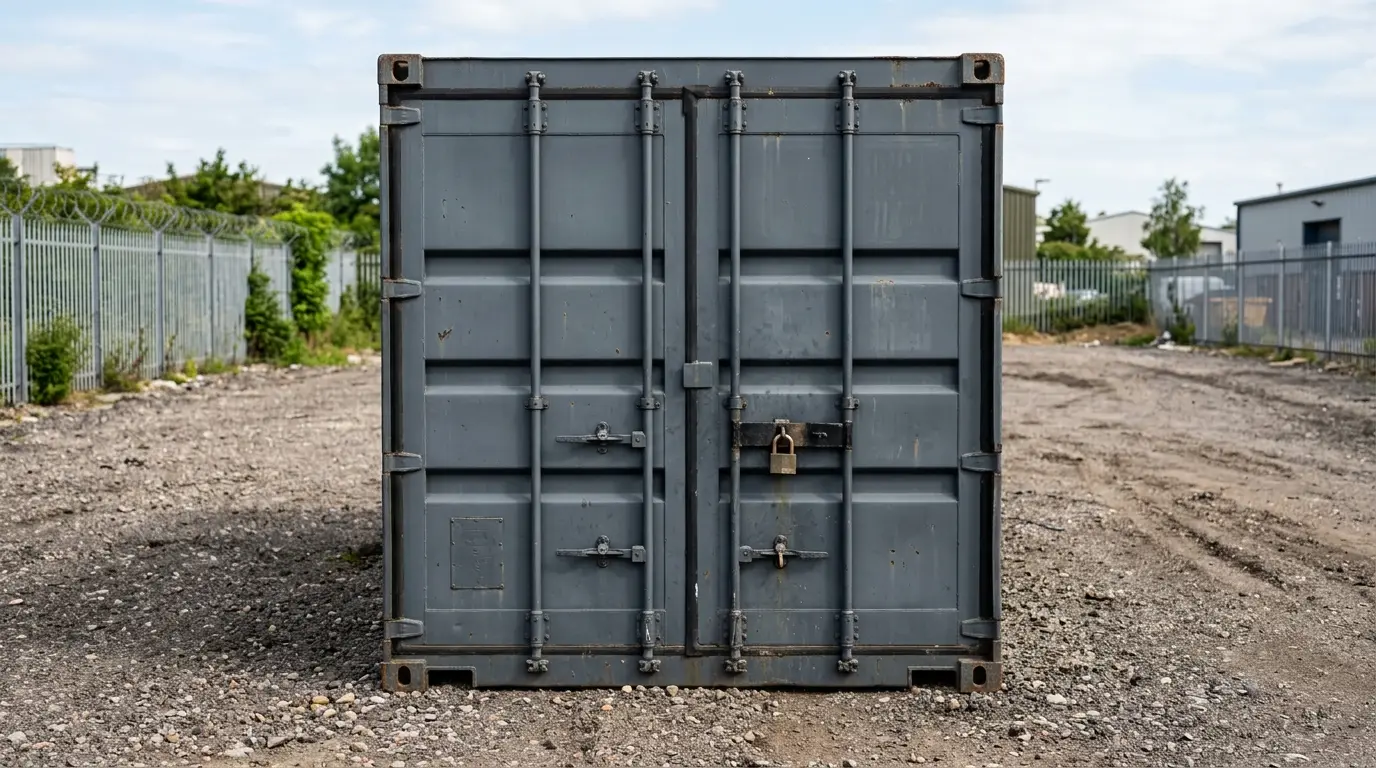
When space runs out, a storage container is usually the most pragmatic answer. It needs no construction time, no foundation in the classic sense and no utility connections. A low-loader delivers it, a crane sets it down, and minutes later you have lockable, weatherproof floor space. The real work happens beforehand: deciding which size, design and condition suit the purpose. A badly chosen container creates follow-on problems, from rusted-through floors to doors that no longer close on uneven ground.
What storage containers deliver
A storage container is a self-supporting steel box. Its rigidity comes not from a frame with thin cladding but from the profiled wall panels themselves, which act as the load-bearing structure.
Three properties make it attractive for storage:
- Material thickness. Wall panels are typically 1.6 to 2.0 millimetres of Corten-type steel, the floor cross members considerably heavier. The material withstands impacts, dropped objects and weather for decades as long as rust protection is maintained.
- Locking. The doors are held by several locking bars engaging the frame top and bottom. A door cannot simply be levered open – the weak point is practically always the padlock.
- Weather resistance. Continuous rubber seals and a fully welded roof make the container rainproof. Watertight, however, does not mean breathable: moisture that gets in, stays in.
Rule of thumb: a storage container reliably keeps out water from the outside. Only proper ventilation protects against water from the inside – condensation.
In shipping containers the floor is usually a bonded plywood panel around 28 millimetres thick on steel cross members. It carries forklift loads but reacts badly to standing moisture.
Sizes at a glance
The common sizes follow the ISO standard. Usable area figures are rounded and refer to internal dimensions; volume is a rough guide value.
| Size | Approx. external (L × W) | Approx. usable area | Approx. volume | Typical use |
|---|---|---|---|---|
| 8 ft | 2.44 × 2.20 m | 5 m² | 10 m³ | Garden equipment, tools, club storage, tight courtyards |
| 10 ft | 2.99 × 2.44 m | 6.5 m² | 15 m³ | Site materials, trade storage, small moves |
| 15 ft | 4.55 × 2.44 m | 10 m² | 24 m³ | Middle ground when 10 ft is too small and 20 ft too bulky |
| 20 ft | 6.06 × 2.44 m | 13.5 m² | 33 m³ | The standard size: contents of a three-room flat, machinery storage |
| 40 ft | 12.19 × 2.44 m | 28 m² | 67 m³ | Bulk storage, furniture, exhibition kit, production buffer |
The 20-foot container is the standard for good reason: it moves with ordinary transport equipment, fits most pitches and covers the needs of most users. Forty-foot units are cheaper per cubic metre but need far more manoeuvring space – roughly twice the container length in clear approach.
Alongside the standard height of around 2.59 metres there is the high-cube variant at about 2.90 metres. The extra 30 centimetres of internal height pay off as soon as goods are stacked high or a later fit-out with insulation is planned. All dimensions are covered in Container sizes and dimensions.
Designs compared
Not every storage container is a shipping container. Several construction principles compete, differing in price, handling and fit-out potential.
| Design | Construction | Strengths | Weaknesses |
|---|---|---|---|
| Shipping container as storage | ISO steel container, load-bearing corrugated walls, double doors at one end | Very robust, stackable, inexpensive, available worldwide | Heavy, no insulation, prone to condensation, only one opening |
| Material container, modular build | Frame construction with inserted wall elements, often sandwich panels | Lighter, often better door solutions, easy to fit out | Less stackable, more impact-sensitive, more expensive |
| Double-door container | Doors at both ends (tunnel container) | Load-through possible, good cross ventilation, flexible loading | Less usable wall space, limited supply |
| Side-door container | Additional hinged door in the long wall | Short routes when loading and unloading, good for shelving | Higher price, lower torsional stiffness |
| Open-side / side-opener | Entire long side opens | Ideal for bulky goods and displays | Considerably more expensive, rare on the used market |
For pure storage with no later conversion, the classic shipping container is usually the most economical choice. Where goods move in and out frequently, a side door pays for itself quickly.
Condition grades and quality
The used market has no official standard, but well-established terms. Understanding them makes offers genuinely comparable.
- As-new / one-trip. Loaded once and shipped from Asia to Europe, after which it counts as used. Visually almost new, seals and paint intact. Clearly cheaper than new stock, clearly dearer than genuinely used material.
- WWT (wind and watertight). The standard for storage. The container shows wear, dents and surface rust but is tight. Minor repairs and touch-up paint are normal.
- Cargo worthy. Additionally certified as seaworthy. For land-based storage this status is usually unnecessary.
- As is / in need of repair. Cheap, but with rust-through, defective doors or a damaged floor. Only sensible for buyers who can weld and paint themselves.
What to check on inspection: the floor panel for soft spots, door seals for cracks, corners and cross members for rust-through, locking bars for smooth operation. Looking from the inside with the doors closed reveals leaks immediately – points of daylight do not belong there. This is covered in Buying a used container.
Ventilation and condensation
Warm, humid air cools overnight against the steel ceiling, drops below the dew point and settles as water. This “container rain” is the most common cause of damage to stored goods and has nothing to do with leaks. Four measures work reliably: store only dry goods, fit additional vents diagonally offset, use desiccant bags and – for sensitive goods – insulate the ceiling. The physics and the suitability of individual goods are explained in Using a storage container properly.
Accessories and fit-out
A storage container ex works is an empty box. Only accessories turn it into a functioning store.
- Shelving. Heavy-duty racks along the long walls double the usable area. Do not bolt them to the container if it will be transported later – flexing during lifting tears rigid connections apart.
- Vents. Retrofit grilles with insect mesh cost little and work immediately. Position them low on one side and high on the opposite side.
- Lighting. Without a power supply, battery LED strips with motion sensors do the job. With a fixed connection, an installation including an RCD is part of the package.
- Flooring. An extra layer of OSB or a plastic covering protects the original panel from moisture and abrasion.
- Partition wall. Separates storage from a workshop area, or allows two compartments with separate access.
- Ramp. Access ramps make loading with pallet trucks and sack barrows far easier.
Security
The weak point of a container is the padlock: an ordinary one is off in seconds with bolt cutters. A welded lockbox that fully encloses the shackle changes the situation fundamentally, because no tool can get purchase. Locking-bar locks, positioning the doors against a wall or a neighbouring container, plus lighting and visibility all add to this. Lock types and site choice are covered in Securing a container.
Buying or renting: price overview
Important note: all figures below are rough approximate ranges (as of 2026) and serve only as orientation. Actual prices depend on condition, region, availability and market conditions. They are neither a price guarantee nor an offer.
| Size | Used purchase (WWT) approx. | As-new / one-trip approx. | Rental per month approx. |
|---|---|---|---|
| 8 ft | €1,300 – 2,200 | €2,500 – 3,800 | €50 – 90 |
| 10 ft | €1,500 – 2,600 | €2,800 – 4,200 | €60 – 110 |
| 15 ft | €1,900 – 3,000 | €3,200 – 4,800 | €75 – 130 |
| 20 ft | €1,800 – 3,200 | €3,000 – 5,000 | €70 – 150 |
| 40 ft | €2,800 – 5,000 | €4,800 – 7,500 | €110 – 230 |
On top come ancillary costs that are easy to overlook: delivery and collection at roughly €250 to €700 per trip, crane hire where needed, and with rentals a deposit and cleaning charges. As a rough rule, renting pays off up to around twelve to eighteen months; beyond that buying is usually cheaper, not least because the container retains residual value. See Buy or rent?.
Site and installation
The ground determines service life. A container must not sit flat on soil: waterlogging beneath the floor cross members causes rust-through within a few years. Four to six point supports of concrete slabs under the corner castings have proven themselves, with intermediate points for 40-foot units.
Precise levelling in both axes is essential. If the container stands crooked, the frame twists and the doors no longer lock cleanly – an error only fixable by realigning it. A slight fall of a few millimetres towards the door end is desirable, so that rainwater drains away. See Container foundation; whether a permit is needed depends on region, duration and use – see Container building permit.
Selection checklist
- How much volume is genuinely needed, and is demand likely to grow?
- Do goods move in and out often? Then consider a side or double door.
- Are the goods moisture-sensitive? Then plan ventilation and insulation from the start.
- How long is the container needed – under or over about eighteen months?
- Is the approach clear for a low-loader, and is there room to manoeuvre?
- Does the ground bear the load, and are point supports feasible?
- Is a lockbox fitted or retrofittable?
- Has the condition been inspected on site – floor, seals, corners, locking gear?
Conclusion
Storage containers are the cheapest form of immediately available extra space. Choosing one is less a question of supplier than of honest needs analysis: assess volume, access frequency and the sensitivity of the goods realistically, and the right size and design follow almost automatically. A used, wind- and watertight 20-foot container on clean point supports, with additional vents and a welded lockbox, covers the vast majority of use cases – and with a little rust maintenance lasts two decades.