
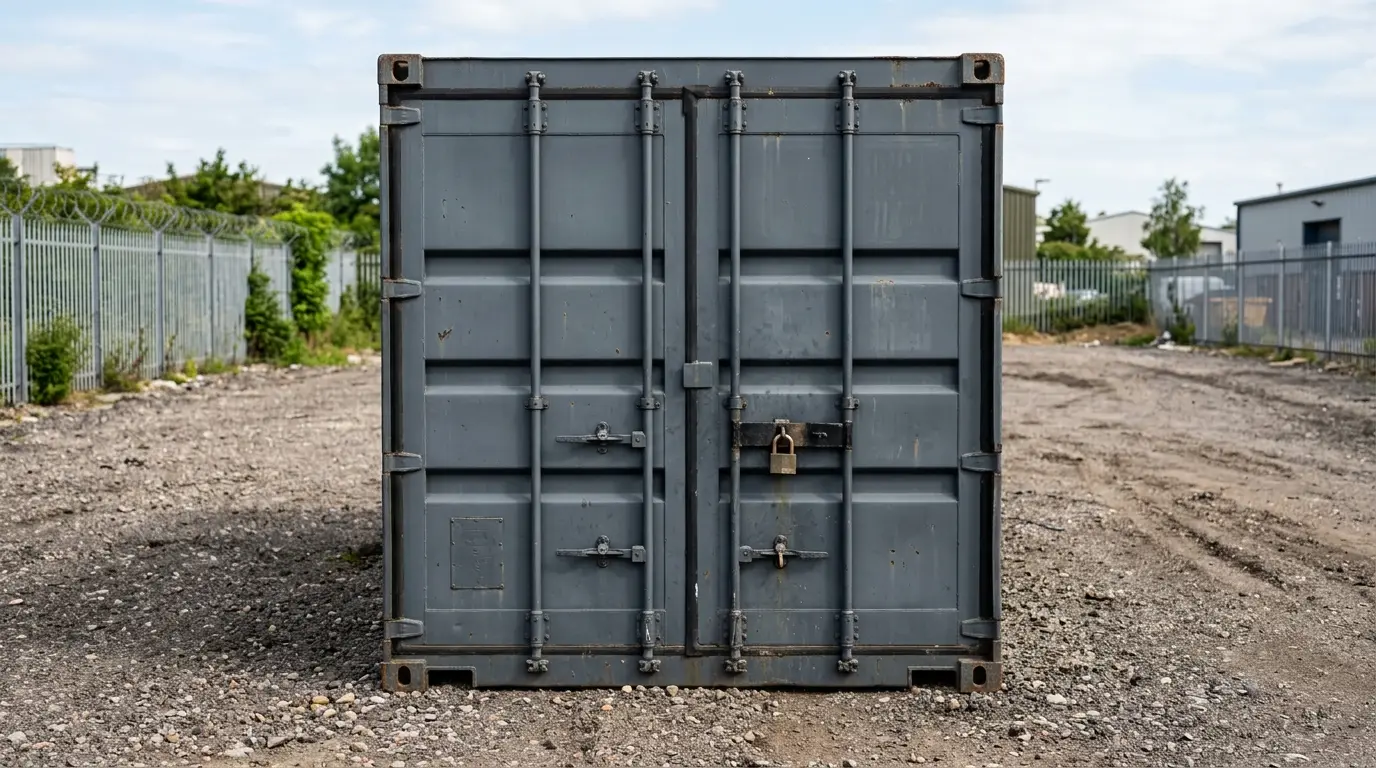
The question “buy or rent?” comes up in almost every container project – from a storage container in the garden and a site container on a construction site to a converted office container. There is no one-size-fits-all answer. Three factors are decisive: how long you need the container, how much budget you have available and how much flexibility matters to you. This guide sorts through the typical scenarios and uses an example calculation to show when buying starts to pay off compared with renting.
Every route in detail: besides buying and renting there are leasing and hire purchase. A comparison of all four with a worked example is in the Buy & rent section.
When buying pays off
Buying plays to its strengths above all with long-term use. If you use a container for several years as permanent storage, as a workshop or as a fixed part of a business site, buying is usually the cheaper option in the long run. Rent keeps running month after month, whereas the purchase price is a one-off investment.
Typical arguments in favour of buying:
- Permanent location: The container stays in the same spot for years. There is no repeated delivery and collection.
- Individual customisation: As the owner you can modify the container as you wish – windows, doors, shelving, insulation, wiring or a fresh coat of paint. With rental containers, structural changes are usually prohibited or must be undone.
- Asset value: A purchased container retains a residual value. Used shipping containers are a sought-after commodity and can often be resold later with only a moderate loss in value.
- Planning certainty: No ongoing costs, no notice periods, no dependence on the rental provider’s availability.
For an initial overview of the acquisition costs, see the article What does a container cost?.
When renting is the better choice
Renting scores whenever the need is limited in time or hard to plan. For projects, construction sites and interim solutions it is often the more economical and convenient option.
Typical arguments in favour of renting:
- Short-term need: If the container is only needed for a few weeks or months – for example during a move, a renovation or an event – buying rarely makes sense.
- Projects and construction sites: On building sites, location and requirements change frequently. Rental containers can be ordered flexibly and simply returned once the project ends.
- No transport or storage effort: Delivery and collection are usually handled by the rental provider. You do not have to worry about logistics, interim storage or resale.
- Predictable costs: Monthly rent is a clearly calculable operating expense – often immediately tax-deductible and without tying up capital.
- Maintenance included: Many rental contracts cover upkeep and repairs, so you carry no risk for wear and tear.
Cost comparison with break-even
The decisive point is the so-called break-even – the moment at which the accumulated rent exceeds the purchase price. From then on, buying would have been the cheaper choice in hindsight.
The following table shows a simplified example for a used 20-foot standard container. The figures are for illustration only and do not replace a concrete quote.
| Item | Buy (example) | Rent (example) |
|---|---|---|
| One-off purchase price (used) | approx. €1,800–2,500 | – |
| Monthly rent | – | approx. €80–150 / month |
| Cost after 12 months | approx. €2,200 | approx. €1,200 |
| Cost after 24 months | approx. €2,200 | approx. €2,400 |
| Cost after 36 months | approx. €2,200 | approx. €3,600 |
| Residual value after 3 years | approx. €1,200–1,800 | €0 |
Example calculation, as of 2026. Prices vary widely depending on condition, size, region and provider. Transport, delivery and possible additional costs are not included here.
In this example the break-even lies at roughly 18 to 24 months. Rule of thumb: if the container is needed for more than about two years, there is a strong case for buying – especially since the residual value shifts the balance further in favour of the purchase. For shorter use, renting is usually the more economical choice.
Important: the exact break-even depends heavily on container size and fit-out. A high-quality office container shifts the calculation differently than a simple storage container.
Additional factors
Beyond the pure price comparison, you should consider a few practical points that can noticeably affect the total cost:
- Transport and delivery: Transport by truck with a crane or hook lift is a cost block of its own – often several hundred euros depending on distance and effort. When buying it applies at least once; when renting it usually applies for both delivery and collection.
- Standing area and foundation: A container needs a load-bearing, ideally level surface. Point foundations, concrete slabs or bearing plates prevent waterlogging and sinking – a factor that matters especially for a permanent purchase.
- Permits: Depending on the region, duration of placement and use, a building permit may be required. This tends to apply more to permanently placed, purchased containers than to short-term rentals. Clarify this early with the relevant authority.
- Maintenance: As the owner you carry maintenance, rust protection and repairs yourself. With renting, this is often covered by the contract.
- Resale value: Purchased containers can be resold later. For shipping containers in good condition, the loss in value is usually moderate.
- Rent-to-buy option: Some providers offer models in which rent already paid is partly credited towards a later purchase. This can be useful when it is not yet clear at the outset how long the container will be needed.
Decision guide
The following checklist helps with an initial assessment:
Rather buy if …
- You expect to use the container for more than two years.
- The location is permanently fixed.
- You want to customise the container individually.
- A residual value and independence from the provider matter to you.
- Sufficient capital is available for the one-off investment.
Rather rent if …
- The need is short-term or uncertain (weeks to a few months).
- You need a project or construction-site container.
- You would rather not deal with transport, maintenance and resale.
- You prefer predictable, ongoing costs over a large one-off payment.
- The location might change.
Conclusion
Buying or renting is not a question of right or wrong, but a question of how long you need the container and what your priorities are. Rule of thumb: up to around two years of use, renting is usually cheaper and more convenient; beyond that, buying generally pays off – supported additionally by the residual value. Short-term, flexible or project-based needs argue for renting; permanent locations with individual fit-out argue for buying. If you are unsure, you can start with a rent-to-buy option and keep the decision open. In any case, obtain several quotes and factor transport, foundation and possible permits into your calculation.