
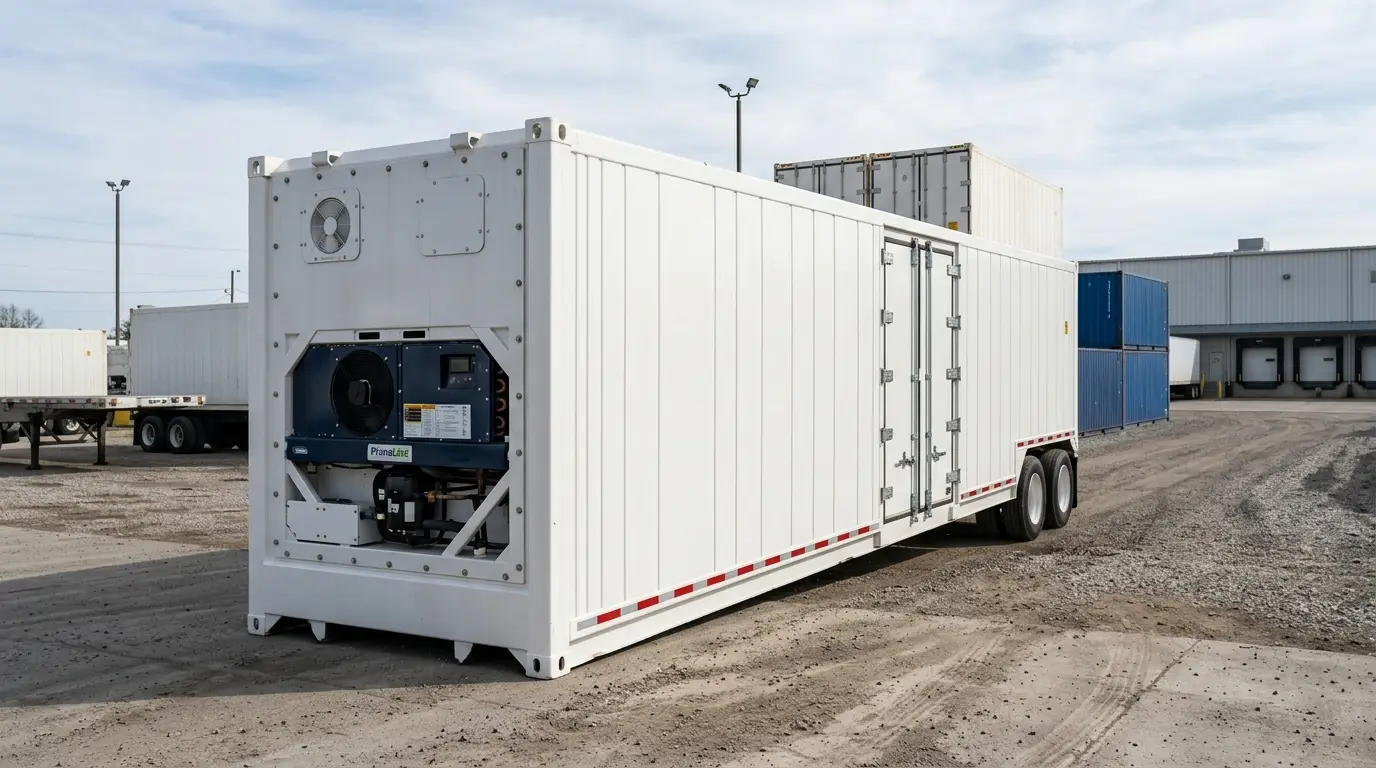
Refrigerated containers are the fastest way to create temporary or permanent cold storage without building. They are delivered, connected to power and ready for use after a short pull-down period. But because goods, liability and considerable electricity costs depend on them, a close look at technology, connection ratings and operating costs pays off.
What a refrigerated container is
A refrigerated container – a reefer in the trade – is an ISO container with an insulated shell and its own permanently installed refrigeration unit. This design is also called an integral container because refrigeration and container form one unit. As soon as power is applied, the unit automatically controls to the set point.
To be distinguished from this are insulated containers (historically also porthole containers). They have the same insulation but no unit of their own. Cold air is generated externally and fed in through connection openings – in the port or on board. Without that external supply they hold a temperature only passively and for a limited time. For stationary use on a company site, a reefer is therefore practically always the right choice. An overview of further designs is offered by Shipping container types.
Technology and construction
- Refrigeration unit: refrigeration machine with compressor, condenser, evaporator and fans, usually integrated into the front wall. Many units can also heat in order to hold an above-zero temperature in frost.
- Insulation: a continuous insulating core, usually rigid polyurethane foam, between inner and outer skin. The doors have circumferential seals.
- Air circulation: cooled air is guided rearwards beneath the T-section floor, rises through the cargo and returns to the unit at the top. The cargo must therefore neither block the air channels nor be stacked above the load line.
- Fresh air vent: an adjustable opening exchanges outside air. It is important for respiring goods such as fruit and vegetables in order to remove carbon dioxide and ethylene. For frozen goods it stays closed.
- Controller and data logger: microprocessor control showing set and actual temperature, alarms and operating hours. Recording functions document the temperature history – a central piece of evidence in food and pharmaceutical logistics.
Temperature ranges and applications
Common units cover roughly a range from approx. −25 °C to +25 °C; individual special versions go lower. What always governs is the data sheet of the specific unit plus the ambient temperature at which the value is to be achieved.
| Range | Typical goods | Note |
|---|---|---|
| +12 to +18 °C | Chocolate, wine, flower bulbs, electronics | Tempering rather than cooling; watch condensation |
| +2 to +8 °C | Dairy, meat, convenience food, pharma | Tight tolerances, recording usually required |
| 0 to +4 °C | Fruit, vegetables, salads | Open the fresh air vent depending on variety |
| −18 to −20 °C | Frozen food, ice cream, bakery goods | Markedly higher power demand, door discipline matters |
| −25 °C and below | Special applications | Capacity falls at high ambient temperatures |
Not every product tolerates every temperature. Many fruit and vegetable varieties react sensitively to values that are too low. The set point should therefore come from the supplier’s specification or food hygiene requirements, not from a rule of thumb.
Sizes and capacity
Reefers are commonly available in 20 and 40 feet, with the 40 ft version almost always built as a high cube. Because insulation and the unit take up space, the internal dimensions are noticeably smaller than those of a dry container of the same nominal size.
| Size | Internal dim. approx. (L × W × H) | Usable volume approx. | Euro pallets approx. |
|---|---|---|---|
| 20 ft reefer | 5.45 × 2.29 × 2.25 m | 27–28 m³ | 9–10 |
| 40 ft reefer | 11.58 × 2.29 × 2.25 m | 59–60 m³ | 21–23 |
| 40 ft reefer high cube | 11.58 × 2.29 × 2.50 m | 65–67 m³ | 21–23 |
The pallet figures apply to single-tier placement; more is possible in height provided the load line and air circulation are respected. Further dimensions can be found under Container sizes and dimensions.
Power and connection
In Europe the connection is usually three-phase 400 V / 50 Hz, mostly with a 32 A CEE plug; depending on unit and year of construction, different ratings or adapters may be required. A dedicated, adequately protected supply cable with residual current protection is mandatory – extension reels and household sockets are unsuitable.
Consumption varies widely. It depends on set point, ambient temperature and solar gain, the condition of insulation and door seals, how often the doors are opened, and the heat load of the stored goods. A freshly loaded container with warm cargo draws a multiple of its later steady-state load during the pull-down phase.
How to turn this into annual costs and what can be saved is shown in Reefer containers in operation: calculating and cutting power costs.
| Operating case | Rough consumption guide |
|---|---|
| Chilled (+2 to +8 °C), moderate weather | approx. 4–8 kWh per day |
| Chilled, high summer | approx. 8–20 kWh per day |
| Frozen (−18 °C), moderate weather | approx. 15–30 kWh per day |
| Frozen, high summer | approx. 30–60 kWh per day |
| Pull-down phase after loading | temporarily much higher |
Disclaimer: these values are very rough approximate ranges for initial orientation and are not an assurance. Only the manufacturer’s data for the specific unit and your own measurement in operation are reliable.
For sensitive goods, protection against power failure should be considered from the start: alarms on loss of voltage, a prepared emergency power connection and a contingency plan for relocating the goods.
Siting
- Ground: level, load-bearing and drained. Asphalt, concrete or compacted gravel with bearing points beneath the corner castings. A slight fall towards the door end helps defrost water run off.
- Ventilation: warm exhaust air must be able to escape freely in front of the unit. A clearance of about one metre from walls and neighbouring containers is a sensible guide value; tight recesses cause capacity loss and higher consumption.
- Shading: a shaded location noticeably reduces consumption, particularly in frozen operation.
- Noise: compressor and fans cycle, at night as well. Near residential development, location, operating hours and emission control requirements should be checked in advance.
- Access: allow sufficient space in front of the doors for pallet trucks or forklifts.
Rental or purchase
| Item | Rental | Used purchase | New purchase |
|---|---|---|---|
| 20 ft | approx. €250–600/month | approx. €8,000–18,000 | approx. €25,000–40,000 |
| 40 ft high cube | approx. €400–900/month | approx. €12,000–25,000 | approx. €35,000–55,000 |
| Transport / placement | approx. €300–1,200 per leg | additional | additional |
| Electricity (example €0.30/kWh) | approx. €35–550/month by case | identical | identical |
| Maintenance | usually included in the rent | approx. €300–800/year | approx. €300–800/year |
Disclaimer: non-binding approximate ranges without warranty, strongly dependent on region, age, term and availability.
Short-term demand – season, harvest, event, failure of your own refrigeration – clearly favours rental, not least because maintenance and breakdown service are usually included. For permanent demand beyond roughly two years, purchase pays off, provided maintenance and electricity costs are budgeted realistically. A general comparison is available under Buying or renting a container.
Maintenance and hygiene
A reefer is a refrigeration machine in continuous operation and needs corresponding care:
- Clean the condenser regularly of dust, leaves and grease – fouled fins are the most common cause of capacity loss.
- Check door seals and locking gear; icing at the seals indicates leakage.
- Monitor defrost cycles and condensate drainage so that no ice builds up on the evaporator.
- Have the refrigerant circuit checked by qualified contractors; depending on charge size and refrigerant, stationary systems are subject to leak-testing and documentation duties.
- Clean the interior after every batch; for foodstuffs, a cleaning schedule, temperature records and traceability are part of in-house control.
Typical mistakes
- Placing units too close together: warm exhaust air is drawn back in and consumption rises markedly.
- Overloading: goods above the load line or on the floor profile block the airflow and create warm pockets.
- Loading warm goods: the container maintains temperature, it is not a blast freezer.
- Fresh air vent set wrongly: open in frozen operation causes icing, closed with respiring goods harms quality.
- Door discipline: frequent or lengthy opening is the biggest avoidable cost factor in frozen operation.
- Underestimating the power supply: undersized cable, missing protection or no alarm on failure.
Conclusion
Refrigerated containers are a mature, quickly available solution for additional chilled or frozen storage. Technically decisive are the right set point for the goods, clean air circulation inside, and a location where the unit can breathe freely. Economically, two items dominate: electricity and maintenance. Anyone who budgets both realistically and has the connection installed professionally gets a mobile cold store that compares well with a purpose-built cold room – with an incomparably shorter lead time.