
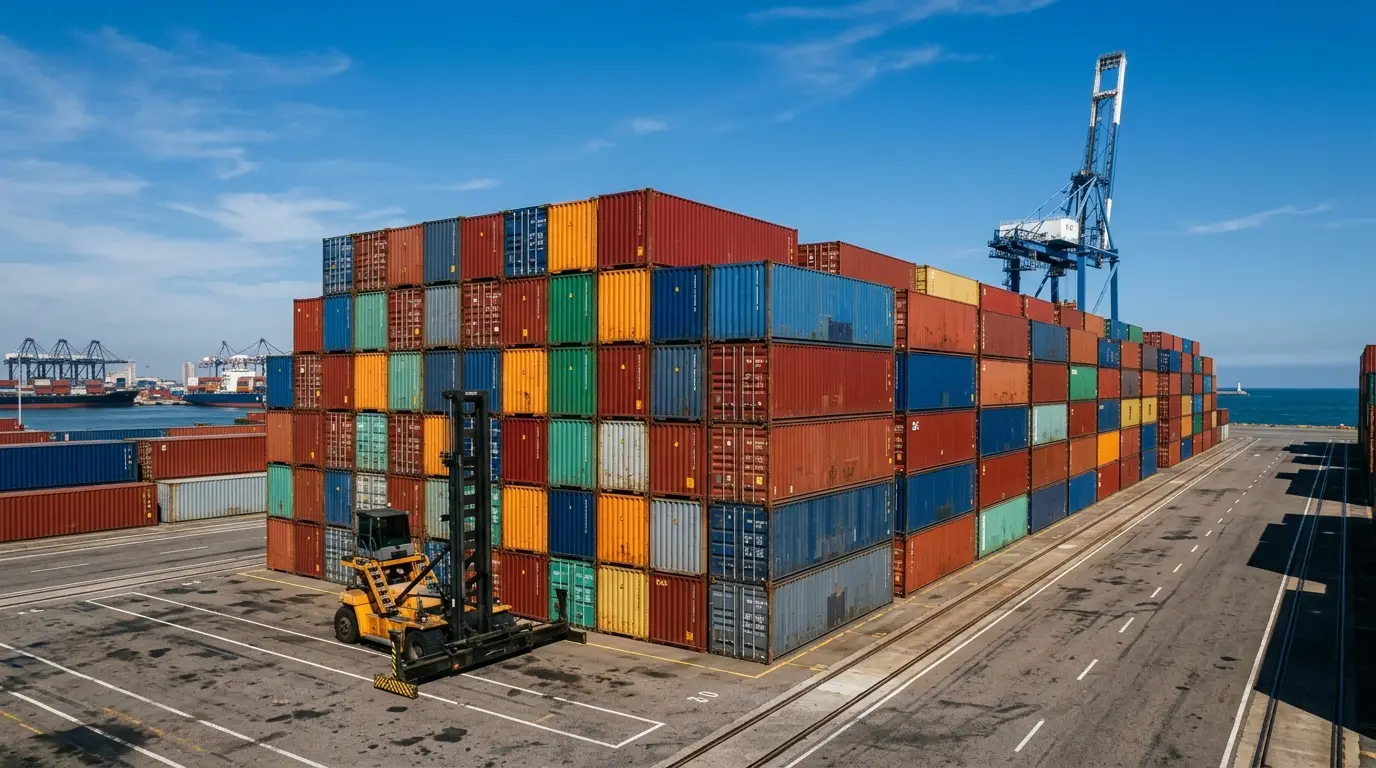
When people first encounter shipping containers, they usually picture the classic steel box with two doors at one end. In reality, however, there is a whole range of standardised designs, each developed for particular cargo and transport tasks. The spectrum reaches from the simple standard box and the taller High Cube to reefer, tank and bulk containers. This guide introduces the most important types, explains their features and typical uses, and shows how to recognise a container from its markings.
What makes an ISO container
Shipping containers are standardised internationally. The ISO 668 series and additional standards define exterior dimensions, corner castings and load capacity precisely. This is the only way containers can be stacked, lashed and handled worldwide with the same cranes, trailers and ships – regardless of which country built them or what goods they carry.
Length is traditionally given in feet. The most common are the 20-foot container (6.058 m exterior) and the 40-foot container (12.192 m exterior). The width is a uniform 2.438 m (8 feet) for virtually all designs. Differences arise mainly in height, roof construction, walls and floor – and precisely from these the various types emerge.
Detailed figures on lengths, widths, heights and weights can be found in the guide Container sizes & dimensions. This guide is about the designs themselves.
The most important designs in detail
Standard / Dry Van
The standard container, also called a dry van or simply a “dry”, is the classic and by far the most common design. It is a closed, weatherproof steel box with a fixed roof, fixed side walls and two doors at one end. The standard height is 2.591 m (8 feet 6 inches).
Use: universal for almost all dry general cargo – boxes, pallets, machinery, furniture. On land, too, the standard container is the first choice for storage and material purposes.
High Cube
The High Cube is essentially a standard container with extra height: it is around 30 cm taller than the standard version, measuring 2.896 m (9 feet 6 inches) on the outside. Length and width remain identical, so it can be moved on the same infrastructure. For easier identification, High Cubes often carry a yellow-and-black striped warning marker along the top edge.
Use: bulky but light cargo that benefits from the additional volume. On land, High Cubes are popular for conversion into office, living or technical rooms thanks to their greater interior height.
Open Top
In the open-top container, the fixed roof is replaced by a removable tarpaulin stretched over removable roof bows. The upper door header can usually be swung out as well. This allows cargo to be loaded from above by crane, or over-height goods to protrude.
Use: bulky or over-height goods that cannot be loaded through the doors – such as machinery, glass, pipes or building materials.
Flat Rack
The flat rack has neither side walls nor a roof, only a reinforced floor with two end walls. On many models these end walls fold down (collapsible flat rack), so the empty frames can be stacked to save space. Flat racks are designed for high point and heavy loads.
Use: heavy and oversized cargo such as vehicles, boats, construction machinery, transformers or pipe bundles, loaded from the side or from above.
Reefer / refrigerated container
The reefer (from “refrigerated”) is a refrigerated container with an integrated cooling unit and insulated walls. Via an external power supply it keeps the cargo permanently at a defined temperature – from deep-frozen to lightly chilled. Because of the thick insulation, the usable interior is somewhat smaller than in a standard container.
Use: temperature-sensitive goods such as food, fruit, meat, flowers or pharmaceuticals.
Tank container
The tank container consists of a cylindrical stainless-steel tank mounted in a standardised ISO frame. This means liquid or gaseous goods can be transported in the same dimensions and with the same handling equipment as solid cargo. Depending on the version, tank containers are approved for food, chemicals or dangerous goods.
Use: liquids, gases and powdered substances – from edible oil and juices to chemicals and liquefied gases.
Bulk
Bulk containers are designed for free-flowing bulk material. Externally they resemble a standard container, but they have several loading hatches in the roof for filling and discharge openings on the door side for controlled emptying.
Use: dry bulk material such as grain, cereals, granulate, plastic pellets or malt.
Ventilated
The ventilated container (also called a coffee container) is a standard container with additional ventilation openings in the upper and lower longitudinal rails. The passive ventilation lets air circulate and prevents condensation (“container rain”).
Use: moisture-sensitive but not refrigeration-dependent goods such as coffee, cocoa or other organic products that need to breathe.
Overview table: type, feature, use
| Type | Key feature | Typical use |
|---|---|---|
| Standard / Dry | Closed box, fixed roof, doors at one end | Dry general cargo of all kinds, storage |
| High Cube | Approx. 30 cm taller (2.896 m) | Bulky, light cargo; conversion on land |
| Open Top | Open roof with tarpaulin instead of fixed lid | Over-height goods, loading from above |
| Flat Rack | Floor and folding end walls only | Heavy loads, vehicles, oversized cargo |
| Reefer / refrigerated | Cooling unit and insulation | Temperature-controlled goods, food |
| Tank container | Stainless-steel tank in ISO frame | Liquids, gases, chemicals |
| Bulk | Loading hatches in roof, discharge at door | Dry bulk material, grain, granulate |
| Ventilated | Passive ventilation openings | Coffee, cocoa, breathing organics |
Marking and codes
Every shipping container carries a unique identifier. The BIC code (issued by the Bureau International des Containers) consists of four letters and seven digits: three letters for the owner, a category identifier (usually “U” for freight containers), six serial numbers and a check digit. This code allows the container to be uniquely identified and tracked worldwide.
In addition, the ISO size-type code (per ISO 6346) provides information on design and dimensions. It consists of four characters: the first two encode length and height, the last two the type. So the code for a 40-foot High Cube standard container differs from that of an open top or reefer. On the container you will also find the CSC safety plate (Convention for Safe Containers) with inspection data, as well as details of tare weight, maximum payload and permissible gross weight.
Practical tip: If you want to buy a used container, it is worth checking the CSC plate and the ISO code. They reveal age, design and whether the container is still approved for sea transport.
Which type for use on land?
For stationary purposes – storage, workshop, office or living space – standard and High Cube containers are the most relevant. The High Cube is usually the better choice for conversion, because the extra 30 cm of height leave a noticeably more comfortable interior after floor, insulation and ceiling are installed. For pure storage, the cheaper standard container is often enough.
Special designs such as open top or flat rack only make sense on land in niche cases, for instance when bulky goods have to be introduced from above. Reefers are occasionally reused as cold rooms. For the classic conversion into living or office containers, however, the route almost always runs through the standard or High Cube type.
Conclusion
Shipping containers are strictly standardised and yet surprisingly varied. The closed standard box and the taller High Cube cover the majority of all transports, while open top, flat rack, reefer, tank, bulk and ventilated were each developed for special cargo. Anyone who knows the designs and their markings will find the right container more quickly – whether for global goods traffic or for use on land. For the exact dimensions, it is then worth consulting the guide Container sizes & dimensions.