
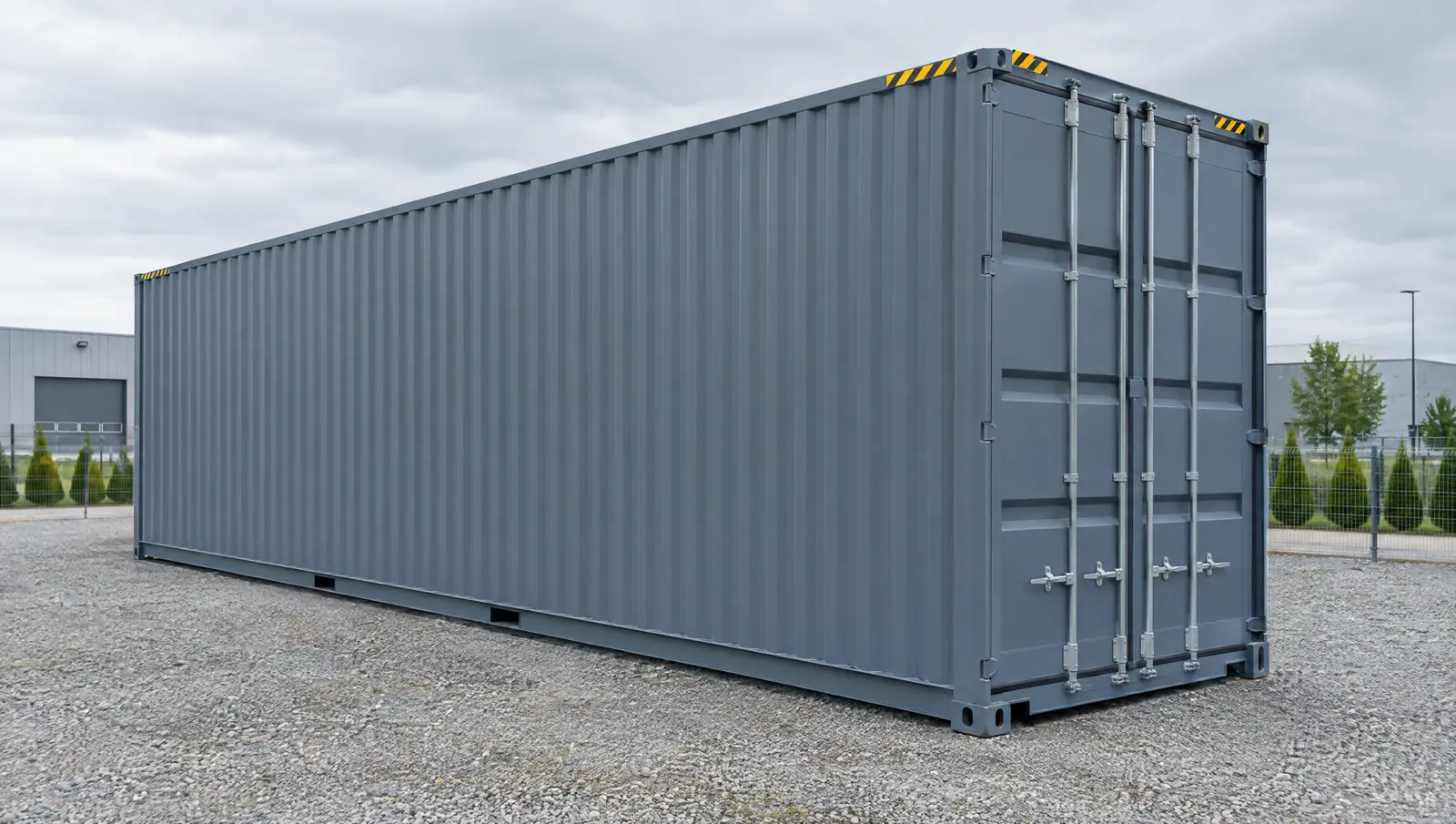
Using a container as a detached workshop, hobby space, or garage is an obvious idea: robust, quickly available, and usually less complicated than an extension. Whether placing it needs planning permission depends, as with any container, on location, duration and use – see Container planning permission. But between “put the container down” and “work in it safely and comfortably” lies a series of decisions that Container use cases only touches on briefly. This guide goes into depth for the specific case of a workshop or garage.
Note on German law: planning permission (or its absence) for placing and using a container depends on the plot, local development plan and intended use; the German-law references in this article are general orientation, not advice for a specific site.
Choosing the right container type and size
For most workshop and garage uses, a 20-foot high-cube container is the best compromise: the roughly 30 extra centimetres of height compared with a standard container create noticeably more headroom over a workbench and shelving. A car lift, by contrast, is not realistic even in a high cube with about 2.70 m of internal height – it needs considerably more headroom. Details on dimensions are in Container sizes and dimensions.
| Use | Recommended type | Why |
|---|---|---|
| Hobby or small workshop | 20 ft high cube | More headroom, enough floor area for a bench and shelving |
| Bike store, garden equipment | Mini container (6–8 ft) | Compact, affordable, often movable without a crane |
| Workshop needing side access for material | Open-side container | Opens along the full length of one side, ideal for long workpieces |
| Garage for a vehicle | 20 ft or 40 ft high cube | Check the vehicle’s dimensions against the door opening (see below) |
Power: when tools need more than a single socket
A circular saw or cordless drill runs from any ordinary socket. Once a compressor, pillar drill, welding set, or table saw with a three-phase motor is added, a three-phase supply is often required. How the connection to the grid – temporary site supply or a fixed connection – is planned and sized is covered in detail in Power connection for a container. For a workshop, additionally:
- At least two separate circuits, so an overloaded circuit (e.g. a compressor) doesn’t take the lighting down with it.
- Sockets at working height on the bench, not only at floor level.
- A 30 mA RCD, especially important given moisture from coolants or an open door.
- A master switch at the entrance to isolate the whole installation when leaving.
Lighting
A workbench and machine workstations need noticeably more light than a storage shelf. As a guideline, around 300 to 500 lux at the bench is typical, with more at precision workstations (drawing, fine mechanics). Damp-proof LED fittings are the right choice given dust and occasional moisture; an additional swing-arm lamp at the bench compensates for shadows cast by your own body.
Ventilation and extraction: dust, fumes, exhaust
An enclosed container with roughly 33 to 37 cubic metres of interior volume (20 ft standard or high cube) concentrates pollutants quickly. Depending on the activity, a targeted solution is needed:
| Activity | Hazard | Recommended solution |
|---|---|---|
| Sawing, sanding | Fine dust | Extraction directly at the machine, plus basic ventilation |
| Welding | Fume | Dedicated fume extraction arm, window ventilation alone is not enough |
| Painting, bonding | Solvent vapour | Mechanical ventilation is essential; check whether explosion-protected electrics are needed |
| Vehicle with engine running | Exhaust gas (CO) | Never without an open door or an exhaust hose routed outside |
| General workshop use | Moisture, odours | Cross-ventilation as in a storage container, see Container ventilation |
The last row is not a minor point: a vehicle engine must never run inside a closed container without a safe path for exhaust gas to the outside – carbon monoxide concentration rises to life-threatening levels very quickly in that small air volume.
Floor and load capacity
The standard timber-composite floor of a container is designed for evenly distributed storage loads, not necessarily for the concentrated point load of a heavy pillar drill, lathe, or band saw. Before installing heavy individual machines, it is worth checking the permissible point load with the supplier; where in doubt, a load-spreading sub-structure of steel plate or timber beams under the support points helps. For general workshop use with a bench, shelving, and hand tools, the standard floor is normally sufficient on its own.
Fire safety: flammable materials and sparks
Workshops bring typical ignition sources that pure storage or office use does not: welding sparks, hot cutting discs, solvents, paint residue. Basic rules:
- Carry out welding and cutting work only on a non-combustible surface and at a distance from insulation, timber shelving, and stored goods.
- Store solvents, paint, and fuel in approved, labelled containers – ideally not in the same space as the ignition source.
- Keep a suitable fire extinguisher (powder or foam, depending on fire class) ready at the exit.
- A smoke alarm is worthwhile in a workshop too, but does not replace the measures above.
If the workshop is also used as an occupied space, further requirements on escape routes and separation distances apply, as described in Container fire safety.
Theft protection for tools and machinery
Tools and machinery are an attractive target for theft, often more so than the container shell itself. The standard measures – security locks, bolt bars, alarm systems, an inconspicuous location – are covered in detail in Securing a container. Additionally worthwhile for workshops: secure high-value machines individually with a chain lock to a fixed anchor point, so that a break-in cannot result in everything being taken at once.
Insulation: often optional for a workshop
Unlike residential or office containers, full insulation is not essential for many workshop uses. Anyone working only occasionally, mostly in the warmer half of the year, often manages without it. Arguments for at least simple roof and wall insulation include year-round use, sensitive electronics or tools that need protection from condensation. The basics of condensation and insulation methods are in Insulating a container; anyone who only wants to protect against dripping condensation on the ceiling will find condensation mats (see Container ventilation) a considerably cheaper interim solution.
Vehicles in a container: what actually fits through the door
A common misconception: it is not the interior dimension but the door opening that decides whether a vehicle fits. On standard and high-cube containers, the door opening is roughly 2.34 m wide; the height is roughly 2.28 m (standard) or 2.58 m (high cube) – exact figures vary by manufacturer, see Container sizes and dimensions.
In practice, this means most cars with folded-in wing mirrors pass through the width. Getting out is the tight part: with about 2.35 m of internal width and a car just over 1.8 m wide, there is barely a hand’s width to 30 cm on each side – the driver’s door will hardly open. As an everyday garage, a container therefore suits narrow small cars, motorcycles, classic cars in winter storage or trailers better. It becomes tighter with high-roof vans, vehicles with roof boxes or roof racks, and tow bars that reduce the usable length. A trial run into the empty container before final fit-out avoids surprises. Anyone who regularly needs to bring in very wide or bulky vehicles and machinery is better served by an open-side container with full side access than by the end door alone.
Buy or rent?
For a permanent workshop, buying a used container is usually worthwhile – the purchase cost is recovered quickly compared with ongoing rental payments. For a time-limited project, or to trial the use case, renting is the more flexible option. The decision criteria in detail are covered in Buy or rent a container and in the Buying & renting section.
Cost overview
The following figures are rough indicative ranges without guarantee for fitting out a used 20-foot high-cube container for workshop use, in addition to the container price itself (see What does a container cost?).
| Item | Cost range approx. |
|---|---|
| Electrical retrofit incl. three-phase circuit | €600–2,000 |
| Workbench, shelving, basic fit-out | €300–1,200 |
| Damp-proof LED lighting | €150–500 |
| Extraction system (stationary, basic) | €300–1,500 |
| Additional security lock and bolt bars | €150–500 |
| Simple roof/wall insulation | €800–2,500 |
Checklist before converting
- Which machines will be used – is 230 V enough, or is a three-phase supply needed?
- Will dust, fumes, or exhaust gas be produced that require mechanical extraction?
- How heavy are the heaviest individual machines – is the standard floor sufficient?
- Does a vehicle need to fit inside, and has the door opening been checked against the vehicle’s actual dimensions?
- Is a fire extinguisher provided, and are flammable materials stored away from ignition sources?
- Is the standard lock sufficient, or are the tools and machinery valuable enough to warrant extra theft protection?
- Is the workshop used year-round – would at least simple insulation pay off?
Conclusion
A container does not automatically become a functioning workshop or garage just because it is robust and quick to set up. What matters is a power connection matched to the use, ventilation or extraction suited to the specific activity, a floor capable of the machine loads involved, and a fire safety approach that accounts for the ignition sources typical of a workshop. Sorting these points out before the conversion, rather than after, saves expensive retrofitting and avoids avoidable risks.