
At a business, the need usually arises suddenly: the warehouse is full, a refurbishment needs temporary space, new staff need a break room, or seasonal stock has to go somewhere. A container is often the fastest answer – it is available within days, stands without major building work and can be removed later. That very speed tempts people to skip questions that come back to bite them: does the site fit the escape route layout? Is the use allowed here at all? Does buying beat renting?
This guide is aimed at businesses, clubs with grounds and self-employed people who want to use one or more containers permanently or for a longer period on their own or leased premises. Legal references relate to German law. For time-limited construction sites, read Containers on construction sites: occupational safety instead.
First: what is the container for?
The use determines almost everything else – container type, fit-out, permit situation and costs. The table compares the most common business uses.
| Use | People present | Typical container | Main issues |
|---|---|---|---|
| Material and spare-parts storage | briefly only | standard shipping container, possibly an open-side container for pallet access | ventilation, access, theft protection |
| Seasonal storage (stock, decorations, garden furniture) | briefly only | storage container, possibly a high cube for more volume | condensation, order, shelving |
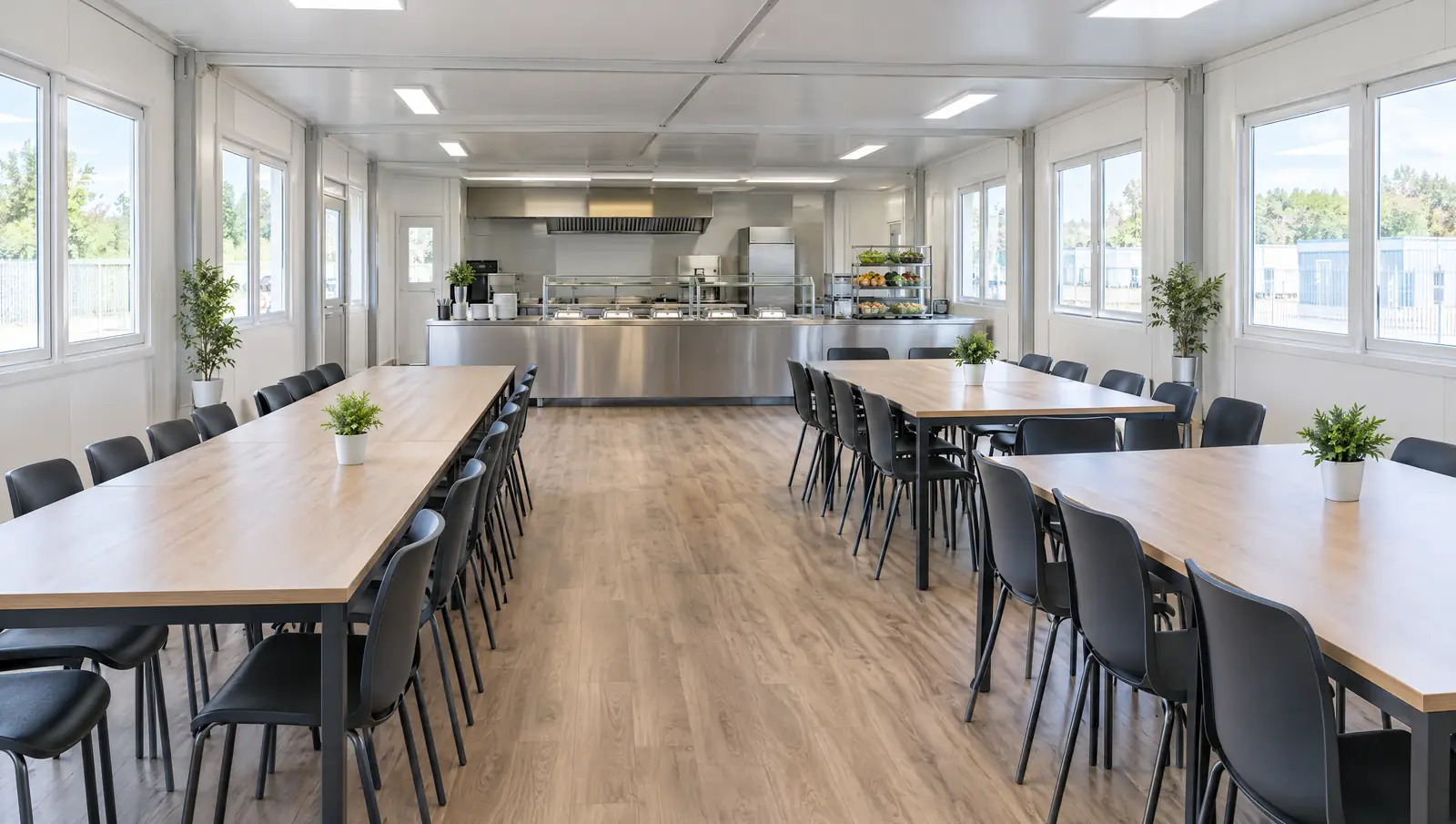
| Break and common room | permanently | fitted-out accommodation container | workplace regulations, escape routes, heating |
| Changing rooms and sanitary | regularly | sanitary or changing-room container | water, waste water, frost |
| Interim office | permanently | office container | insulation, sound insulation, indoor climate |
| Workshop, small-scale production | permanently | standard or high cube | electrics, noise, fire load |
| Cooling (food, drinks) | briefly | reefer container | power consumption, hygiene, maintenance |
Keep two limits in view early on: as soon as people stay for more than a short time, the container becomes a habitable room in the eyes of building law and workplace safety law – with much higher requirements. And as soon as hazardous substances (paints, solvents, gas cylinders, batteries, fuels) are involved, separate rules apply that an ordinary storage container does not meet. Special hazardous-materials containers exist for this; storage in a standard container is not a solution.
Space planning: the container is smaller than its footprint requirement
A 20 ft container measures about 6.06 × 2.44 m on the outside, i.e. roughly 14.8 m² of floor area. The space actually needed is considerably larger:
- Access: In front of the double doors there must be room to open the door leaves and to work. If you work with a forklift or pallet truck, you need additional manoeuvring space in front of the door; how much depends on the equipment.
- Delivery: For lorries with a tilt-and-slide system or a crane, you need an accessible, load-bearing site plus space for manoeuvring and outriggers. Height matters (gates, cables, trees). Notes on delivery and crane work are in Transporting a container and Lifting a container correctly.
- Distances: Building-law and fire-safety distances apply to buildings, plot boundaries and other containers (see below).
- Keep clear: escape routes, fire-service access, emergency stairs, access to hydrants and extinguishing equipment, the main traffic routes of the business.
An example calculation for orientation: you place two 20 ft containers side by side. The pure footprint is about 2 × 14.8 ≈ 29.6 m². Allow a surrounding strip of roughly one metre for maintenance and ventilation along the long sides, and several metres in front of the door side – then the total area occupied is more in the order of 50 to 70 m² than 30 m². That is the figure to compare with your site, not the container footprint.
The ground must suit the load. An empty 20 ft standard container weighs roughly 2 t; loaded, it can reach many times that. For containers standing permanently, a level, load-bearing base with point or strip foundations or a gravel surface is worthwhile; basics in the guide Container foundations.
Worked example: buy or rent?
On company premises the buy-or-rent question differs from the private one: liquidity, accounting and flexibility come into play. A simple example with assumed orientation values (see also What does a container cost? and Rental prices and calculation):
| Item | Buy (used, 20 ft) | Rent (20 ft) |
|---|---|---|
| Purchase | approx. €2,400 | – |
| Delivery | approx. €250 | approx. €250 |
| Collection at the end | approx. €250 | approx. €250 |
| Monthly rent | – | approx. €95 |
| Expected resale | approx. €1,700 proceeds after 3 years (assumption) | – |
How many months must the container stand before buying becomes cheaper?
- Conservative, without resale proceeds (the container stays in the business, no collection costs): buy = 2,400 + 250 = €2,650; rent = 500 + 95 × n. Break-even at n = (2,650 − 500) / 95 ≈ 23 months.
- With resale at the assumed price: net cost of buying = 2,400 + 250 + 250 − 1,700 = €1,200. Break-even at n = (1,200 − 500) / 95 ≈ 7.4, i.e. about 8 months.
The gap between 8 and 23 months shows that what matters is what the container is worth later – and whether you actually sell it. Therefore calculate both scenarios. With very uncertain demand (refurbishment phase, seasonal peak), flexibility argues for renting; with stable long-term demand, for buying. Leasing and rent-to-own are a middle way for businesses that want to spread the investment; the models are explained under Leasing and Rent-to-own, and you can calculate with the leasing calculator. An overview of all routes: Buy and rent; rental page: Rent a container.
For tax purposes, the classification of the container (movable asset or building) is decisive for depreciation; basics in the guide Tax and depreciation. Have the binding classification confirmed by your tax adviser.
Permits and business law: the key decisions
A container on your own business premises is neither automatically exempt from permits nor automatically subject to them. Whether a permit is needed depends on location, duration and use: on the federal state (the state building codes differ), the development plan, the size and whether the container is used for permanent occupation. The starting point is the guide Containers and building permits; for changes of use of an existing area see Building application and change of use.
Businesses face some typical additional questions:
- Existing permits: Are storage or parking areas fixed in an existing permit or plan? A new container can amount to a change of the approved use.
- Type of area: In commercial or industrial areas, storage is often more readily permitted than in mixed or residential areas. How development plans and the outskirts (Außenbereich) work is explained in Development plans and the Außenbereich.
- Boundary distances: Setback areas follow the state building code; details in Neighbour law and boundary distances.
- Leased land: On someone else’s land you also need the owner’s consent; regulate removal and liability in writing.
- Noise and emissions: Workshop, cooling or ventilation equipment can disturb neighbours; limit values and basics: Noise control and acoustics in a container.
Fire safety and occupational safety
Where employees stay in the container, workplace law applies: the Workplace Ordinance (ArbStättV) and the Technical Rules for Workplaces (ASR). ASR A4.2 is relevant for break and standby rooms; whether a break room is required and how large it must be depends, among other things, on the number of employees and the type of work. The employer’s risk assessment must also cover the new workplace. An overview of rooms, orders of magnitude and inspections is in the guide Occupational safety on construction sites – much of it applies by analogy in a business, but the binding rules are those for your type of operation.
Two fire-safety points are particularly important in practice:
- Limit the fire load: A fully packed storage container right against the warehouse wall is an additional fire load. Clarify distances to the building and to other containers; an overview with guide values is provided by Fire safety in containers.
- Escape routes and extinguishing equipment: The container must not narrow fire-service access or escape routes. Fire extinguishers, smoke alarms and signage belong with any occupied use.
If your insurer or fire-safety officer sets requirements, check them in addition.
Protection: locks, insurance, liability
A container with contents is a theft target – even on a fenced business site. Mechanical and organisational measures are explained in Securing a container. For protecting container and contents: check whether existing business and contents insurance covers the container or whether an addition is needed. What is possible and which exclusions are typical is in Insuring a container. For rented containers, also clarify who is liable for damage.
Typical mistakes in daily operations
- Use creeps up unnoticed: “Just storage” becomes a smoking corner, then a break room. The requirements change with it – plan the actual use, not the one originally intended.
- Site planned on footprint alone: manoeuvring and access areas are missing, and the forklift cannot reach the door.
- Delivery route not checked: the lorry does not fit through the gate, the crane site is occupied, overhead lines are in the way.
- No concept for moisture and climate: if you store goods, paper or electronics without thinking about ventilation, you will find condensation later; see Ventilating a container and Using a storage container properly.
- The container is forgotten: inspections (electrics, extinguishers, doors, seals) are not scheduled because nobody is responsible.
- Removal not thought through: with rental or leased land – who collects, in what condition, with how much notice?
Checklist before ordering
- Record the use in writing (what, who, how often, how long).
- Measure the site including manoeuvring and access areas; mark escape routes and access roads.
- Clarify responsibilities: building code, development plan, lease if any, operating permit.
- Involve fire and occupational safety (risk assessment, distances, extinguishing equipment, signage).
- Plan delivery: vehicle, access, crane, date.
- Prepare the ground (level, load-bearing, drainage).
- Calculate buy, rent or lease with both scenarios (8 vs. 23 months in the example).
- Clarify insurance and security.
- Define maintenance and inspection: who checks what, and when?
- Think about removal or resale in advance.
Important note
This guide is orientation and does not replace legal, tax, building or occupational-safety advice. Figures and prices are indicative values without guarantee; the worked example uses assumed values. Binding are the state building codes, the Workplace Ordinance including ASR, the fire-safety concept for your site and the requirements of your authorities and insurers. If in doubt, speak to the responsible building authority, your safety officer and your tax adviser.