
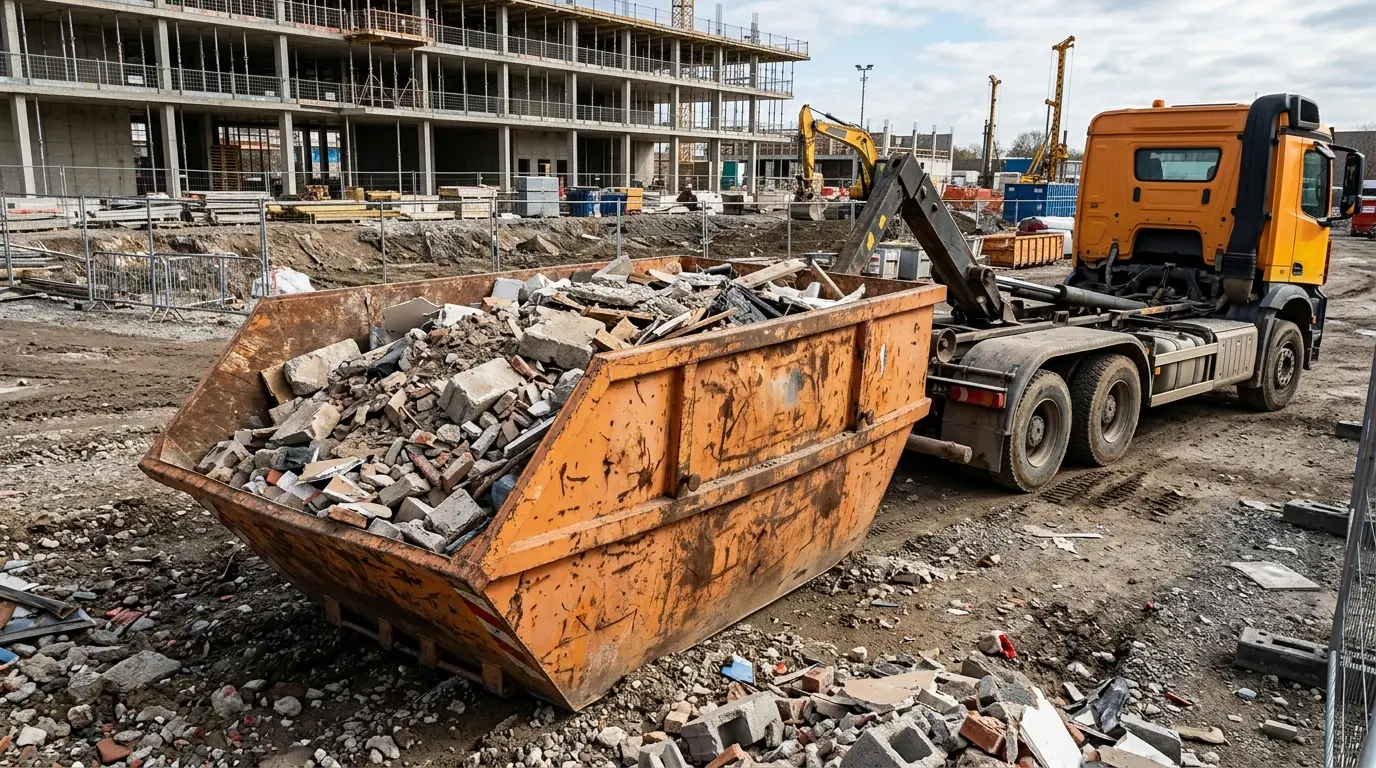
Why transport is the underestimated item
A container has to be moved twice: there and back. Both journeys cost money, both frequently only become visible on the final invoice, and together they regularly exceed the sum of all rental instalments for hire periods under roughly four months.
The reason lies in the costing. A lorry with a driver costs money the moment it leaves the yard – regardless of whether it is carrying a container worth €2,000 or €20,000. The transport price therefore depends hardly at all on the value of the container, but on vehicle type, distance and time spent on site.
From this follows a consequence that surprises many: a cheap container from far away is almost never a good deal.
The three vehicle types and what they cost
Which vehicle is needed determines the order of magnitude. This is the single most important cost factor.
| Vehicle | Suitable for | Rough cost per journey | Space needed |
|---|---|---|---|
| Skip loader | Skips, containers up to approx. 10 ft, tipped sideways | approx. €120–250 | little, approx. 3.5 m width |
| Roll-off (hook lift) | Roll-off containers, 20 ft containers on a frame | approx. €180–350 | medium, manoeuvring space required |
| Lorry with loader crane | 10 and 20 ft containers, precise placement | approx. €350–800 | lateral clearance, no overhead lines |
| Articulated lorry / low loader | 40 ft containers, heavy modules | approx. €400–900 plus crane | large turning circle, firm access |
| Mobile crane ordered separately | difficult positions, stacking, long reach | approx. €600–1,800 per day on site | standing area with load capacity |
The decisive branch is between self-unloading and crane. A container that can simply be rolled off backwards with a hook lift is considerably cheaper than one that has to be lifted over a hedge or a neighbouring building. Choosing a position where the lorry can drive right up and roll off often saves several hundred euros.
Per-kilometre rates and flat fees
Most providers work with a combination of a base fee and a per-kilometre rate.
| Billing model | Typical magnitude | Note |
|---|---|---|
| Local area flat fee (up to approx. 20–30 km) | approx. €120–300 per journey | the most common model |
| Per-kilometre rate beyond that | approx. €1.80–4.50 per km | sometimes one-way, sometimes return distance |
| Hourly rate, lorry with driver | approx. €80–150 per hour | where the effort is unclear |
| Crane hour | approx. €150–350 per hour | often with a minimum charge |
| Crane mobilisation fee | approx. €150–500 | in addition to the crane hours |
Always ask whether the per-kilometre rate applies to the one-way or the return distance. This is the most common reason why two quotes with identical rates end up twice as far apart as expected. Charging the return journey is technically correct – the lorry has to come back – but it is sometimes already covered by the flat fee.
The items nobody budgets for
This is where the additional charges arise.
Waiting time. If access is blocked, the foundation is not ready or nobody is on site, the driver waits – and that is billed, usually after a free allowance of 15 to 30 minutes at around €60 to €120 per hour started. One hour of waiting can cost more than 20 kilometres of travel.
Wasted or repeat journey. If the container cannot be set down because the ground is too soft, a car is in the way or the crane cannot be positioned, the lorry returns empty. It is charged all the same, often the full journey, and the second trip comes on top. This is the most expensive avoidable mistake.
Surcharges. Delivery on a Saturday, outside core hours or within a time window under two hours attracts a surcharge, often 20 to 50 per cent.
Manoeuvring effort. Narrow yard entrances, turning manoeuvres, help with alignment. Becomes visible where time is billed.
Permits. If the container has to be set down on public land or a road briefly closed, a special use permit and traffic safety measures are added; details in Containers on public land.
Abnormal loads. Above certain dimensions – particularly XL modules 3 m wide or several coupled units – transport becomes subject to permits, sometimes with an escort vehicle and night travel. That moves costs into an entirely different bracket, roughly from €1,500 upwards.
Worked examples
The figures are rough orientation, but they show the structure.
20 ft storage container, 25 km, level yard with access
| Item | Amount |
|---|---|
| Delivery, hook lift, local area | approx. €220 |
| Collection | approx. €220 |
| Total transport | approx. €440 |
20 ft office container, 60 km, lifted over a hedge with a loader crane
| Item | Amount |
|---|---|
| Base fee | approx. €250 |
| 30 km beyond the local area, return distance at €2.80/km | approx. €170 |
| Crane work on site, 1.5 h | approx. €330 |
| Delivery total | approx. €750 |
| Collection in the same configuration | approx. €750 |
| Total transport | approx. €1,500 |
40 ft container, 120 km, articulated lorry plus mobile crane
| Item | Amount |
|---|---|
| Articulated lorry incl. kilometres | approx. €700 |
| Mobile crane, half day on site | approx. €900 |
| Return journey later | approx. €700 |
| Total transport | approx. €2,300 |
Comparing the three cases shows: it is not the distance but the need for a crane that drives the cost. The jump from case one to case two comes almost entirely from the crane, over just 35 extra kilometres.
Planning a transport-friendly position
These points decide whether a crane becomes necessary:
- Direct access to the position. A hook lift needs roughly the container length plus around 5 metres of manoeuvring space behind it, in a straight line.
- Load-bearing ground. A 40-tonne lorry sinks into soft meadow. After rain, this is the classic cause of a wasted journey. Gravel or slabs along the wheel track solve it more cheaply than any crane hour.
- Overhead clearance. Branches, overhead lines, canopies and balconies prevent tipping off and force a crane with greater reach – which raises the price disproportionately.
- Lateral clearance. A loader crane needs room at the side to extend its outriggers, roughly 1.5 to 2.5 metres each side.
- Foundation ready beforehand. Point footings must be cured and level before the lorry arrives. Details in Container foundations.
- A contact on site. Somebody to open the access, show the position and answer questions. Saves waiting time.
Send the provider photos of the access route and the position plus a map extract in advance. Reputable providers will then quote more accurately and flag problems before the lorry sets off.
Six ways to cut transport costs
- Buy or hire locally. The most effective lever. A container €300 cheaper 150 kilometres away costs more in total.
- Avoid the crane. Choose a position that allows roll-off. Often the difference between €220 and €750.
- Several containers in one journey. Two 20 ft containers fit on many articulated lorries. One journey instead of two.
- Be flexible on timing. Offering a window of several days lets you be fitted into an already planned route. That is often rewarded with a discount.
- Use return loads. Providers already collecting a container in your direction can quote the outbound leg more cheaply. It is worth asking.
- Prepare the ground. A few tonnes of gravel costs less than a wasted journey plus a second delivery.
What belongs in the quote
Insist on these items in writing:
| Item | Why it matters |
|---|---|
| Vehicle type | determines the order of magnitude |
| Delivery, amount | main item |
| Collection, amount | often forgotten and usually the same |
| Kilometre billing: one-way or return | most common comparison trap |
| Included time on site | when waiting time starts being charged |
| Hourly rate for waiting | size of the additional charge |
| Cost of a wasted journey | should be stated in advance |
| Requirements for access and ground | otherwise the risk shifts to you |
| Surcharges for out-of-hours slots | avoidable with flexible planning |
Important note
All prices are rough orientation values without guarantee. Transport costs depend on region, order volumes, fuel prices, vehicle availability and site conditions, and vary considerably. Only an individual quote based on the actual circumstances is binding. Requirements for load securing, abnormal loads and permits follow road traffic law and the conditions set by the responsible authorities.
Conclusion
Over short hire periods transport is the largest single item, and its size is determined not primarily by distance but by whether a crane is needed. Plan the position so the lorry can drive up and roll off, firm up the ground beforehand and send photos of the access route – that keeps costs at the lower end and avoids the most expensive case of all: the wasted journey followed by a second delivery.
Further reading: Transporting a container, Container foundations and Understanding hire prices.