
Why public land is treated differently
A container on your own plot is a building law question. The moment the same container stands on a pavement, in a parking bay, on a verge or on the carriageway, a completely different legal regime applies: public traffic areas are dedicated to common use – they are available to everyone, for traffic, not for storage.
Anyone occupying that space for a private purpose and thereby impairing common use is engaging in special use (Sondernutzung), which generally requires a permit. This applies to the skip you order for clearing out an attic just as much as to the site container that blocks two parking spaces for three months.
A common misconception in practice: many people assume a short period makes the whole thing permit-free. It does not. What matters is not the duration but whether common use is impaired. A container blocking a pavement for a week is a special use – a container sitting on a lorry for ten minutes is not.
Who decides – and what you apply for
Responsibility is where most projects stall, because different authorities decide depending on the situation.
| Situation | Usually responsible | Legal basis (orientation) |
|---|---|---|
| Container on pavement or parking bay, no traffic management | Municipal road authority, public order office | State road and pathways act |
| Container affecting moving traffic, lane narrowing | Road traffic authority | § 45 StVO (traffic order) |
| Loss of parking spaces, temporary no-stopping zone | Road traffic authority, often via the contractor | § 45 StVO |
| Federal or state road outside built-up areas | Regional roads authority | Federal Trunk Roads Act, state road act |
| Private land with public access (e.g. supermarket car park) | Owner, no special use | Civil law, right of the owner |
In many cities all cases run through a single form at the public order or civil engineering department. Also relevant in practice: larger container services and construction firms routinely apply for the permit and bill it with the job. Ask about this explicitly – if nobody applies, the container stands unpermitted.
Process and lead time
The application itself is unspectacular but needs time. Expect the following sequence:
- Apply early, ideally two to four weeks ahead. In large cities with scarce street space, longer periods may apply.
- Prepare the details: exact location with a site plan or sketch, container dimensions, period from–to, purpose, name of the party placing it.
- Traffic signage plan, if moving traffic is affected. For larger projects a traffic safety contractor supplies this.
- Wait for the permit and keep it available. The permit or a copy should be visible or to hand at the container.
- Set up the no-stopping zone in good time if parking spaces are lost. As orientation, many places apply a 72-hour lead time so that vehicles already parked there may be towed at the owner’s cost. Miss that window and the vehicle stays – and the container has nowhere to go.
That last point is by far the most common reason deliveries fail. The no-stopping sign must not only be in place; the date it was erected must be documented, otherwise the deadline cannot be proven later.
What it costs
Fees are set locally and vary considerably. The figures below are rough orientation values, not a commitment.
| Item | Rough range | Note |
|---|---|---|
| Special use permit, base fee | approx. €30–150 | depending on municipality and administrative effort |
| Area fee | approx. €0.20–2 per m² and day | significantly higher in city centres |
| Traffic order | approx. €50–250 | where moving traffic is affected |
| No-stopping zone (contractor) | approx. €80–200 | incl. signs, set-up, documentation |
| Traffic safety measures, barriers | approx. €100–500 | depending on scope and hire period |
For a simple skip on a parking bay for one week, many projects end up in the low three-figure range overall. For a site set-up over several months in a central location, the area fee alone can become the largest item – it is worth genuinely optimising the footprint here.
Securing the site: what is actually required
A container in public space is an obstacle, and obstacles must be visible. The specific conditions are set out in the permit; typical requirements are:
- Retroreflective hazard markings on the sides facing the carriageway so the container is visible in headlights at night.
- Lighting or warning lamps in darkness where street lighting is insufficient.
- Barriers or beacons where the container projects into the traffic area.
- Remaining pavement width for pedestrians. A minimum width is often required so wheelchairs and prams can pass; where that is impossible, a secured alternative route must be provided.
- Keeping hydrants, manhole covers and escape routes clear. A blocked hydrant is one of the points where the fire service has no discretion at all.
- Restoring the surface after removal, including cleaning and repair of any damage to the paving.
Liability: the part that really gets expensive
The fees are the smaller risk. It gets serious when damage occurs.
Anyone placing an obstacle in the traffic area assumes the duty to maintain safety for it. If somebody trips over an unlit container at night, or a car hits an unsecured barrier, liability generally falls on whoever placed the container or arranged for it – regardless of whether a permit existed.
Two constellations are particularly unpleasant:
Placed without a permit. Besides the fine – a two- to three-figure amount depending on the municipality, more for repeat offences – the authority can order immediate removal and carry it out itself at your expense. Crane and haulage costs fall on the party responsible. If damage occurs on top of that, a liability insurer will scrutinise the claim because of the unauthorised use.
Conditions not met. If the container has a permit but lacks the prescribed markings, the permit is of little help in a liability case. The conditions are not a formality; they are precisely the yardstick applied afterwards.
Clarify with your insurer in advance whether your business or private liability cover extends to placement in public space. For commercial use this is often subject to conditions. More on this in Insuring a container.
Special case: skips and waste containers
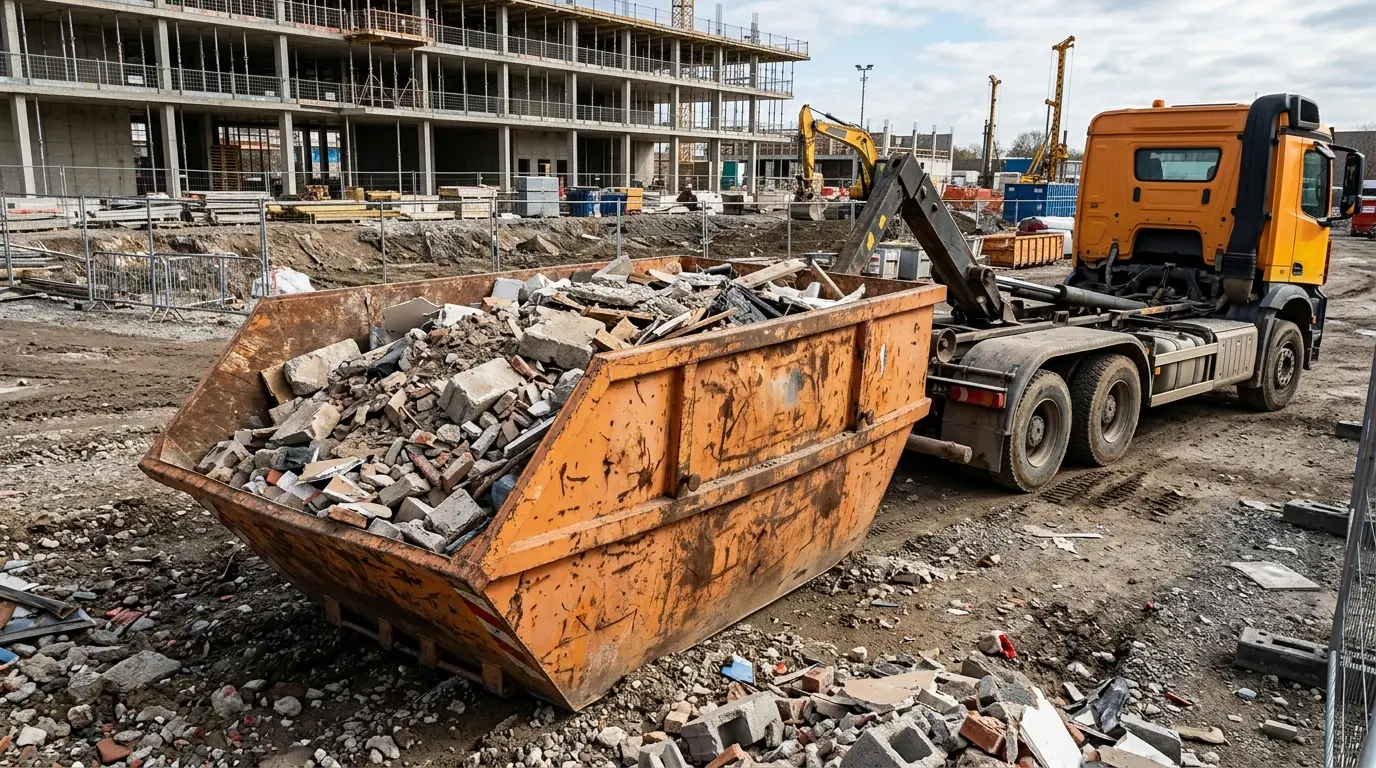
For rubble and bulky waste skips the waste contractor usually handles the permit – but not always and not automatically. Check the quote for a line such as “placement permit” or “special use”. If it is missing, you as the customer are responsible.
In addition: the skip must not be overfilled, protruding items must be secured, and where covering is required (for instance against wind-blown debris) the tarpaulin must actually be on. These too are safety duties.
Common mistakes
| Mistake | Consequence |
|---|---|
| Assuming the container service handles it | Container stands unpermitted, fine goes to the customer |
| No-stopping zone set up too late | Parked vehicles cannot be towed, delivery fails |
| Date the signs were erected not documented | Deadline cannot be proven, towing refused |
| Pavement completely blocked | Condition breached, removal order, liability risk |
| Period exceeded | Additional fees, future applications refused if repeated |
| Reflectors missing | Full liability in an accident despite the permit |
Important note
This article contains general information and does not constitute legal advice. Special use is governed by state and municipal law; responsibilities, procedures, deadlines and fees differ considerably from one municipality to the next. All cost figures are rough orientation values without guarantee. Binding information is provided solely by the responsible road or road traffic authority in your municipality.
Conclusion
As soon as a container occupies public traffic space you need a special use permit – no matter how short the period. Apply two to four weeks ahead, clarify explicitly whether the container service takes this on, and set up any required no-stopping zone early and with documentation. Follow the safety conditions to the letter: the fees are manageable, the liability after an accident is not.
Further reading: Container building permit, Transporting a container and Insuring a container.