
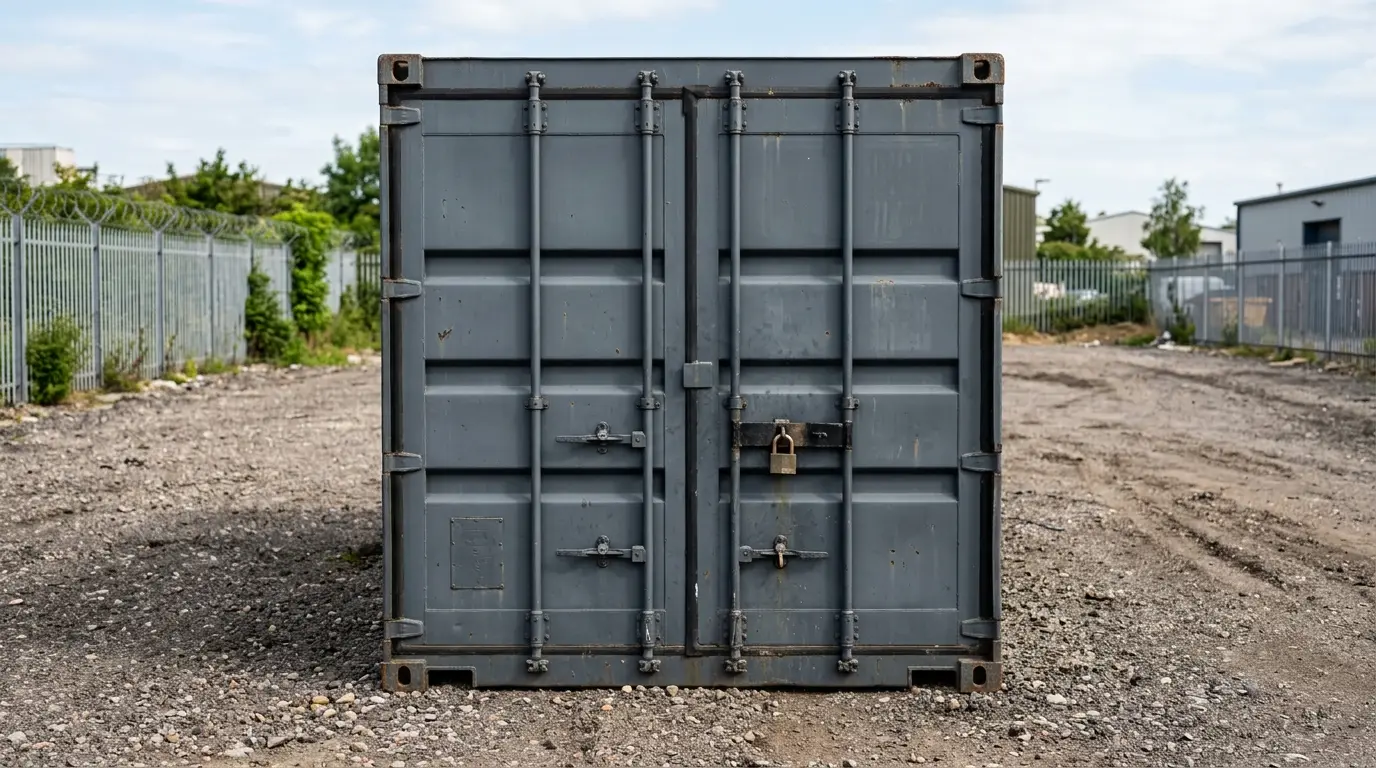
Why moisture builds up so quickly in a container
A 20-foot container has an internal volume of roughly 30 cubic metres, and after a fit-out with insulation, lining and furniture considerably less free air remains. An ordinary living room easily reaches double that. This is the first reason moisture is a permanent topic in containers: the same amount of water vapour drives relative humidity up far faster here than in a larger room.
Three structural characteristics add to this. The steel shell as delivered is almost completely sealed and has none of the involuntary leaks through which older buildings get a base air change. The steel walls and above all the ceiling form very large, highly conductive surfaces that get very cold in winter. And thin-walled steel reacts extremely quickly to temperature swings: a sunny afternoon and a clear night can shift the surface temperature by double-digit values within hours.
The moisture sources themselves are unspectacular, but they add up:
- People release roughly 1 to 2 litres of water per day through breathing and skin – with two occupants, up to four litres.
- Cooking, showering and drying laundry each release further litres; an indoor drying rack is the most underestimated source of all.
- Plants evaporate practically all the water they are given.
- In storage: goods stored while damp, wet ground beneath the container, and temperature swings driving moisture out of timber, cardboard and textiles.
Container rain explained
Container rain is a phenomenon familiar to anyone who has opened an uninsulated storage container in autumn: water drips from the ceiling although it is not raining and the container is watertight.
The sequence is always the same. By day the sun heats the steel and the internal air warms with it, absorbing moisture from goods and floor. At night the steel roof cools rapidly, often below outside air temperature, radiating against the clear night sky. The warm, humid air rises, meets the cold ceiling, falls below the dew point and condenses. Droplets form and fall – the container rains from inside.
The consequences are immediate: soaked cardboard, damp stains on textiles, corrosion on tools, swelling wood-based panels. Anyone storing goods over winter without protection regularly finds more damage in spring than expected.
The physics in brief
Warm air holds more water vapour than cold air. When humid air cools, its capacity drops; at the dew point the excess condenses out. What matters is not the room air alone but the temperature of the surfaces. At a cold wall, relative humidity in the boundary layer is far higher than in the middle of the room.
Common orientation values:
| Parameter | Orientation range | Meaning |
|---|---|---|
| Relative humidity in living spaces | roughly 40 to 60 per cent | Comfortable and low mould risk |
| Humidity at surfaces | critical above roughly 65 to 70 per cent long term | Mould risk rises significantly |
| Air change rate for living spaces | roughly 0.5 per hour | Rough planning approach for moisture removal |
| CO2 content of room air | around 1,000 ppm as a guide value | Indicator of adequate ventilation |
These figures are orientation values, not a binding commitment for any individual case. Where surfaces are particularly cold the assessment shifts – the domain of thermal bridges, covered in Thermal bridges in shipping containers.
Ventilating a storage container properly
For storage without occupancy, passive ventilation usually suffices if correctly arranged. Cross ventilation is decisive: intake low, exhaust high, diagonally offset, so a flow establishes itself through the whole container.
| Measure | Effect | Cost (rough orientation) |
|---|---|---|
| Vent grilles diagonally offset, high and low | Creates cross ventilation, permanently lowers humidity peaks | approx. 20 to 80 euros per grille |
| Do not place goods directly against wall or floor | Air behind goods prevents local moisture pockets | none to low |
| Use pallets or timber bearers underneath | Air circulates under the goods, the floor stays dry | approx. 5 to 20 euros per pallet |
| Desiccants and dehumidifier bags | Bind residual moisture in enclosed areas | approx. 5 to 30 euros per unit, replaced regularly |
| Condensation mats on the ceiling | Absorb condensate and release it again with a delay | approx. 3 to 10 euros per square metre |
| Light-coloured exterior paint | Reduces solar heat-up and therefore temperature peaks | approx. 5 to 15 euros per square metre of material |
| Choose a site with air circulation | Dry, airy ground instead of a hollow or meadow | none if planned early |
| Never store anything damp | Avoids the single most common cause | none |
The last point is the most important and the cheapest: damp timber, wet tarpaulins or freshly washed textiles bring in the moisture that later condenses on the ceiling. More on storage in Using storage containers properly.
Living and office use: when window ventilation is not enough
As soon as people occupy a container permanently, the situation changes. Moisture is produced continuously, and a fitted-out shell is usually more airtight than any existing flat. Pure window ventilation assumes someone reliably ventilates several times a day – including during absences and at night.
If you ventilate manually, do it properly: purge ventilation with windows wide open for a few minutes exchanges the room air completely without cooling the building components. A permanently tilted window, by contrast, cools reveals and frames so that condensation forms exactly where it is most damaging. Cross ventilation through two opposing openings shortens the time needed considerably.
For planning, two orientation figures are used: an air change rate of around 0.5 per hour for living spaces, and the ventilation concept approach in DIN 1946-6, which addresses user-independent moisture protection. Both are orientation only; the actual design belongs with a qualified planner. Consider ventilation early in the fit-out – see also Living in a container.
Technical ventilation solutions compared
| System | Principle | Advantage | Cost (rough orientation) |
|---|---|---|---|
| Extract fan with humidity sensor | Switches on automatically when humidity rises and extracts air | Simple, cheap, effective at the source (bathroom, kitchen) | approx. 50 to 200 euros |
| Window frame vent | Defined opening in the window rebate for a base air change | Very cheap, low maintenance, no technology | approx. 20 to 60 euros per window |
| Decentralised unit with heat recovery | Operates in pairs, a heat store transfers warmth to the supply air | Recovery rate roughly 70 to 90 per cent, no ductwork | approx. 500 to 1,500 euros per unit plus installation |
| Central ventilation system with heat recovery | Supply and extract via ducts and a central heat exchanger | Best controllability for larger installations and modular builds | project-dependent, considerably higher |
All amounts quoted are rough orientation values without guarantee; prices depend on unit, installation situation and region. In well-insulated containers, heat recovery is particularly attractive because much of the heating energy would otherwise leave with the extract air. With heavily insulated build-ups – for instance using spray foam insulation – planned ventilation is effectively mandatory, since the shell permits no uncontrolled air change at all.
Measuring and monitoring humidity
A hygrometer costing a few euros belongs in every occupied container. For more detail, add a data logger recording temperature and humidity over weeks, plus a CO2 meter. CO2 is not a pollutant in the narrow sense but an excellent indicator: if it rises well above the guide figure of around 1,000 ppm, ventilation has been insufficient – and moisture has usually accumulated with it. A few days of observation suffice to judge your own habits realistically.
Winter operation is particularly critical. Warm internal air meets very cold components, and condensation forms precisely at frame and corner zones. Damp traces in winter usually indicate not just a ventilation problem but a thermal bridge problem as well.
Common mistakes
- Vent grilles built over during the fit-out. Factory openings disappear behind insulation and lining; the container gets tighter with no replacement provided.
- Damaged vapour control layer. One cut for a socket lets humid room air migrate into the construction and condense behind the lining.
- Drying laundry inside the container. Several litres of water per load in a tiny air volume – the most common avoidable cause.
- Permanently tilted windows. Cools reveals, wastes heating energy and still exchanges air only slowly.
- Furniture against the cold external wall. No air movement behind the cupboard, the surface cools further, mould develops unnoticed. Five to ten centimetres of clearance help noticeably.
- Insulation without a ventilation concept. Following Insulating a container while ignoring air movement merely relocates the problem.
Conclusion
Moisture in a container is not a cosmetic defect but the risk that decides both substance and usability. A small air volume, a sealed steel shell and cold surfaces form a combination that invites condensation.
In unheated storage, consistently planned passive cross ventilation is usually enough, combined with dry goods and clearance from wall and floor. For living and office use with a tight, well-insulated shell, there is hardly a way around a technical solution – from a humidity-controlled extract fan to a decentralised unit with heat recovery. What matters most is planning ventilation in from the start rather than retrofitting it once the first stains appear.