
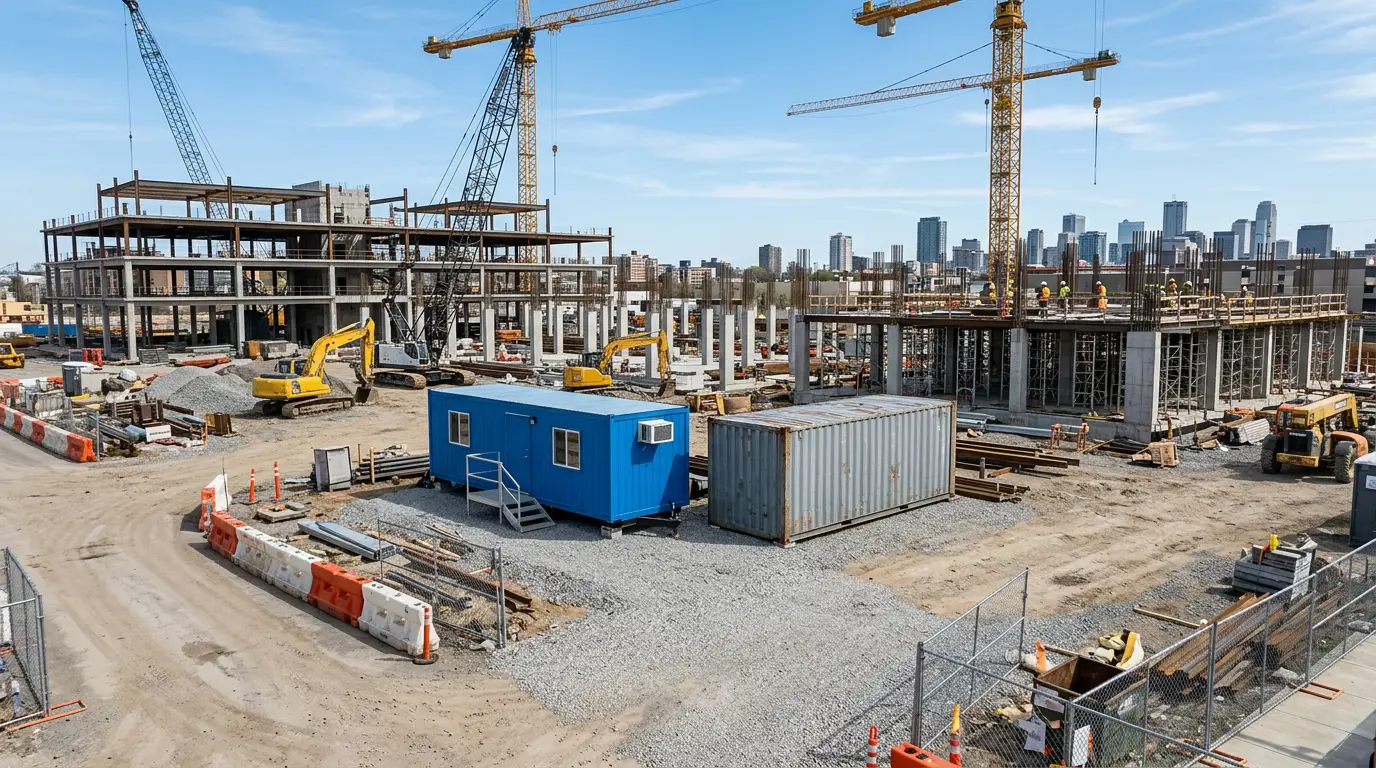
A container is, at first glance, nothing more than a standardised, stackable steel box. That simplicity is what makes it versatile: it arrives by truck almost anywhere, needs no elaborate foundation, is lockable and weatherproof, and can disappear again within hours. Once you see how different the variants are – bare shipping container, insulated office module, refrigerated unit – applications open up far beyond the building site.
This collection covers 30 applications across eight sectors, each with the container type that works in practice. For all variants, see Container types.
Construction & trades
The building site is the classic location, and still the largest market for rented containers.
Site office. Site management, plan reviews, measurements: an insulated module with windows, wiring and heating replaces the makeshift caravan, in 3, 6 or 8 metre lengths. Suitable type: insulated office container.
Break and changing room. Wet clothing and lockers call for heated, ventilated space with seating, washbasin and a separate changing zone. Suitable type: crew container.
Tool and material store. Machines, cable drums and small parts must stay dry and theft-proof; a steel container with double doors and lock box is enough. Suitable type: storage container, 10–20 ft.
Rubble skip. Demolition material, spoil or green waste goes into open skips the contractor swaps out. Suitable type: skip (7–10 m³) or roll-off container (20–40 m³).
Industry & commerce
Where hall space is scarce and expensive, containers create extra floor area quickly, without a long planning phase.
Spare parts store. Wear parts, lubricants and tools sit where they are needed; a container beside the hall saves walking distance. Suitable type: 20 ft shipping container, ventilated.
Outsourced workshop. Welding, electrical and maintenance work continues in a module with three-phase power, workbench and extraction. Suitable type: workshop container.
Test and measuring room. Quality assurance needs stable temperature, low-dust air and quiet – better served by an air-conditioned module than a partitioned hall corner. Suitable type: office container with climate control.
Gatehouse. Access control, barrier operation, visitor reception: 2 to 3 metre modules with all-round glazing. Suitable type: compact gatehouse module.
Note on hazardous materials: paints, solvents, oils and gas cylinders do not belong in an ordinary storage container. Certified hazardous-goods units exist for that, with spill sump, safety ventilation and tested fire resistance – a standard shipping container does not meet those rules.
Retail & logistics
Interim storage during refit. When the shop floor is rebuilt, a container in the yard is cheaper than rented external space. Suitable type: 20 or 40 ft storage container.
Seasonal storage. Garden furniture in winter, Christmas stock in summer, tyres all year: for cyclical inventory a purchased container with shelving pays off. Suitable type: shipping container, insulated if needed.
Sales stand and pop-up store. With a side hatch or folding door a 20 ft container becomes a compact shop – popular at Christmas markets, ski resorts and brand activations. Suitable type: retail container.
Collection point. A lockable module with parcel lockers enables around-the-clock pickup. Suitable type: module container with electrical fit-out.
| Retail & logistics | Typical size | Critical point |
|---|---|---|
| Interim storage | 20 ft | Dry standing area, ventilation |
| Seasonal storage | 20–40 ft | Condensation, shelf fixings |
| Pop-up store | 20 ft fitted out | Power, permit for public land |
| Collection point | 3–6 m module | Power supply, lighting |
Events & catering
Few sectors use containers as creatively as the events industry – they arrive fast and have become a deliberate design element.
Bar container. Unlike a trailer, a container stands firm, offers more working surface and opens into a counter. Suitable type: catering container with hatch, water and grease trap connection.
Backstage. Dressing rooms, make-up area, production office: stacked modules create a full backstage area within a day. Suitable type: office container, stackable.
Ticket and information point. A small module with a service window – lockable, heatable and gone after the event. Suitable type: ticket booth container.
Event sanitary facilities. Toilet and shower containers are more comfortable than single cabins and more hygienic at multi-day events. Suitable type: sanitary container with tank or mains connection.
Refrigerated container for drinks. A reefer keeps thousands of litres chilled, more economically than many single fridges, but needs permanent power. Suitable type: refrigerated container, 20 or 40 ft.
Public sector & education
School and nursery containers. When a wing is renovated, classes move into modular buildings. With insulation, ventilation and acoustic protection these match permanent rooms. Suitable type: school-specification room module.
Temporary administrative space. Citizen services, archives or planning departments work from modular buildings in the interim. Suitable type: office container complex.
Temporary health stations. Vaccination and testing centres showed how quickly waiting areas and cubicles assemble from modules. Suitable type: office container with partitions and washbasins.
Accommodation. Living modules with kitchen, bathroom and bedrooms serve as transitional housing; insulation, fire safety and shared areas matter most. Suitable type: residential module with wet room.
Agriculture & garden
Machinery and feed store. Attachments, seed and tools stay dry and locked away, even on remote plots. Suitable type: 20 or 40 ft shipping container.
Farm shop. A fitted container with window, chilled counter and payment system sells at the field edge, without staff. Suitable type: insulated retail container.
Cooling for the harvest. Berries, asparagus and cut flowers need chilling after picking; a reefer replaces a built cold room. Suitable type: refrigerated container.
Garden house and workshop. In a garden an insulated container replaces the timber shed: lower maintenance, harder to break into. Suitable type: 10 to 20 ft container, insulated.
Sport & leisure
Clubhouse. Without a permanent building, coupled modules provide common room, bar and office. Suitable type: insulated office container complex.
Changing rooms and showers. Two modules give separate cabins for home and away teams. Suitable type: sanitary and changing container.
Equipment store. Goals, nets, hurdles, groundskeeping gear: a container at the pitch keeps kit dry. Suitable type: 10–20 ft storage container.
Climbing and fitness box. Containers become bouldering cubes, calisthenics boxes and mobile gyms; the steel frame carries the loads. Suitable type: shipping container reinforced by a specialist.
Living & working
Tiny house. One or two coupled 20 ft containers give 15 to 30 square metres with bathroom, kitchenette and sleeping alcove. The appeal is cost, build time and mobility; the hurdles are insulation, permits and a site. Suitable type: high cube (extra height for the floor and ceiling build-up).
Garden office. A 3 to 6 metre module creates quiet working space separated from the home; power and network run from the house. Suitable type: insulated office module.
Student and temporary housing. Apartment modules of 18 to 25 square metres are series-produced and relocatable. Suitable type: residential module with wet room.
Holiday accommodation. By a lake, in woodland or on a campsite: cabins with large glazing are weatherproof and usable year-round. Suitable type: high cube with panoramic window.
Overview: purpose, container type, buy or rent
| Purpose | Recommended type | Buy or rent? |
|---|---|---|
| Site office | Insulated office container | Rent |
| Break/changing room | Crew container | Rent |
| Site tool store | Material container 10–20 ft | Rent, buy after 2 years |
| Construction waste | Skip / roll-off container | Rent via contractor |
| Industrial spare parts | 20 ft shipping container | Buy |
| Workshop / test room | Room module with services | Rent or buy |
| Gatehouse | Glazed compact module | Buy |
| Retail interim storage | 20 ft storage container | Rent |
| Seasonal storage | Insulated shipping container | Buy |
| Pop-up store | Retail container | Rent for campaigns |
| Bar container | Catering module | Buy (custom fit-out) |
| Event sanitary | Toilet/shower container | Rent |
| Event drinks cooling | Refrigerated container | Rent |
| School / nursery | School-spec room module | Rent |
| Accommodation | Residential module with wet room | Rent or buy |
| Farm shop | Insulated retail container | Buy |
| Harvest cooling | Refrigerated container | Seasonal rental |
| Garden house | 10–20 ft insulated | Buy |
| Clubhouse | Insulated modular complex | Buy |
| Sports equipment store | Storage container | Buy |
| Tiny house | High cube, fitted out | Buy |
| Garden office | Insulated office module | Buy |
As a rule of thumb, renting is cheaper up to around two years of use; beyond that buying wins, provided there is a permanent site and someone to handle rust protection. The detailed calculation is in Buy or rent?.
What applies to every use
Permits. In planning law a container quickly counts as a structure, especially when people occupy it or it stays longer. Storage on commercial land is often uncritical; living, retail and catering never are. Public land needs a special use permit.
Insulation and condensation. Bare steel sweats: warm air on cold walls forms condensate, the most common cause of mould and spoiled stock. Heated containers need continuous insulation and a vapour barrier; in storage use, vents and a dehumidifier help.
Services. Power, water, drainage and network must be planned before the crane arrives. Refrigerated and workshop units often need three-phase power; for sanitary containers, mains versus tank decides running costs.
Standing area. The ground must be level, load-bearing and drained – pad foundations, slabs or compacted gravel under the corner castings usually suffice. Access matters as much: a truck with a loading crane needs a clear approach and height free of branches or cables.
Conclusion
Containers are a construction kit for temporary and permanent space. What matters is not the supplier but an honest answer to three questions: how long is the container needed, will people occupy it, and which services are available on site? Type, fit-out and the rent-or-buy decision follow from that.
For short projects with a defined end, renting carries the least risk. For recurring or permanent uses, buying pays off quickly: a well-maintained steel container lasts two decades and more. Start with Container types, then check the economics under Buy or rent?.