High cube containers
A high cube container is a shipping container with the same length and width as a standard unit but about 30 centimetres more height: 2.896 instead of 2.591 metres externally. That leaves roughly 2.70 metres inside instead of 2.39 metres. It sounds minor but changes how the container can be used.
For plain storage the gain is moderate – around 13 per cent more volume. For any conversion it is decisive: after insulating floor, ceiling and walls, a high cube still offers about 2.35 to 2.45 metres of headroom, whereas a standard container often ends up only just over two metres. That is why the 40-foot high cube has become the default base for container homes, offices and workshops.
Typical uses
- Base for a tiny house or container home with normal headroom after insulation
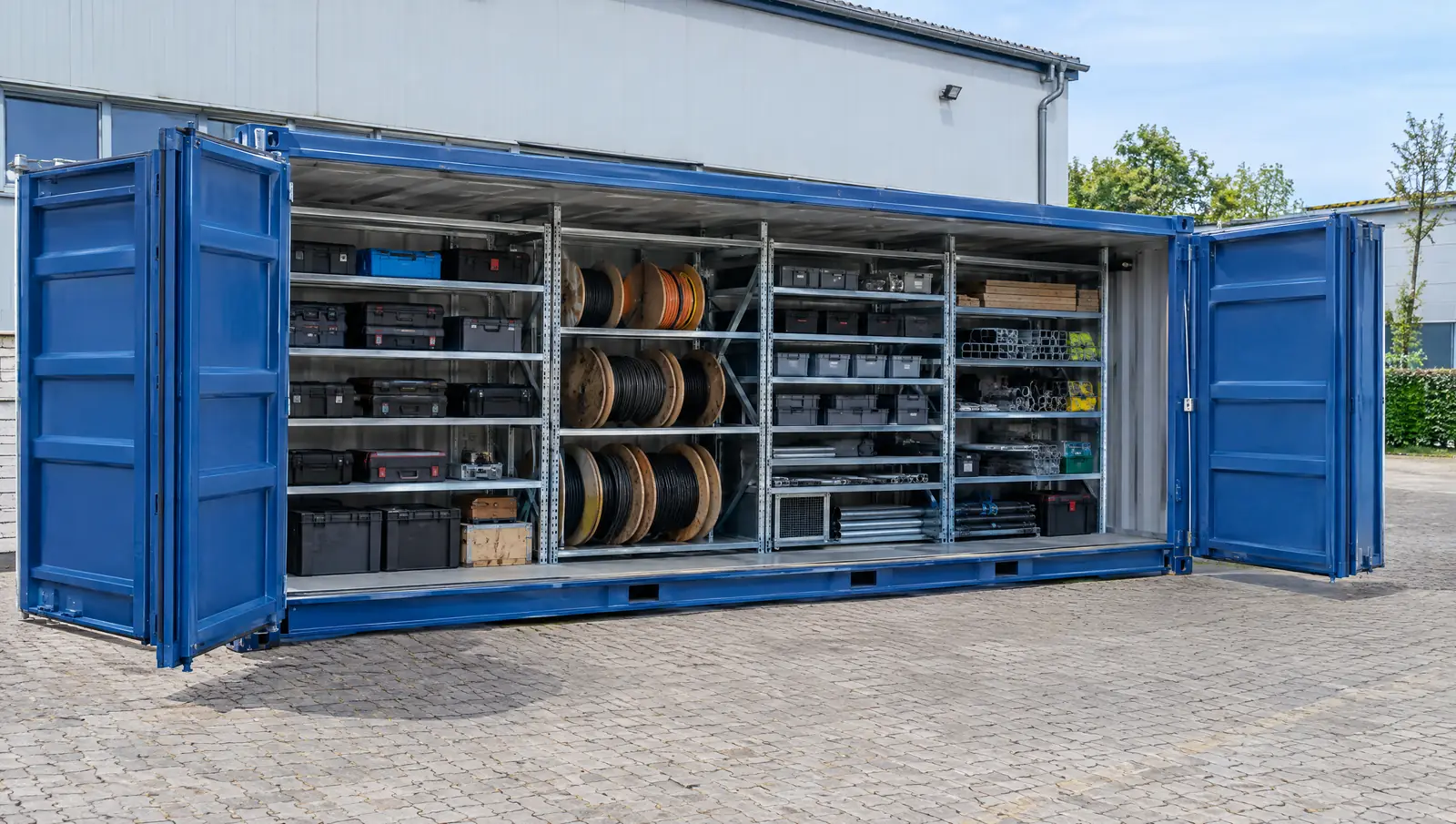
- Workshop with tall racking or an overhead rail
- Storage for bulky, light goods such as furniture, insulation or packaging
- Office and studio space with a suspended ceiling for services
- Sauna, music studio or hobby room with an acoustic ceiling
- Server or plant room with a raised floor
- Removal and overseas shipping when volume matters more than weight
Sizes and dimensions
| Size | External L × W × H | Internal approx. L × W × H | Door approx. W × H | Volume approx. |
|---|---|---|---|---|
| 20 ft HC | 6.058 × 2.438 × 2.896 m | 5.90 × 2.35 × 2.70 m | 2.34 × 2.58 m | 37 m³ |
| 40 ft HC | 12.192 × 2.438 × 2.896 m | 12.03 × 2.35 × 2.70 m | 2.34 × 2.58 m | 76 m³ |
| 45 ft HC | 13.716 × 2.438 × 2.896 m | 13.56 × 2.35 × 2.70 m | 2.34 × 2.58 m | 86 m³ |
External dimensions per ISO standard; internal dimensions, door opening and volume are approximate and vary by manufacturer and year.
✓ Advantages
- About 30 cm more internal height – habitable headroom after fit-out
- Around 13% more volume on the same footprint
- Widely available in 40 ft, both used and one-way
- Same corner castings and transport logistics as a standard container
! Points to consider
- On a standard chassis the load comes close to the permitted vehicle height
- Rarer and relatively dearer as a 20 ft unit
- Slightly higher tare weight, marginally lower payload
- Measure clearance under carports, gateways or trees beforehand
Equipment and options
- Standard end door with four locking bars, lockbox can be retrofitted
- Timber floor (usually plywood on steel cross members), forklift-rated
- Ventilation grilles at the top of the side walls
- Lashing rings on floor and roof rails
- Can be retrofitted: windows, personnel door, roller shutter, insulation, electrics
Price guide
- 40 ft HC used
- approx. €2,800 – 5,000
- 40 ft HC one-way
- approx. €5,000 – 7,500
- 20 ft HC one-way
- approx. €3,500 – 5,500
- Hire 40 ft HC
- approx. €110 – 220 / month
Rough orientation values without guarantee; prices vary by region, condition and market.
What to look out for
- Check the type code: a 5 in second position means high cube – a 42G1 is not a high cube despite being 40 ft.
- For conversion into a habitable room a high cube is practically essential; a standard container lacks headroom after insulation.
- Ask about the vehicle: on a standard chassis the total height can reach the permitted 4 metres.
- Check overhead clearance at the site: branches, power lines and canopies matter when setting down with a loader crane.
- For heavy materials a high cube brings little benefit – weight is the limit, not volume.
Frequently asked questions
How can I tell a high cube?
Most reliably from the type code next to the container number: a 5 in second position (for example 45G1) means high cube. Many high cubes also carry yellow-black hazard stripes along the top edges. Measuring works too: just under 2.90 instead of 2.59 metres externally.
Is the premium worth it for storage?
Only if you store light, bulky goods or want tall racking. For heavy materials such as tiles, stone or metal, payload rather than volume is the bottleneck – a standard container is enough.
How much headroom is left after conversion?
With an insulated floor, insulated ceiling and lining, experience shows about 2.35 to 2.45 metres of clear height, depending on insulation thickness. In a standard container it is often only around 2.05 to 2.15 metres.
Related guides
Planning with high cube containers?
Compare sizes, costs and buying vs. renting in our guides.