
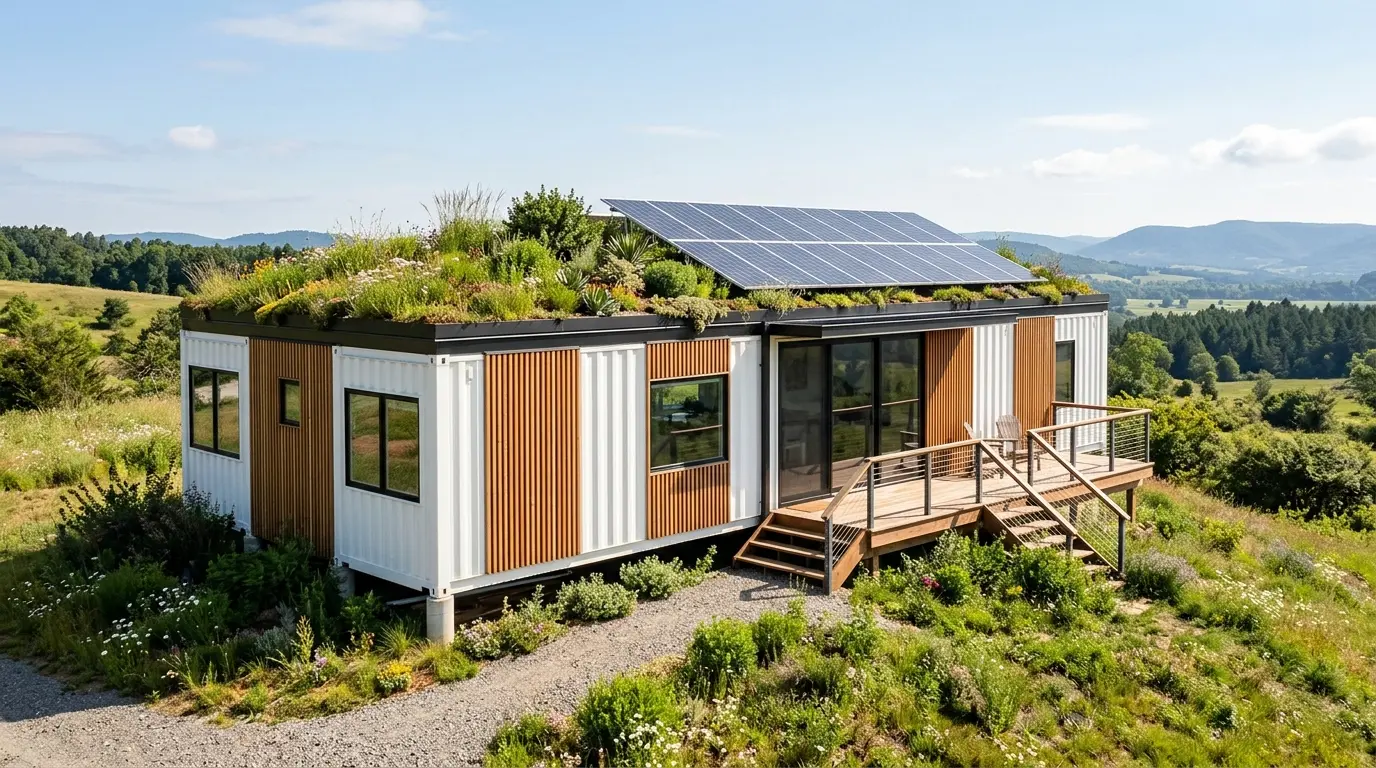
At first glance a container is an ideal platform for solar modules: flat roof, no dormers, no chimney, often free-standing. In practice its value depends on three questions that should be settled before any order: what is the electricity for, how are the modules fixed without damaging the shell, and who registers the installation? This guide answers them in turn and works through an example of when a system pays off. The legal notes refer to Germany.
Three approaches, three very different projects
“Solar on a container” means at least three different things:
| Plug-in solar device | Grid-connected roof system | Off-grid system with storage | |
|---|---|---|---|
| Idea | a few modules, inverter plugged into a socket | system feeds in via the service connection and covers own consumption | container without grid, battery supplies the loads |
| Prerequisite | existing power supply in the container | permanent grid connection | none |
| Typical size | inverter up to 800 VA, modules up to 2,000 Wp | a few kWp | depends on consumption, often 1 to 5 kWp plus storage |
| Installation | socket, registration in the Marktstammdatenregister | electrical contractor, registration with the grid operator | professional design strongly advised |
| Makes sense for | office or workshop with daytime base load | larger use with high daytime consumption | sites without grid, garden office, building site |
| Winter gap | remains (savings are small) | remains, covered by the grid | central problem, see Off-grid living |
The choice follows the demand. For off-grid systems – storage size, winter gap, loads – the essentials are in Off-grid living in a container. This guide concentrates on what is the same for all three routes on the container roof: area, fixing, yield and law.
What the container roof can do – and what not
A standard container has a corrugated roof of thin steel. The load-bearing structure is the steel frame of corner posts plus bottom and top side rails; the corner castings are its nodes. The roof sheet itself is designed for the stresses of sea transport, not as a standing surface or a support for add-ons.
Three basic rules follow:
- Do not drill through the roof if it can be avoided. Every penetration is a possible leak and a starting point for rust because the paint is broken. Corten steel is not stainless; shipping containers are additionally painted, and drilling damages exactly that coating.
- Route loads into the frame, not the sheet. Constructions supported on rails or other load-bearing parts make more sense than solutions that load the sheet at single points. Which fixing a specific container tolerates is for the mounting-system manufacturer or a structural engineer to say.
- Do not simply climb on the roof. Installation and maintenance need fall protection and load-spreading supports; work at height is subject to occupational safety rules.
For rented containers there is a further point: drilling and add-ons are not permitted without the lessor’s consent. Anyone needing solar power is better off considering a free-standing frame next to the container or a rental model that expressly allows add-ons (see Renting a container).
How many modules fit on the roof?
The roof of a 20-foot container is about 6.06 × 2.44 m outside, roughly 14.8 m². A common roof module measures about 1.75 × 1.13 m (around 2 m²) and delivers roughly 400 to 450 Wp in current models. For orientation:
| Container | Module layout (assumption: module 1.75 × 1.13 m) | Modules | Output at 400 Wp each |
|---|---|---|---|
| 20 ft | portrait in two rows lengthways (3 × 2) | 6 | approx. 2.4 kWp |
| 40 ft | portrait in two rows lengthways (6 × 2) | 12 | approx. 4.8 kWp |
The figures are an upper bound: edges, gaps between modules, vents, roof fittings and a tilted mounting frame reduce the usable area. With a single row tilted, mutual shading is small; several rows behind each other shade one another and need spacing.
Two orientation questions:
- Aligning the container: The long axis determines where flat-mounted modules face. East-west, a flat module produces power spread across the day; facing south it produces more at midday.
- Shading: Trees, neighbouring buildings or a second container quickly shade half the area. Even partly shaded module strings lose disproportionate output unless optimisers or micro-inverters are used.
Wind, weight, stability
Modules are light (roughly 20 to 25 kg each); six with mounting material weigh far less than the container’s empty weight of about 2,200 to 2,300 kg. Weight is rarely the problem. Wind is: tilted modules catch wind like a sail; suction and pressure create forces on the fixings and, for a container on point foundations or a gravel bed, overturning moments. Snow load adds to this, acting on modules and substructure (see Containers in winter). A serious mounting system requires a site-specific calculation of wind load, snow load and stability. Where the container does not stand on a load-bearing, anchored base, the foundation needs to be considered too.
Yield and economics: a worked example
Assumptions: 2.4 kWp (six modules on a 20-foot container), annual yield about 900 kWh per kWp (in Germany values range roughly from 800 to 1,000 depending on region, tilt and orientation), electricity price €0.30/kWh, feed-in payment for surplus ignored for simplicity.
- Annual yield: 2.4 kWp × 900 kWh/kWp = approx. 2,160 kWh
- What matters is the self-consumption share: how much of the solar power is actually used in the container at the same time?
- Investment (guide value, without storage): roughly €1,000 to €1,800 per kWp, so about €2,400 to €4,300 for 2.4 kWp. Prices vary widely with mounting system, electrical work and supplier.
| Self-consumption share | Energy used | Saving per year | Payback at €3,000 investment |
|---|---|---|---|
| 30 % (container mostly empty) | approx. 650 kWh | approx. €194 | approx. 15 years |
| 50 % (office/workshop occasionally) | approx. 1,080 kWh | approx. €324 | approx. 9 years |
| 70 % (daytime use with base load) | approx. 1,510 kWh | approx. €454 | approx. 7 years |
The calculation shows: self-consumption decides, not the number of modules. A storage container that uses hardly any power will not pay back a large system. An office or workshop container with daytime base load (computer, lighting, air conditioner, tools) is more likely to. Storage raises self-consumption but makes the system more expensive; whether it pays depends on the consumption profile. Not included are maintenance, inverter replacement after some years and the decline in module output over time.
Plug-in solar as the small variant: Two modules totalling about 800 Wp produce around 720 kWh a year under the same assumptions. If a base load runs in the container during the day (router, fridge, lighting, laptop), part of it is covered; surplus fed into the grid is generally not paid for. Because the devices are easier to fit, the effort stays manageable – but the saving is correspondingly small.
The winter gap: In Germany a system delivers only a fraction of a summer month in December and January. For heated containers, solar power is therefore scarce exactly when it would be needed most. This applies to all three routes in the overview.
Law and registration
The following points reflect the position when this article was written; rules change, so check the current situation before acting.
- Plug-in solar devices: Under the rules in force since 2024 they may be operated up to an inverter output of 800 VA and a module output of 2,000 Wp. Registration is simplified, in the Bundesnetzagentur’s Marktstammdatenregister (core energy market data register); a separate registration with the grid operator is not required. The existing meter must be suitable (backstop or bidirectional meter) – if in doubt ask the grid operator.
- Grid-connected systems: Installation and commissioning belong in the hands of an electrical contractor. Registration with the grid operator and in the Marktstammdatenregister is mandatory.
- Building law: Whether a solar installation on a container is exempt from permits depends on state law and on whether the container itself stands with or without permission. For the container itself it depends on location, duration and use – see Building permit for containers.
- Energy law: For residential use, solar power also plays a role under the Building Energy Act, see Containers and energy law (GEG).
- Tax: Simplifications exist for small systems in VAT and income tax. The exact treatment depends on use and contractual situation – clarify with a tax adviser if in doubt; basics on depreciation of the container itself are in Tax and depreciation.
- Insurance: Modules and inverter should be reported to the insurer; storm, hail and theft damage are covered differently depending on the policy, see Insuring a container.
Safety: electrics, earthing, fire protection
A container is a steel body. It is electrically conductive, and modules, frames and cables must be integrated into a protection and earthing concept – the electrician determines this, as well as surge protection and cable routing. DC cables on the roof are live in sunlight even when the inverter is off; they must not chafe and must be routed weather- and UV-resistant. For firefighting, the fire service wants clarity on where isolation points are. For fusing and earthing of the container in general: Power supply for a container; for fire-protection requirements when people use the container: Fire protection in containers.
Decision aid before buying
- Measure or estimate daytime consumption: without meaningful daytime load, a system does not pay.
- Clarify ownership and tenancy: may the container be drilled or built onto?
- Check the site: shading, orientation, wind and snow load zone.
- Prefer fixing without roof penetration; ask for the manufacturer’s approval.
- Compare offers: have output in kWp, inverter, mounting, electrical work, registration and warranty itemised.
- Clarify registration and meter before installation.
- Inform the insurer.
Common misconceptions
- “Just screw it to the roof.” Drilling breaks the coating and can lead to leaks and rust.
- “More is better.” Without daytime consumption, payback time rises quickly.
- “Solar makes the container self-sufficient.” Not in winter; see Off-grid living.
- “The system needs no registration.” Even small systems must be registered.
Important note
This guide does not replace professional, legal or tax advice. Electrical installation, structural design of the fixing and registration should be checked by specialist firms. Cost and yield figures are guide values without guarantee; they depend on location, orientation and supplier. Legal bases include the federal Renewable Energy Sources Act (EEG) and the state building codes (Landesbauordnungen).
Conclusion
Solar on a container works when three things come together: daytime consumption that absorbs the power, a fixing that does not damage the shell, and proper registration. Clarifying these before ordering avoids the most common disappointments – unused overcapacity, a perforated roof or a system that was never registered.