
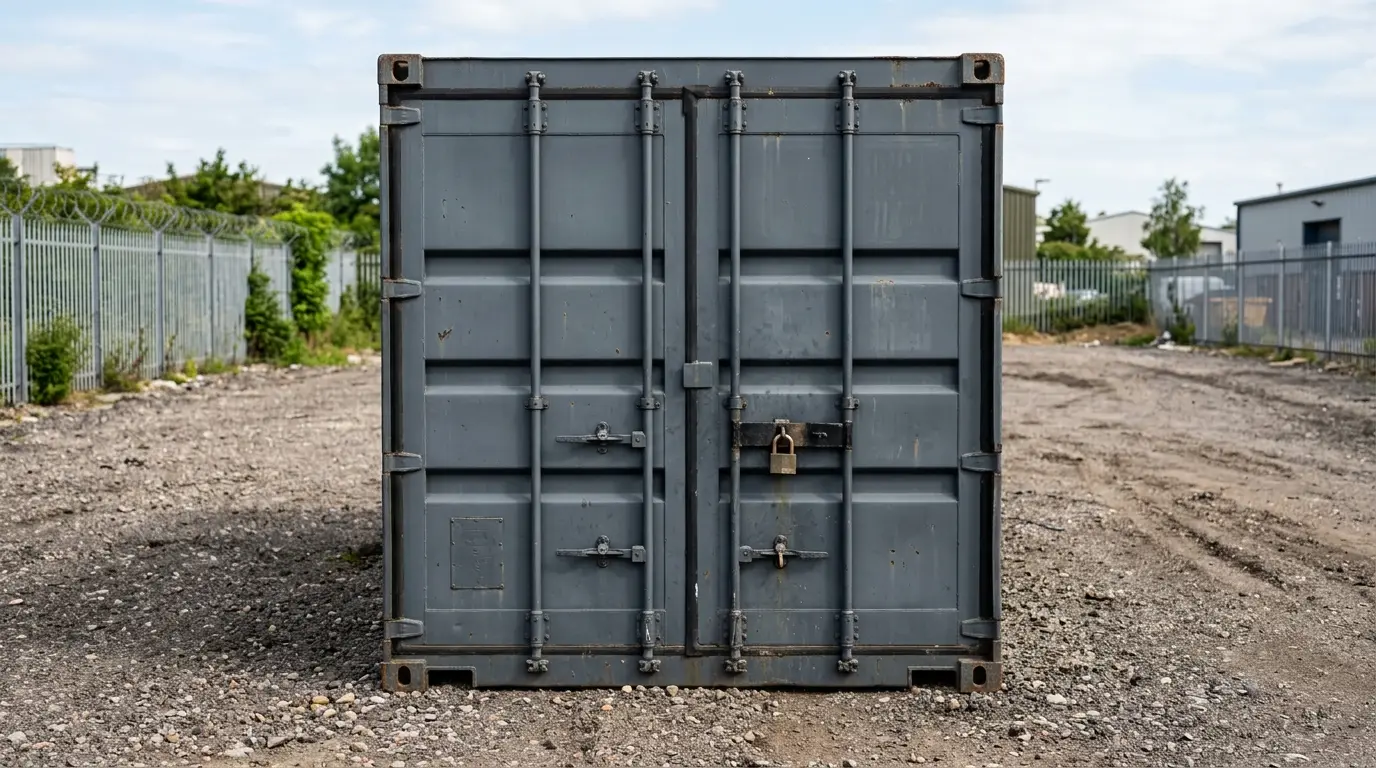
A storage container is essentially a steel box: watertight against rain, stable against wind, lockable against uninvited guests. That very robustness tempts people to treat it like a garage – open the door, throw things in, close the door. Yet most damage to stored goods is not caused by break-ins or storms, but by moisture that originates inside. Anyone who understands the physics and follows a handful of basic rules can store goods damage-free for years.
What stores well – and what does not
Not every item tolerates the conditions inside an unheated steel container. The decisive factors are temperature swings, humidity and whether the material reacts badly to condensation.
| Suitability | Examples | Note |
|---|---|---|
| Well suited | Garden furniture, building materials, tyres, tools, metal parts, plastics, bicycles, exhibition kit, shelving | Oil or preserve bare metal first; never store anything wet |
| Suitable with conditions | Electronics, files and paper, upholstered and wooden furniture, textiles, instruments, artwork | Only with moisture protection: desiccants, pallets, protective wrapping, ideally an insulated container |
| Only with special equipment | Food, beverages, plants, medicines, paints and varnishes | Refrigerated or temperature-controlled container required; observe frost limits and hygiene rules |
| Unsuitable | Hazardous goods without approval, pressurised gas cylinders, fuels, ammunition, animals, perishables in a standard container | Hazardous storage requires certified special containers with a spill sump and formal approval |
The line between “conditional” and “unsuitable” is not a question of the container but of the fit-out. Files can be stored in a container for years without issue – on pallets, in closed archive boxes and with working ventilation. Cartons stacked directly on the wooden floor, by contrast, draw up moisture and buckle within a single winter.
Understanding condensation: the “container rain” effect
Warm air holds more water than cold air. When the air inside the container cools overnight, it eventually falls below the dew point – and the water condenses on the coldest surface. In a steel container that is almost always the underside of the roof. When it drips from there onto the goods, people call it container rain or container sweat. From the outside the box is perfectly tight; the water was inside all along.
Rule of thumb: every gram of moisture you load in stays in the container. Dry goods, dry packaging and dry air during loading are the most effective protection there is.
Four measures reliably help:
- Ventilation. Factory-fitted vents are enough for insensitive goods. For sensitive cargo, additional vent grilles pay off, ideally offset diagonally (low on one side, high on the opposite side) so a cross-flow develops.
- Desiccants. Hanging calcium-chloride desiccant bags bind several litres of water depending on size. They are consumables and must be checked and replaced.
- Insulation. An insulated ceiling – mineral wool, PU panels or a sprayed-on layer – raises the surface temperature and stops the roof becoming the condensation surface. This is the most durable solution.
- Load dry. No damp pallets, no freshly washed textiles, no wet garden furniture. Wooden pallets in particular carry a surprising amount of bound water.
For especially sensitive goods a small dehumidifier with a power supply can make sense – but with a drain hose leading outside, otherwise the water simply stays in the container.
Ground and siting
An empty 20-foot container weighs around 2.2 tonnes and, when loaded, easily ten times that. Almost all of the load rests on the four corner castings – as point loads, not spread across the floor.
- Load-bearing and level. Compacted gravel, concrete slabs or strip footings under the corners. Soft lawn or freshly filled ground leads to settlement.
- Align horizontally. A twisted container has jamming doors. A slight rearward tilt (one to two centimetres) helps carry rainwater away from the door end.
- Air beneath the floor. Timber beams or concrete slabs create ten to fifteen centimetres of clearance to the ground. This keeps standing moisture away and protects the base frame from rust.
- Keep the door side clear. Allow two to three metres of free space in front of the doors – the leaves swing wide. Orient the door end away from the prevailing weather where possible.
- Distance from vegetation. Leaves and branches on the roof trap moisture and accelerate corrosion.
Sensible fit-out
An empty container is just a volume. Only the fit-out turns it into usable storage.
| Item | Benefit | Approximate cost |
|---|---|---|
| Heavy-duty shelving along the long walls | Uses the height, keeps goods off the floor | approx. €150–500 per bay |
| Additional vent grilles | Cross-ventilation, less condensation | approx. €60–200 per pair incl. fitting |
| Ceiling insulation | Most effective protection against container rain | approx. €800–2,500 per 20-foot unit |
| LED lighting strip | Safe working, no trip hazard | approx. €100–400 incl. wiring |
| Mezzanine deck | Two levels for lightweight goods | approx. €400–1,200 |
| Floor protection (OSB, rubber mat) | Protects the timber floor from oil and point loads | approx. €100–300 |
All figures are rough guide values and vary by region, supplier and specification. Obtain concrete quotes for your own project.
Order and access
The most common day-to-day annoyance is not damage but searching. A well-planned layout saves more time in the long run than any accessory.
- Keep a central aisle. Shelving against the long walls, at least 70 centimetres of walkway – otherwise you have to unload everything to reach the back.
- Heavy loads low and over the rails. Machines and metal belong on the floor, as close as possible to the long sides where the frame carries the load.
- ABC principle. Frequently needed goods at the front, seasonal items at the back.
- Keep an inventory list. A simple table with a position reference (“bay B, shelf 3”) is enough. Photos taken during loading also help with insurance questions.
- Label cartons on the face pointing towards the aisle.
- Stack against tipping. No free stacks above two metres, never heavy crates on top.
Security in brief
Standard padlocks on container doors yield to bolt cutters in seconds. What works is a shrouded-shackle padlock combined with a welded lock box, backed up by locking bars and a visible, well-chosen location. More detail can be found in the article securing a container.
Maintenance and inspection
A storage container is low-maintenance but not maintenance-free. An inspection round every three months is usually enough:
| Interval | Check |
|---|---|
| Monthly (sensitive goods) | Check desiccants, read the hygrometer |
| Quarterly | Roof for leaves and pooling water, seals, grease door hinges |
| Half-yearly | Sand down and touch up rust spots, check floor condition |
| Annually | Verify stability and alignment, reconcile inventory |
Treating small rust spots early takes minutes; a rusted-through roof section costs a repair – or the container.
Conclusion
A storage container is one of the cheapest and most flexible storage solutions available – provided you treat it as what it is: an unheated steel space with its own microclimate. Load dry goods, arrange cross-ventilation, insulate the ceiling for sensitive cargo, and site the box on load-bearing, slightly sloped ground with air underneath, and you have covered the decisive 90 percent. The rest is organisation: shelves instead of stacks, an aisle instead of cramming, an inventory list instead of memory. With one inspection round per quarter, the goods will still be in the condition you stored them in years later.