
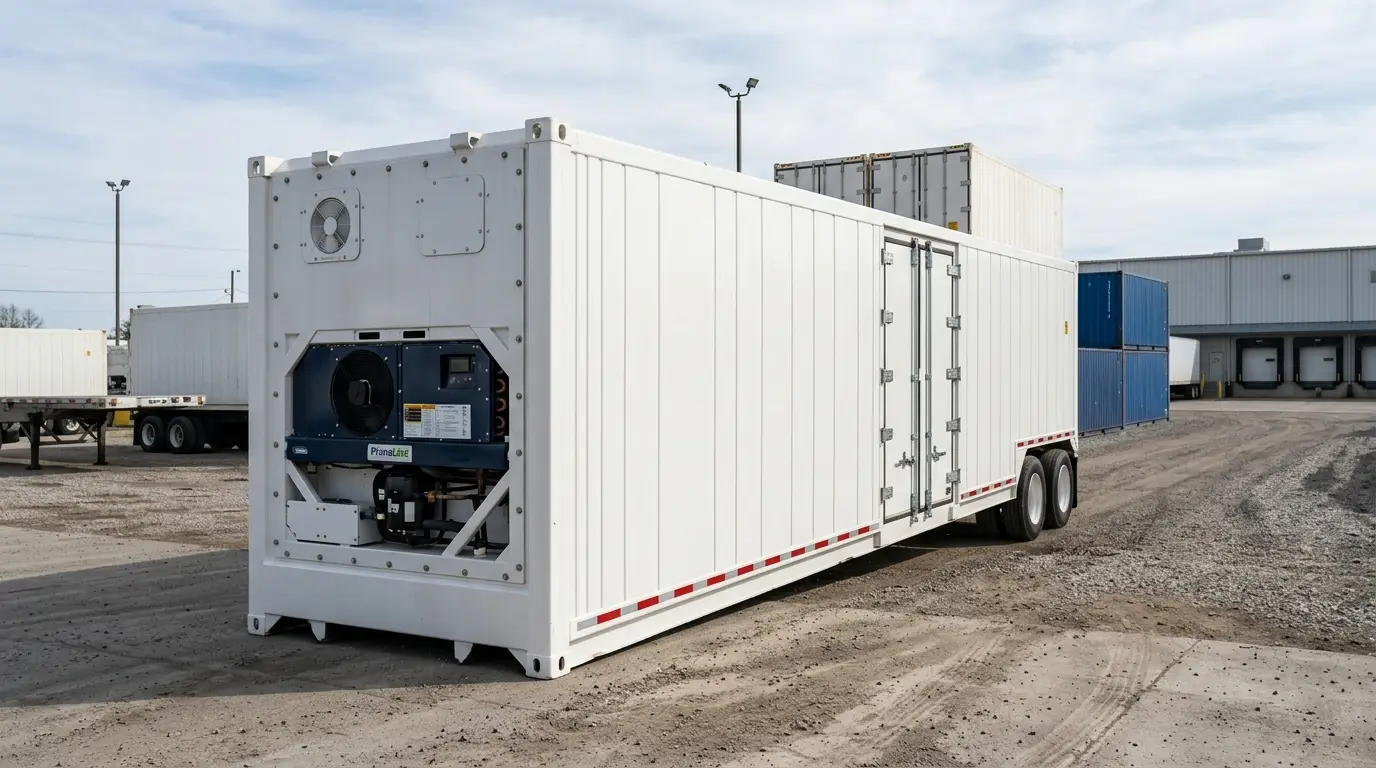
The guide to reefer containers explains technology, sizes and connection. This article deals with the question that follows after acquisition: what does ongoing operation cost, what does it depend on and how can it be reduced? All figures are guide values; the data sheet and your own measurements are what count. Electricity prices are in euros and relate to the German market.
What power consumption depends on
A reefer does not create cold from nothing; it has to move heat outwards. So what matters is how much heat gets in and how big the temperature difference is:
- Set temperature: the lower, the greater the effort. Frozen operation needs a multiple of chilled operation.
- Outside temperature and sun: in midsummer a unit works much harder than in spring.
- Insulation and door seals: old, damaged or iced-up seals let heat in.
- Door openings: each opening swaps cold air for warm, humid air; the moisture later freezes on the evaporator.
- Heat load of the goods: warm goods must be pulled down first; that is the most energy-intensive phase.
- Siting: cramped units draw in their own exhaust air and lose capacity.
From kWh to euros: the calculation
The formula is simple: daily consumption × days × electricity price = cost. Using the guide values from the reefer guide and a price of €0.30/kWh gives:
| Operating case | kWh per day (approx.) | Cost per month (30 days, approx.) |
|---|---|---|
| Chilled, moderate weather | 4–8 | €36–72 |
| Chilled, midsummer | 8–20 | €72–180 |
| Frozen, moderate weather | 15–30 | €135–270 |
| Frozen, midsummer | 30–60 | €270–540 |
Note: approximate ranges for orientation, without guarantee. Your tariff, your unit and your location may differ considerably. Recalculate with your actual price per kWh.
The range is deliberately wide. It shows that between a shaded spot in spring and a sunny yard in midsummer, frozen operation can easily differ by a factor of two.
Worked example: farm shop with chilled storage
Suppose a farm shop runs a 20-foot reefer for dairy products and vegetables at +2 to +8 °C all year. Assumptions (freely chosen, for illustration):
- 7 months (30 days each) of moderate weather: 6 kWh/day
- 5 months (30 days each) of hot weather: 14 kWh/day
- Electricity price €0.30/kWh
Calculation: 7 × 30 × 6 = 1,260 kWh plus 5 × 30 × 14 = 2,100 kWh, together 3,360 kWh per year. At €0.30/kWh that is approx. €1,008; at €0.40/kWh it would be approx. €1,344. That averages about €84 per month (at €0.30).
For comparison: the reefer guide gives approx. €250–600 per month for a rented 20-foot unit. Even adding €84 of electricity per month, total running costs come to roughly €330–680 a month – here electricity is the smaller item; with frozen operation and ownership it can become the largest.
The biggest levers for saving
- Choose the site: shade or a sun canopy reduces the load. Leave enough space around the unit (rule of thumb about one metre).
- Door discipline: remove goods in batches, never leave the door open. A strip curtain can reduce heat ingress where access is frequent.
- Load pre-chilled goods: the container holds temperature; it is not a blast chiller.
- Set temperature no lower than needed: every degree costs energy; the target comes from your supplier and hygiene rules, not from gut feeling.
- Keep the condenser clean: dirty fins are the most common cause of extra consumption.
- Check seals and fasteners: ice on the doors is a warning sign.
- Source power smartly: a sub-meter makes consumption visible; own power from photovoltaics can cover part if generation and cooling demand coincide – cooling demand peaks in summer, which fits well.
Measure before and after a change to see whether it works. A simple intermediate meter is enough.
Protection: when the power fails
Chilled goods are quickly worthless if cooling fails. So plan for:
- Alarms for power loss and temperature excursions, ideally with a notification to a mobile phone.
- Emergency power option: a prepared connection point for a generator; ask the manufacturer about power demand beforehand.
- Emergency plan: where can the goods be moved, who decides, who holds keys?
- Temperature log: for food, part of your own-check system. Records also help with the insurer, see insuring a container.
Also check whether business-interruption or goods insurance covers chilled stock in a power failure – an often-overlooked point.
Connection and siting: what to clarify first
The electrical connection must match the unit. Many units use three-phase power; the supply line must be adequately protected and installed professionally, see power supply for containers. Operation can create noise, especially at night; near residential neighbours check noise protection and the location. Whether permits are needed to place a container on your land depends on location, duration and use, see containers and building permits.
Rent, buy or alternative?
If you only bridge a season or an event, renting is usually cheaper because maintenance and fault service are normally included (buying & renting: rental). If you cool all year, compare total costs over several years including electricity. A fixed cold room can be an alternative for continuous operation but has a longer lead time; for mobile or temporary solutions the container remains superior. An application example is in containers for events and catering. For an overview of the type itself, see the reefer container page.
Typical calculation mistakes
- Comparing only the rental price: with frozen storage, electricity can outweigh the price difference between two offers.
- Using the average value: summer and pull-down phases lift the annual total.
- No reserve for maintenance: annual costs arise even when you own the unit.
- Electricity price set too low: commercial and private tariffs differ; calculate with your contract.
Important note
This article is general orientation. Electricity, food-hygiene and emissions requirements follow German federal and state law and your local authority; it is no substitute for professional or legal advice.
Conclusion
In continuous operation, temperature, siting and door discipline decide the electricity bill. Calculate with your own price and both seasons, measure afterwards and protect the goods against failure. Only then does it become clear whether renting or buying is the better fit.