
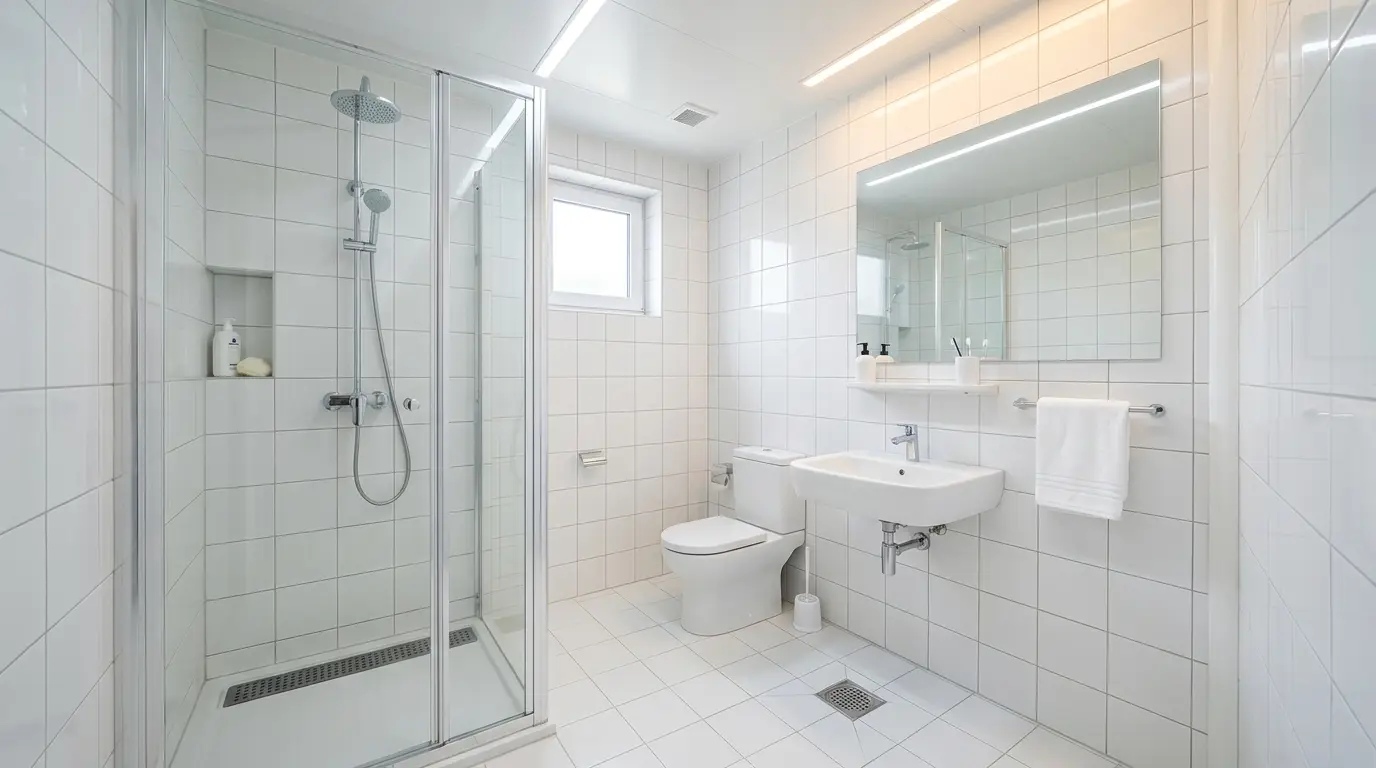
A container with a kitchen, shower or toilet needs more than just power: it needs a solution for fresh water and for what is left afterwards. Unlike electricity, where an extension lead will do in a pinch, water cannot simply be “extended” – at least not the wastewater. This guide sets out the common options, from a simple self-sufficient tank to a fixed mains connection, and covers what matters for frost protection.
Note on German law: this guide describes the German legal framework (water law, connection obligations). Read it as background, not as advice for your specific jurisdiction.
Three basic situations
| Situation | Water supply | Wastewater |
|---|---|---|
| Short-term, no connection (construction site, event) | Jerrycans, IBC tank, portable toilet | Chemical toilet, collection tank, removal by a service provider |
| Permanent, but off the grid | Own well or tank with regular refilling | Sealed cesspit or small treatment plant |
| Permanent, serviced plot | Fixed connection to the public mains | Connection to the public sewer |
Which option fits depends – much as with a power connection – mainly on how long the container will stay and where it stands. For the parallel topic of electricity, see Power connection for a container.
Drinking water: the fixed mains connection
On a serviced plot, the container is connected to the local drinking water network like any building. The local water utility is responsible; it sets out how the connection is built, checks the pipework and fits a water meter. The actual installation – running pipes to and inside the container, connecting fittings – belongs in the hands of a licensed plumbing contractor, since drinking water installations follow their own technical rules, among them protection against contaminated water flowing back into the public network.
Where a connection already exists on the plot, scope and cost stay modest. Where a new pipe has to be run from the nearest distribution point, cost rises quickly with distance.
Drinking water without a mains connection
Without a mains connection, supply relies on a fresh water tank. Common choices are IBC totes (around 1,000 litres) or larger plastic tanks, refilled by tanker or jerrycan. A pump with a pressure switch provides the line pressure needed for taps and a shower. For water quality: use only food-grade tanks and hoses, clean the tank regularly, and do not treat stored water as a permanent drinking supply over long periods unless proper quality assurance is in place. For non-potable use only (toilet flushing, garden watering), these requirements are correspondingly lower.
Tank sizing depends on actual demand. As a rough benchmark, average drinking water consumption in Germany runs around 120 to 130 litres per person per day for all purposes – a container fitted out sparingly (camping-style fittings, deliberate use) often sits well below that. Anyone living off-grid without a mains connection should adjust this figure to their own situation rather than applying it unchecked.
Wastewater: sewer connection, small treatment plant or sealed cesspit
For wastewater, one distinction is often underestimated: it is not enough to let water drain away somewhere. In Germany, wastewater falls under water law, governed by the federal Water Resources Act (Wasserhaushaltsgesetz) and the state water acts, and enforced by the local water authority at district level – independent of any planning permission for the container itself. Three routes are common:
- Connection to the public sewer. The standard case on a serviced plot; the municipality or wastewater association sets the connection obligation and technical requirements.
- Small treatment plant (Kleinkläranlage). Treats wastewater biologically on site and discharges it, treated, into a watercourse or the ground; needs a water-law permit and regular servicing by a specialist contractor.
- Sealed cesspit (abflusslose Sammelgrube). Stores wastewater untreated and must be emptied at intervals by a licensed contractor; the simplest option, but the most expensive over time, since every collection run costs money.
Which option is permitted is decided by the local water authority – not by whoever sets up the container. For any permanent use with a toilet or shower, the wastewater question should be settled before purchase, much like planning permission. For more on the permission question in general, see Container planning permission.
For short-term or mobile use without a sewer connection, a dry composting toilet or chemical toilet is often the more practical solution than a cesspit. A dry toilet produces no liquid black water at all; a chemical toilet produces only small amounts in its waste tank, which is emptied at approved disposal points or by a service provider.
Grey water and black water
Not all wastewater is treated the same way:
- Grey water – water from showers, basins and the kitchen sink, without faecal matter. Less heavily loaded, and in some setups (for example garden irrigation after pre-treatment) easier to reuse.
- Black water – wastewater containing faecal matter, i.e. from the toilet. Subject to stricter requirements for collection and disposal.
For a sealed cesspit, it is worth considering whether to collect grey and black water separately – this can noticeably affect emptying intervals and cost, but must be agreed with the responsible authority first.
Frost protection: keeping pipework safe through winter
Water-carrying pipes in or on a container are especially vulnerable in winter, because the thin steel shell conducts cold through quickly. Freezing water expands and reliably bursts pipes and fittings.
- Route pipework inside the insulated envelope, not in cold perimeter zones or uninsulated penetrations.
- Buried supply pipes must sit below the frost line; the required depth depends on the region and should be checked with the local water utility or a groundworks contractor.
- Pipe trace heating (an electric heating cable) adds protection to exposed sections, for example the supply run into the container.
- Shut off and fully drain outdoor taps and hose connections before the first frost.
- For tanks kept outdoors: site or insulate the tank against frost, and place the pump inside the heated envelope wherever possible.
- If the container is not used over winter, drain the whole system rather than simply switching it off – that is the most reliable protection.
For how to avoid condensation and thermal bridges on the steel shell more generally, see Thermal bridges in a container.
Hot water: instantaneous heater or storage tank
Two basic approaches exist for hot water. An electric instantaneous water heater heats water only as it is drawn, and needs a lot of electrical power for a short burst to do so – often 18 to 21 kW, which practically always requires a three-phase power connection (see Power connection for a container). A storage water heater (cylinder) heats a volume of water slowly and keeps it ready; it needs a much lower connected load, but takes up space and, following accepted technical practice, generally needs a storage temperature of at least around 60°C to guard against Legionella growth in standing hot water.
For a container in occasional use (workshop, office), a small instantaneous heater (about 3.5–6.5 kW, single-phase) or a small under-sink storage heater is often enough – sufficient for a hand basin, not for a shower. For permanent living with a shower, it is worth checking the available electrical supply before deciding.
Costs at a glance
The following figures are rough guide ranges only, without guarantee – actual costs depend heavily on region, distance to the nearest connection point and local fees.
| Item | Cost range approx. |
|---|---|
| IBC tote (approx. 1,000 l) incl. pump | €150–500 |
| Fresh water fixed connection (existing supply on plot) | €500–2,000 |
| New drinking water pipe run (distance-dependent) | from approx. €30–80/m plus connection fee |
| Wastewater connection to an existing sewer | €500–2,500 |
| Small treatment plant (purchase and installation) | €5,000–15,000 |
| Sealed cesspit (installation, size-dependent) | €2,000–8,000 |
| Cesspit emptying (per collection) | €100–300 |
| Small instantaneous heater / boiler | €100–400 |
Common mistakes
- Leaving the wastewater question until after the container is set up. Without a settled sewer connection or an approved cesspit, use can be prohibited and retrofit costs follow.
- Outdoor pipework not laid frost-free. A single hard frost is enough to destroy pipes and fittings.
- Mixing grey and black water without involving the authority. Can needlessly complicate the permitted disposal route and its cost.
- Planning an instantaneous heater without sizing the power connection for it. The peak load often exceeds the existing supply.
- Treating a drinking water tank as a permanent solution without cleaning it or checking water quality over longer periods.
Important note
This article is not a substitute for water-law or plumbing-engineering advice. Whether a fixed connection, a small treatment plant or a sealed cesspit is permitted is decided case by case by the responsible local water authority or the local water utility. Cost figures are guide values only, without guarantee.
Conclusion
For water and wastewater, how long the container stays in place decides the right solution: short-term, a tank or chemical toilet is enough; permanent use on a serviced plot leaves little alternative to a fixed connection. Where no sewer is available, the local water authority decides whether a small treatment plant or a sealed cesspit applies – settle that question before buying, not after. And anyone using or pausing the container over winter should route pipework reliably frost-free, or drain it in good time.