
Three situations, three standards
How carefully a container must be loaded depends on what happens to it afterwards.
| Situation | What the cargo has to withstand | What matters |
|---|---|---|
| Stationary store | nothing – the container does not move | access, floor protection, moisture, order |
| Transport on land (relocation, moving house) | braking, cornering, lifting by crane or hook lift | weight distribution, load securing, road weight |
| Sea freight | ship movements over weeks, repeated handling | all of the above plus weight verification |
Many mistakes happen because a container was loaded as a store and later moved after all – for example when relocating it on the plot or returning a hired container. Packing from the start as if the container might one day be transported saves repacking.
How much can go in? Payload and road weight
A container’s payload is higher than you will ever need in daily use:
| Container | Tare approx. | Payload approx. | Volume approx. |
|---|---|---|---|
| 10 ft | 1,300 kg | 8,000 kg | 16 m³ |
| 20 ft | 2,200–2,300 kg | 28,000 kg | 33 m³ |
| 40 ft | 3,700–3,800 kg | 26,500 kg | 67 m³ |
| 40 ft high cube | 3,900–4,000 kg | 26,500 kg | 76 m³ |
The values on the CSC plate on the door of the specific container are binding; see Reading the container number and CSC plate.
In practice the lorry, not the container, is usually the limit. In Germany the permitted gross weight of an articulated lorry is generally 40 tonnes. Deduct the tractor (roughly 7.5 t), the trailer (roughly 5 t) and the empty container, and only about 25 tonnes remain for the cargo of a 20 ft container on the road, about 24 tonnes for a 40 ft. For smaller vehicles such as lorries with a loader crane the limit is much lower.
More importantly: a loaded container often cannot be lifted by a lorry-mounted crane at all. If you intend to relocate the container later, agree the weight with the haulier beforehand – or empty it first. How containers are lifted safely is covered in Lifting a container properly.
Keep the centre of gravity in the middle
The key principle when loading: weight must be evenly distributed and as central as possible.
- Lengthwise: a widely used rule of thumb is 60/40 – no half of the container should hold more than about 60% of the cargo weight. If the centre of gravity is well off-centre, the container hangs at an angle when lifted and individual lorry axles are overloaded.
- Across: left and right as equal as possible. One-sided loading tips the container when craned and loads one side of the vehicle in transit.
- Vertically: heavy at the bottom, light at the top. A high centre of gravity makes transport and lifting unstable.
In practice: the heaviest items go in the middle of the container, directly on the floor. Fill towards the front and back with lighter goods.
Do not overload the floor
The container floor is usually plywood on steel cross members. It is very strong – under the standard it is tested with forklifts carrying several tonnes of axle load. Its weak spot is point loads: a heavy item on a small footprint.
| Cargo | Risk | Remedy |
|---|---|---|
| Machine on steel feet | Feet sink into the timber, cross members bend | Place timber or steel beams underneath crosswise to spread the load over several cross members |
| Heavy crates or stone on pallets | usually uncritical | Set pallets down with full contact |
| Forklift with narrow wheels inside the container | Axle load | Only use equipment whose axle load suits the floor; if in doubt, lay steel plates |
| Rolling loads (trolleys, drums) | Shifting, damage | Wedges, supports, firm lashing |
For single loads of several tonnes on a small area, ask the manufacturer or hire company what load spreading is needed.
Pallets: what fits?
| Container | Euro pallets (1.20 × 0.80 m) | Industrial pallets (1.20 × 1.00 m) |
|---|---|---|
| 20 ft | 11 in one layer | 10 in one layer |
| 40 ft | 24–25 in one layer | 21 in one layer |
| 20 ft pallet wide | 15 in one layer | – |
The internal width of about 2.35 m is not quite enough for two euro pallets side by side crosswise; in a standard container they are therefore mixed lengthwise and crosswise. The remaining gaps must be filled for transport.
The door opening is also a limit: at about 2.28 m (standard) or 2.58 m (high cube) it is a little lower than the interior. Measure tall goods and double-stacked pallets beforehand.
Securing the load
For transport on land the principle is: the cargo must be secured so that it does not shift under emergency braking, an evasive manoeuvre or lifting. As orientation for road transport, forces of about 80% of the cargo weight forwards and about 50% sideways and backwards are assumed. Under German road traffic rules, both driver and loader are responsible for a roadworthy load.
The main methods:
- Blocking: pack the cargo tightly against the walls and front end. This is the simplest and most effective securing.
- Fill gaps: close free spaces with pallets, timber, dunnage bags (inflatable air cushions) or filler. A gap of a few centimetres is enough for heavy goods to gather momentum.
- Top-over and direct lashing: attach straps to the lashing rings on the floor and side walls. Depending on the container, each lashing point holds in the order of about one tonne; use several points for heavy single items.
- Anti-slip mats: they increase friction between cargo and floor considerably and reduce the lashing needed.
- Secure the door end: cargo must not press against the doors. A locking bar or a final pallet wall prevents anything falling out when the doors are opened.
Sea freight: additional duties
If you ship a container yourself – for a move abroad, say – there is more to observe:
- Weight verification: since 2016 the international SOLAS convention requires a verified gross mass for every container before it goes on board. The shipper must determine and declare the weight.
- Stronger securing: at sea, alternating forces act in every direction for weeks. The international CTU Code is a recognised guideline for packing containers.
- Moisture protection: temperature changes cause condensation. Desiccants and tight packaging protect sensitive goods; more in Container ventilation.
- Dangerous goods: batteries, fuel, gas cylinders or paints are subject to their own rules and must not simply be loaded.
Arranging a stationary store sensibly
If the container is a permanent store, the focus is less on securing than on order and access:
- Leave a central aisle. Shelving along the long walls, an aisle in the middle – otherwise everything behind the first row is out of reach.
- Frequently used items at the front, seasonal goods at the back.
- Do not place goods directly against the walls, especially cardboard and textiles: condensation forms on the cold steel wall.
- Anchor heavy shelving so it does not topple when the container is moved or bumped.
- Protect the floor: pallets or gratings under moisture-sensitive goods.
- No hazardous substances without a concept: paints, solvents and fuels need spill sumps and ventilation; see Hazardous materials containers.
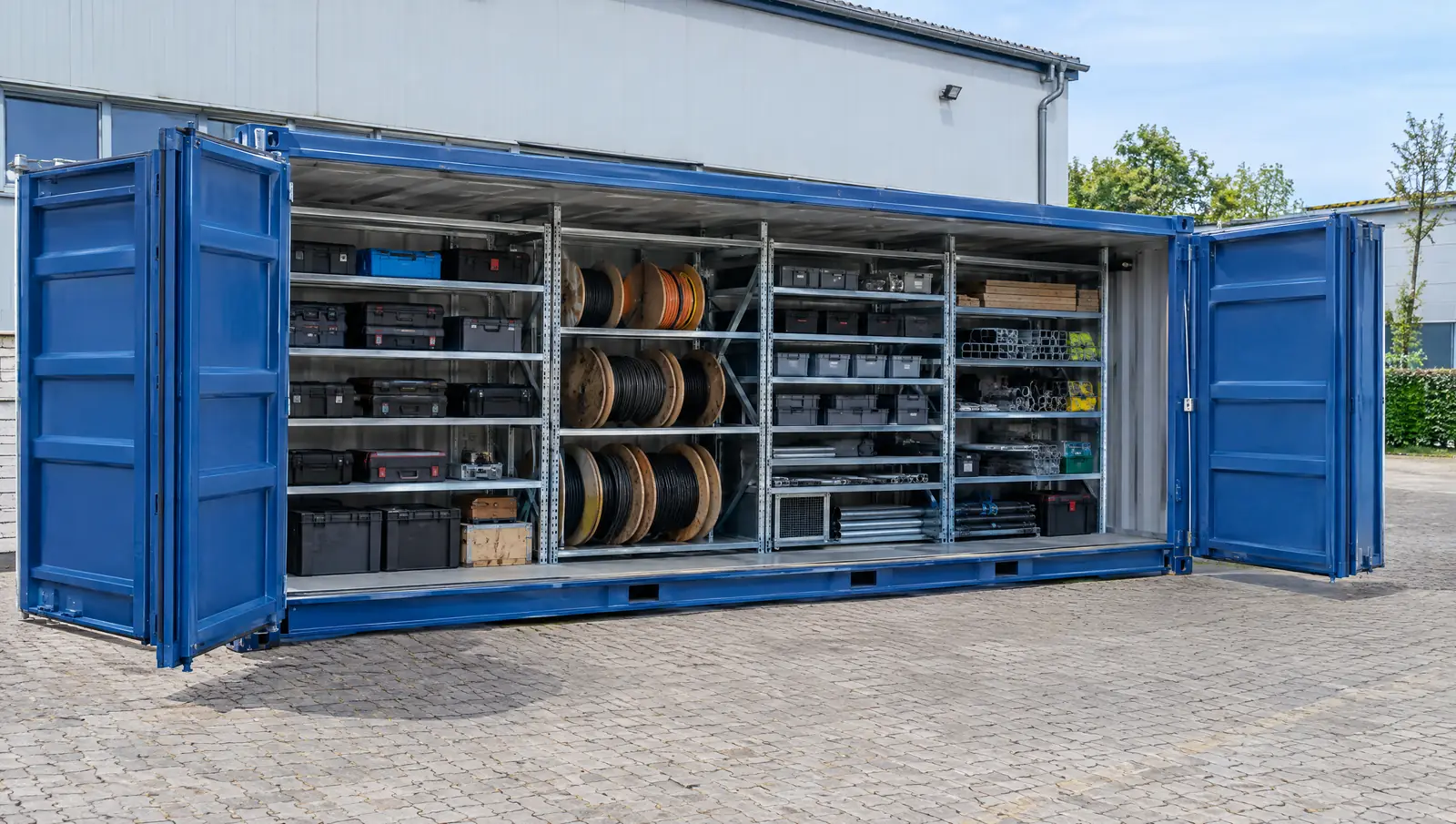
If you often need individual items, an open side container, whose entire long side opens, is the better choice.
Typical mistakes
| Mistake | Consequence |
|---|---|
| Heavy items packed against the end wall | Container hangs at an angle when craned, axle overload |
| More loaded than the lorry may carry | Transport fails or has to be re-planned at cost |
| Machine placed on the timber floor without supports | Dented floor, damaged cross members |
| Gaps not filled | Cargo shifts, damage to goods and walls |
| Cargo presses against the door | Door will not open or goods fall out |
| Damp goods stored | Mould and corrosion |
| Loaded container relocated without consultation | Crane too weak, container tips |
Checklist before closing the door
- Total weight estimated and matched against payload and transport vehicle
- Centre of gravity central, neither half noticeably heavier
- Heavy goods at the bottom, point loads spread
- Gaps filled or cargo lashed
- Nothing pressing against the doors
- Moisture, hazardous substances and fire loads considered
- For sea freight: weight determined and declared
Important note
This information is general orientation without guarantee. The values on the container’s CSC plate, the haulier’s requirements and the applicable load securing rules are binding. Special rules apply to sea freight and dangerous goods; take advice from your forwarder.
Conclusion
Loading properly means: weight in the middle and at the bottom, point loads spread, gaps closed and nothing against the doors. If you want to move the container later, keep an eye on the weight too – it is almost always the lorry or crane that sets the limit, not the container.
Further reading: Lifting a container properly, Using a storage container properly and Transporting a container.