
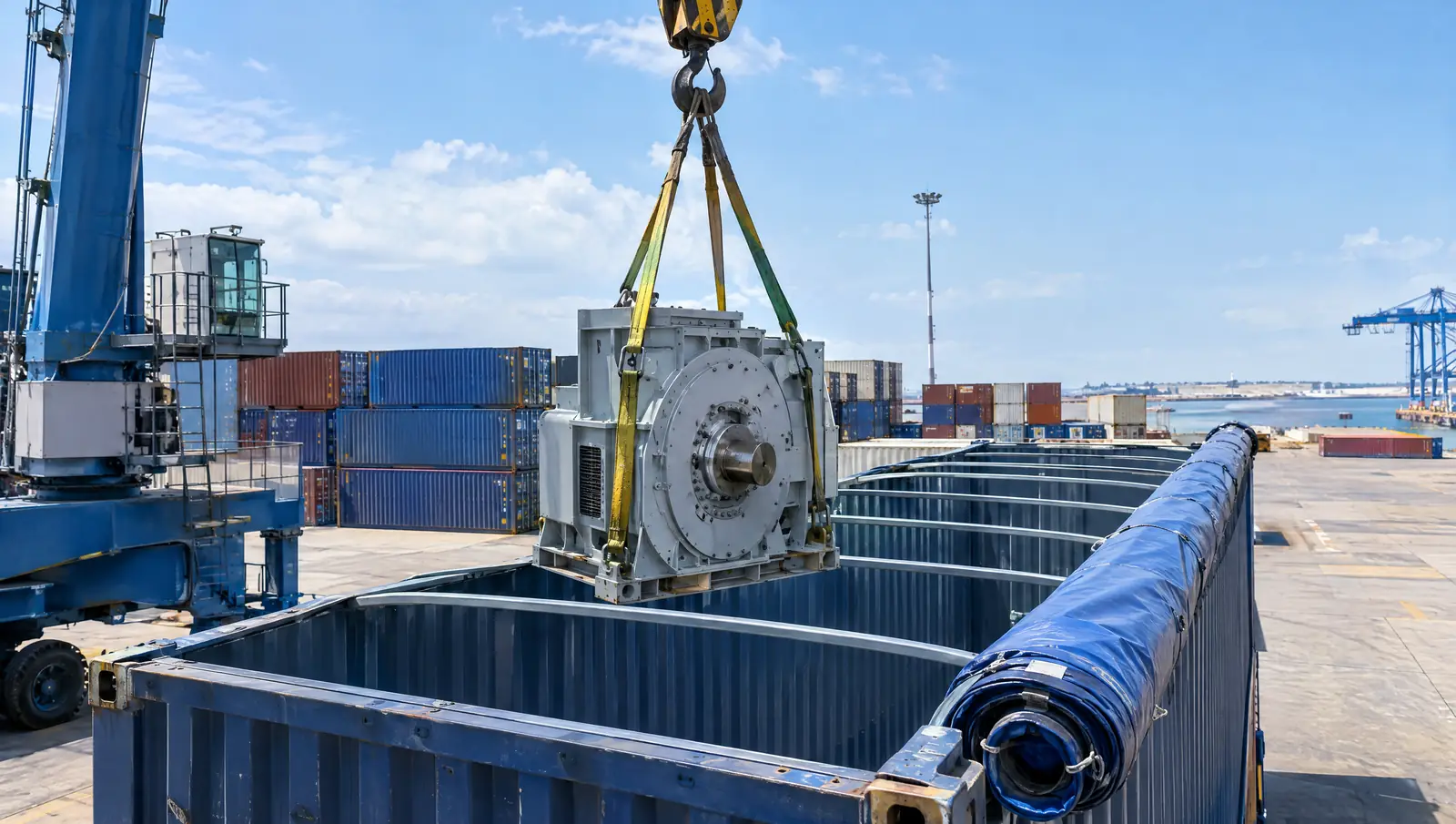
Why only the corner castings carry the load
A shipping container is built so that all forces during lifting, stacking and transport run through its eight corner castings and the corner posts. Walls, roof and doors are not designed for this. Lifting a container by its door, the locking bars, the roof edge or with a sling around the body will at best bend it – at worst something tears.
The corner castings have oval openings on top and on the sides. The lifting gear engages in these openings.
Four ways to lift a container
| Method | How | Suitable for | Who does it |
|---|---|---|---|
| Spreader from above | Frame with twistlocks engages vertically in the four top corner castings | empty and loaded containers | port, terminal, container depot |
| Slings on the top corners | Chain or wire rope sling with hooks or lifting lugs, angled to the crane hook | mainly empty containers | lorry with loader crane, mobile crane |
| Slings on the bottom corners | Sling on the bottom corner castings, spread at the top by a lifting beam | heavy or loaded containers where no spreader is available | mobile crane with specialist staff |
| Forklift | Forks in the forklift pockets in the base frame | 10 and 20 ft containers with forklift pockets, usually empty | depot, business yard |
For private and business customers, almost only two cases matter: the lorry with a loader crane that sets the container down on delivery, and occasionally a forklift on company premises.
The sling angle is decisive
When a container hangs from four angled legs, each leg pulls not only upwards but also inwards. The flatter the angle, the greater the force in the leg – and the more the top side rails are compressed.
| Leg angle to the horizontal | Force factor | Force per leg at 2,300 kg, spread evenly over 4 legs |
|---|---|---|
| 90° (vertical, as with a spreader) | 1.00 | approx. 575 kg |
| 60° | 1.15 | approx. 664 kg |
| 45° | 1.41 | approx. 813 kg |
| 30° | 2.00 | approx. 1,150 kg |
| 15° | 3.86 | approx. 2,222 kg |
Two consequences:
- Rig as steeply as possible. An angle of 60° or steeper is ideal; a container should not be lifted by its top corners at less than 45° to the horizontal. Long slings or a lifting beam help keep the angle steep.
- Do not rely on all legs. With four-leg slings, the legs almost never share the load equally in practice. When choosing the sling, calculation is therefore usually based on only three load-bearing legs – with unfavourable load distribution even only two.
Attaching hooks correctly
A common mistake is an incorrectly attached hook. If a hook is pushed into the side opening of a corner casting from the outside, it can slip out during lifting or put the load sideways onto the hook tip.
- Hook tip pointing from inside to outside: the hook is attached so its tip points away from the container.
- Better: container lifting lugs. Specially shaped lugs or twistlocks for corner castings sit positively and cannot slip out.
- Safety latch on the hook must be closed.
- Only use inspected lifting gear with a legible load rating – damaged chains or frayed ropes must be taken out of service.
What a loader crane can really do
A lorry loader crane’s capacity is given as a load moment in tonne-metres. Simplified: load moment divided by outreach gives the possible load. The further from the lorry the container is to be set down, the less the crane can lift.
| Crane (load moment) | 4 m outreach | 6 m | 8 m | 10 m |
|---|---|---|---|---|
| 20 tm | approx. 5.0 t | approx. 3.3 t | approx. 2.5 t | approx. 2.0 t |
| 30 tm | approx. 7.5 t | approx. 5.0 t | approx. 3.8 t | approx. 3.0 t |
| 40 tm | approx. 10.0 t | approx. 6.7 t | approx. 5.0 t | approx. 4.0 t |
These values are a simplified estimate; the load chart of the specific crane is always authoritative, and the weight of the lifting gear counts too.
What that means: an empty 20 ft container of around 2.3 tonnes can be set over a fence or hedge by a medium loader crane. A loaded container, or one to be placed far from the lorry, quickly exceeds the capacity. So always give the haulier the actual weight and the distance from the roadside to the site. How to keep the weight under control when loading is covered in Loading a container properly.
Lifting with a forklift
Many 10 and 20 ft containers have forklift pockets in the base frame. The rules:
- Only via the pockets. Never drive the forks under the floor or under the side rails.
- Insert the forks fully. They must pass right through the pockets, otherwise the load rests on the fork tips.
- Observe the marking. Many forklift pockets are rated only for the empty container. 40 ft containers generally have no forklift pockets.
- Check the forklift’s capacity at the load centre distance – a container is wide, its centre of gravity lies far in front of the mast.
Room and office containers
Insulated room containers are built differently from shipping containers but are likewise lifted by their corner castings or special lifting eyes. The manufacturer’s requirements apply here, for example on minimum angle or use of a lifting beam. Because the fit-out, windows and lining are sensitive, a wrongly rigged room container distorts more easily than a shipping container: doors jam, windows crack. Coupled modules in a complex are separated before lifting.
Safety when lifting
- Never step under a suspended load – not even “just briefly” to align it.
- Use tag lines. The container is guided with ropes from a safe distance, not by hand.
- Trial lift: first raise the container only a few centimetres and check that it hangs level. If it hangs at an angle, the centre of gravity is off – set it down and re-rig.
- Mind the wind. A container has a large side area and turns quickly in wind. The crane operator decides, according to the manufacturer’s limits, whether lifting may continue.
- Distance from overhead lines. As orientation, minimum distances apply for work near overhead lines that increase with voltage – from around one metre for low voltage to several metres for high voltage. If it is unclear what voltage a line carries, the network operator must be asked.
- Crane footing. The outriggers need load-bearing ground; on soft ground, spreader pads are used.
- Qualification. Crane operators and slingers must be instructed and competent. The German statutory accident insurers’ rules on operating lifting accessories provide the framework.
Typical mistakes
| Mistake | Consequence |
|---|---|
| Rigged on door, locking bars or roof | Deformation, container tears out |
| Sling angle too flat | High leg forces, compressed side rails |
| Hook attached from the outside | Hook slips out, container falls |
| Loaded container lifted with too small a loader crane | Crane overloaded or tips |
| Centre of gravity not central | Container hangs at an angle, swings |
| Forklift used without forklift pockets | Damaged floor, unstable load |
| Standing under the load | Danger to life |
Important note
This article conveys basics and does not replace instruction. Lifting by crane and forklift is a job for competent specialist staff. The requirements of the crane and container manufacturer, the rated capacities of the lifting gear and the applicable occupational safety rules are authoritative. All figures are orientation values.
Conclusion
A container is lifted only by its corner castings, with as steep a sling angle as possible and lifting gear that is sufficient even if not all legs share the load. Success or failure usually comes down to weight: an empty 20-footer is routine for a loader crane, a loaded one or one to be set down far away quickly becomes too much. Giving the actual weight and distance honestly in advance avoids wasted journeys and dangerous situations.
Further reading: Loading a container properly, Transporting a container and Transport and delivery costs.