
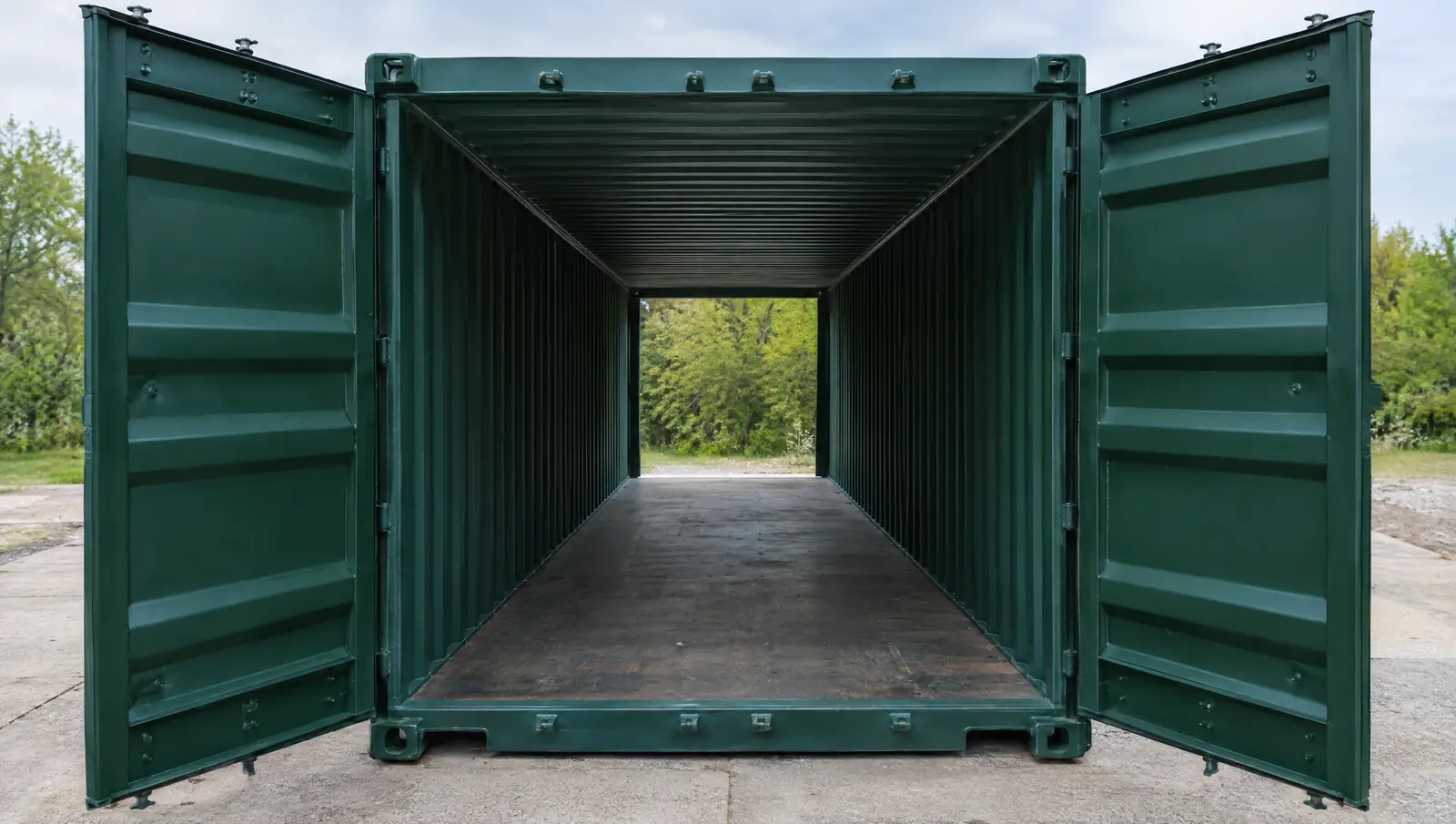
Most guides explain how to buy a container. This one turns the perspective around: you own a container – as storage, left over from a building project, or because the plot is being used differently – and want to sell it. A container has material value and, as a rule, a market, but it is bulky, heavy and legally a second-hand item, which makes it easy for seller and buyer to talk past each other. Good preparation means a faster sale, a better price and less trouble afterwards.
Note: Prices in this article are indicative values without guarantee. The actual market price depends on region, condition and market situation. The legal remarks refer to German law.
Sell, keep or rent out?
Before writing a listing, take a short look at the alternatives.
| Situation | Obvious solution | Reasoning |
|---|---|---|
| Container no longer needed, unconverted and in good shape | Sell | Good demand for simple storage containers; material value supports the price |
| Use is only paused (e.g. seasonal business) | Keep | Replacing it and transporting it often costs more than the ongoing standing time |
| Container stands permanently on your plot and is under-used | Consider partial third-party use | Renting it out brings regular income but requires a contract and insurance |
| Heavily customised conversion (living, sanitary, office) | Sell, but be realistic | The market tends to pay the value of the shell plus a premium, not your conversion costs |
| Container is rusted through or leaking | Calculate scrap or repair | Sell as a project unit or for recycling, not as a “storage container” |
Why a conversion is only partly reflected in the sale price is explained in more detail in Container running costs and depreciation.
Assessing the value realistically
The most common mistake among private sellers is a price based on the new price or on a hoped-for figure. A market comparison is more reliable: look for offers of the same size, comparable condition and similar region, and note what used containers actually cost there. As a rough guide, What does a container cost? gives a range of approx. €1,500 to €3,000 for used 20 ft storage containers.
The following factors move your price within that range:
- Condition of walls and roof: Surface rust spots are harmless; rusted-through areas, dents with crushed corrugations or leaking roof panels reduce the value markedly.
- Floor: A soft, swollen or repeatedly patched wooden floor is a bargaining chip for buyers.
- Doors and seals: Do the doors close properly, are the rubber seals intact and the locking gear smooth?
- Year of manufacture and history: A container that has made only one sea voyage (“one-trip”) is valued differently from one with years of use. The year can usually be read from the CSC plate, see Container number and CSC plate.
- Location: A container still standing on your plot must be collected by the buyer. The harder the access and loading, the lower the willingness to pay.
- Steel price and demand: Simple storage containers depend on the market. A price that was realistic a year ago need not be today.
Worked example (fictional)
Five years ago you bought a used 20 ft storage container for €2,500. As a guide to residual value after five years, the article on running costs and depreciation gives approx. 70 to 85 % for used sea containers in storage use, i.e. around €1,750 to €2,125. Your container has paint damage on one side wall, a freshly patched section of floor and a slightly sticking door locking bar. A plausible approach:
| Item | Amount (approx.) |
|---|---|
| Reference value for comparable containers in the region (assumption) | €2,200 |
| Deduction for paint and surface rust | – €150 |
| Deduction for floor repair | – €200 |
| Deduction for door locking bar (repair effort) | – €100 |
| Realistic offer price | approx. €1,750 |
As an asking price you would then set somewhat higher, around €1,900 to €2,000, to leave room for negotiation. The figures are a thought model – what matters is the method: comparison value minus documented defects, not wish price.
Documents and preparation
The more complete your documents, the fewer questions and the more credible the offer. Gather:
- Purchase receipt or invoice for the container (shows origin and price).
- Container number and – if present – a photo of the CSC plate. The eleven-character number identifies the container uniquely.
- Dimensions and type: 20 or 40 ft, standard or high cube, special doors, additional openings. Compare dimensions if needed with Container sizes and dimensions.
- Proof of repairs, paintwork and modifications.
- Weight (tare): An empty 20 ft standard container typically weighs approx. 2,200 to 2,300 kg; the exact figure is on the plate.
Before the sale the container should be empty, swept and dry. Remove shelving, fittings and cables you do not intend to sell. Installed electrical and water systems should only be disconnected by professionals; for electrics that means a qualified electrician, see Power supply for a container.
The listing: what belongs in it
A good listing saves you phone calls and filters out unserious enquiries. At minimum include:
- Size and type (e.g. “20 ft, high cube”) and year of manufacture, if known
- An honest description of condition with all known defects – explicitly including rust, dents and floor damage
- Location (town/postcode), access, and whether a crane or forklift is on site
- Price, whether negotiable, whether fixed, and whether it is a private sale
- Collection: by the buyer, who loads, from when the container is available
Photos are the most important part. Shoot in daylight: all four outer sides, the roof (as far as reachable), the doors from outside and inside, the floor from inside, the plate and container number, and each defect individually in close-up. Showing defects makes you more credible.
Avoid wording that commits you later: “watertight” or “perfect” are statements about condition that the buyer can rely on. Write only what you have verified, and otherwise describe the condition factually.
Ways to sell compared
| Route | Advantage | Disadvantage |
|---|---|---|
| Private sale via classified ads | Usually the highest achievable price | Time effort, time-wasters, fraud risk |
| Purchase by a container dealer | Quick, uncomplicated, often including collection | The dealer builds in a margin; the price is usually below the private market |
| Return to the previous seller | Can be predictable if a buy-back was agreed | Only if provided for in the purchase contract or by arrangement |
| Scrap recycling | Only sensible for rusted-through, unusable containers | Low proceeds; consider disposal of contents and transport costs |
There is no universally best choice. If you have time and an intact container, a private sale usually yields more; if you need the space quickly, a dealer’s offer is often simpler.
Warranty, commercial status and VAT
This is where most misunderstandings arise. In general (simplified, German law):
- Private to private: Liability for defects can be excluded by contract, usually with wording such as “sold as seen, excluding warranty”. The exclusion does not apply if you have fraudulently concealed a defect or have expressly guaranteed a particular condition.
- Business to consumer: A complete exclusion is not possible. For used goods the warranty period may, under certain conditions, be shortened to one year.
- Business to business: Exclusions are possible to a much wider extent than towards consumers.
Anyone who sells containers regularly and with the intention of making a profit may legally count as a business even without a trade registration. That does not apply to a one-off sale of a container you no longer need, but if you are selling several units you should clarify your status.
VAT: Private individuals do not charge VAT. If you sell from a business, the sale is generally subject to VAT unless the small-business scheme applies. In the example above that would be 19 % VAT on €1,750 net, i.e. approx. €332.50, and therefore €2,082.50 gross. If you sell in a business context, state clearly in the offer whether the price is net or gross. The tax treatment of the disposal (book value, gain or loss) depends on how the container was accounted for; basics in Tax and depreciation for containers.
How a complete purchase contract is structured is shown in Purchase contract and warranty. Its contract overview also works as a template for your sale.
Loading and handover
This is where most everyday misunderstandings occur, because a container cannot simply be “taken away”.
- Who loads? The usual arrangement is that the buyer commissions a haulier with a loader crane or hook-lift. Clarify in writing beforehand who organises it, who pays and who is liable for damage to the property (paving, driveway, utilities).
- Accessibility: A container standing between a building and a fence or under overhead lines often needs special equipment. Check access width, load-bearing capacity of the ground and room for the crane. Lifting basics are in Lifting a container correctly and the process in Transporting a container.
- Transfer of risk: Specify from when the buyer bears the risk of damage or loss – usually with loading onto the transport vehicle.
- Payment before loading: Make sure the agreed amount has been received in your account or paid in cash before loading, not “afterwards”.
- Handover record: Note date, container number, condition at handover, price and both parties’ signatures. The buyer should confirm accepting the container in the condition inspected.
If the container stood on a foundation or was connected to power or water, the removal leaves a site that should be left in good order. What the dismantling involves depends on the set-up; for foundations see Container foundations.
Typical scams when selling
Fraud does not only hit buyers. As a seller watch for these patterns:
- Overpayment: The buyer “accidentally” transfers too much and asks you to refund the difference – the original payment later turns out to be uncovered or reversed.
- Payment confirmation instead of payment received: Check the actual receipt in your account, not a screenshot or confirmation email.
- Buyer wants to buy unseen and “sends a haulier”: If someone buys without viewing, without questions and with immediate collection, be cautious. A serious buyer usually wants to see what they are getting.
- Pressure to hurry and payment via link: Do not accept payments via links sent to you or external portals.
You will find similar patterns from the buyer’s side in Fake container dealers and advance-payment fraud. As a rule of thumb: viewing, bank transfer with confirmed receipt or cash on handover, written contract.
Special points for converted containers
If the container is converted or was set up with planning permission, one more point arises: a permit generally relates to location, use and duration. Whether a buyer may use the container elsewhere without further ado depends on location, duration and use; more in Container building permit. Do not withhold from buyers any conditions attached to the container.
Checklist before posting the listing
- Market comparison done, minimum price set
- Container empty, dry, swept
- Container number, CSC plate, dimensions and weight noted
- Photos of all sides and all defects taken
- Defects stated openly in the text
- Clearly stated: private or business sale, net or gross
- Loading clarified: access, ground, crane, date
- Purchase contract and handover record prepared
- Payment received before loading
Important note
This article offers general information on German law and does not replace legal or tax advice. Warranty, commercial status and VAT depend on the individual case. For binding information consult a lawyer or your tax adviser. All price and percentage figures are indicative values without guarantee.
Conclusion
A used container sells well when three things fit together: a price based on market comparison and documented defects, an honest listing with good photos, and an orderly handover in which payment comes before loading. Clarifying from the start whether you sell as a private individual or a business avoids the most common disputes over warranty and VAT. And if you are still on the buying side, Buying a used container gives the other party’s perspective.