
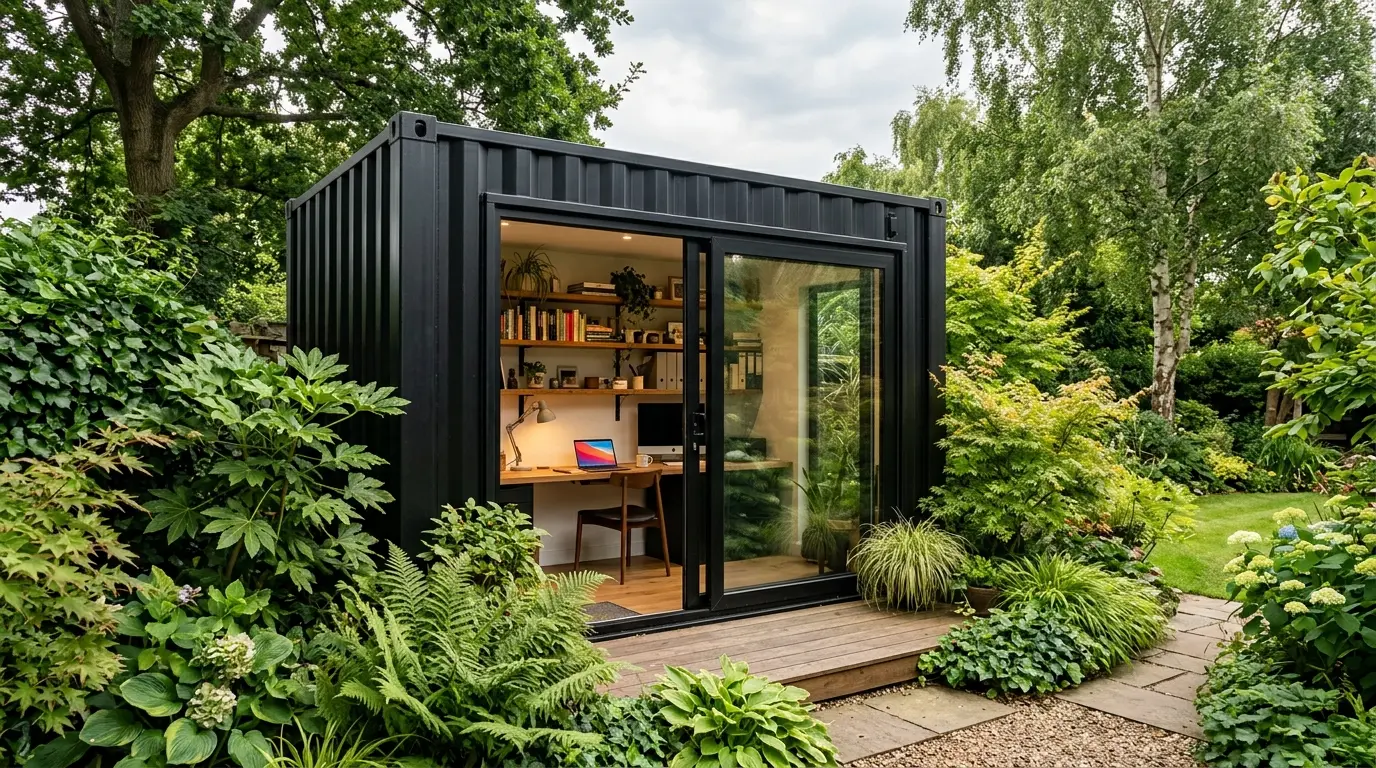
The classic wooden garden shed has some competition. More and more people are discovering the shipping container as a robust, durable and surprisingly flexible alternative. Whether as a quiet garden office, a well-organised workshop or an atmospheric sauna: a container can be turned into a genuine retreat with manageable effort. In this guide you will learn which usage ideas really work, what you need to consider legally and roughly what costs to expect.
Why a Container in the Garden?
Containers bring a number of tangible advantages that make them attractive compared to bricked or timber-built garden houses.
- Robust and durable: A steel container defies wind, weather and moisture. Where wood eventually rots, steel lasts for decades – and even longer with a little rust prevention.
- Affordable to buy: Used sea containers are often significantly cheaper than a high-quality wooden kit of comparable size.
- Mobile and modular: A container can be relocated by crane, taken along or combined with additional modules. If you move house, you simply take the garden house with you.
- Secure: Solid steel walls and lockable doors reliably protect tools, equipment and valuables from break-ins.
- Quick to set up: Prepare the foundation, unload the container, done. The shell stands in a single day.
It is precisely the combination of stability, security and a low entry price that makes the container a serious option – not only for pragmatists, but also for the design-ambitious.
Usage Ideas: From Garden Office to Sauna
A container is an empty space with potential. Depending on the fit-out, a completely different place emerges. An overview of the most popular concepts.
Garden office and home office: The classic in the age of remote work. An insulated, well-lit container a few steps from the house creates a real separation between work and private life – without commuting.
Workshop and hobby room: Whether a wood workshop, bike store or craft room: the container offers robust space for machines, tools and projects that would be in the way inside the house.
Storage and tool shed: Lawnmower, garden furniture, tyres, seasonal goods – the container replaces the overcrowded cellar and keeps everything dry and theft-proof.
Sauna: A well-insulated container is excellent for conversion into a garden sauna. A heater, wooden panelling inside and a small anteroom turn it into a private wellness oasis.
Pool and technical house: Filter system, heat pump and pool accessories find protected space in the container. One section can double as a changing room or outdoor shower.
Guest room: With insulation, a window, a bed and a mini bathroom, the container becomes a charming guest house – ideal for visitors who appreciate their own retreat.
Ideas Compared
| Usage idea | Typical equipment | Effort |
|---|---|---|
| Garden / home office | Insulation, power, window, flooring, heating | Medium |
| Workshop / hobby room | Power, lighting, workbench, possibly light insulation | Low–Medium |
| Storage / tool shed | Shelving, ventilation, lock | Low |
| Sauna | Strong insulation, sauna heater, wood panelling, power | High |
| Pool / technical house | Power, ventilation, water connection | Medium |
| Guest room | Insulation, power, window, mini bathroom, heating | High |
The rule of thumb: the closer the container is to permanent human occupancy, the higher the fit-out standard for insulation, ventilation and services.
Permit and Boundary Distance
The most important point first: a container in the garden is not automatically exempt from permits. Whether you need a building permit depends on the federal state, the size, the use and the location. In Germany, building law is a matter for the individual states, so the regulations vary accordingly.
Roughly speaking: small buildings without a habitable room and without a fireplace are exempt from procedure in many federal states up to a certain volume (often between 20 and 75 cubic metres, depending on the state). As soon as people stay in them permanently – for example in a garden office or guest room – or a fireplace such as a sauna heater is used, the requirements rise significantly.
The boundary distance to the neighbouring plot is also regulated and varies depending on the federal state and the specific use. A pure tool shed may often move closer to the boundary than a heated habitable room. Be sure to clarify this in advance with the building authority.
Important: Never rely on blanket statements from the internet. Ask your local building supervisory authority before setting up. A short phone call can save you an expensive dismantling in case of doubt.
You will find details, exemption limits and typical pitfalls in the detailed article Container Building Permit.
Insulation, Power and Light
Steel is an excellent conductor of heat – and in its raw state that is exactly the problem. Without insulation, the container becomes an oven in summer and a freezer in winter. In addition, condensation threatens on the cold interior walls, which leads to rust and mould over time.
For every use with quality of stay, proper insulation is therefore mandatory. Common builds consist of a substructure, insulation material and interior panelling made of wood or boards. A correct vapour barrier is important so that no moisture gets into the build-up. You can read how this works professionally in the guide Insulating a Container.
On the subject of power, you have two paths: a fixed supply from the house (professionally installed by an electrician) or a self-sufficient solution with a solar module, battery and inverter. For an occasionally used garden office, a small photovoltaic island for light, laptop and phone charging is often enough. Plan for sufficient sockets – retrofitting is laborious.
Light is an underestimated factor. Installing windows and a door with a glass section enormously raises the quality of stay. Roof windows or a strip of glazing bring additional daylight into the depth of the room. For the evenings, warm-white LED lights create a homely atmosphere.
Looks and Cladding
The raw steel look is not everyone’s taste – and it does not have to be. A container can be transformed in design far beyond its industrial origin.
- Wood cladding: A ventilated façade of larch, Douglas fir or thermally treated wood turns the steel box into a high-quality garden building that blends in harmoniously.
- Paint: If you want to keep the container character, you can create a fresh, individual look with special metal paint – from restrained anthracite to a bold accent colour.
- Greening: Trellises with climbing plants let the walls turn green over the years. A green roof additionally improves the microclimate, retains rainwater and protects the roof surface from UV and heat.
With a small terrace in front, a few planters and coherent lighting, the container quickly becomes a place where you like to spend time – visually far removed from any construction-site image.
Cost Range
The costs depend strongly on condition, size and fit-out standard. The following figures are rough guide values and are no substitute for an individual quote.
- Used container (approx. 20 ft): approx. 1,500–3,500 euros
- New or refurbished container: approx. 3,500–6,000 euros
- Insulation and interior fit-out: approx. 2,000–6,000 euros depending on standard
- Electrics, windows, door: approx. 1,500–4,000 euros
- Foundation and installation (crane): approx. 500–2,000 euros
For simple storage, it often stays at a few thousand euros. A fully fitted garden office or guest room, on the other hand, can quickly grow into the five-figure range. Those who do a lot themselves save considerably – but must allow for time and craftsmanship.
Note: All prices are non-binding approximate values (as of 2026) and can vary strongly by region and market situation. Obtain several quotes.
Conclusion
A container is far more than a steel box for tools. Robust, secure and comparatively affordable, it offers the ideal basis for an individual garden house – from a minimalist tool shed to a full-fledged home office or guest room. Three things are decisive for a good result: an honest clarification of the legal situation before setting up, professional insulation for lasting quality of stay, and a well-thought-out design that integrates the container into the garden. Those who observe these points get a durable, flexible and characterful garden house that will bring joy for many years.