
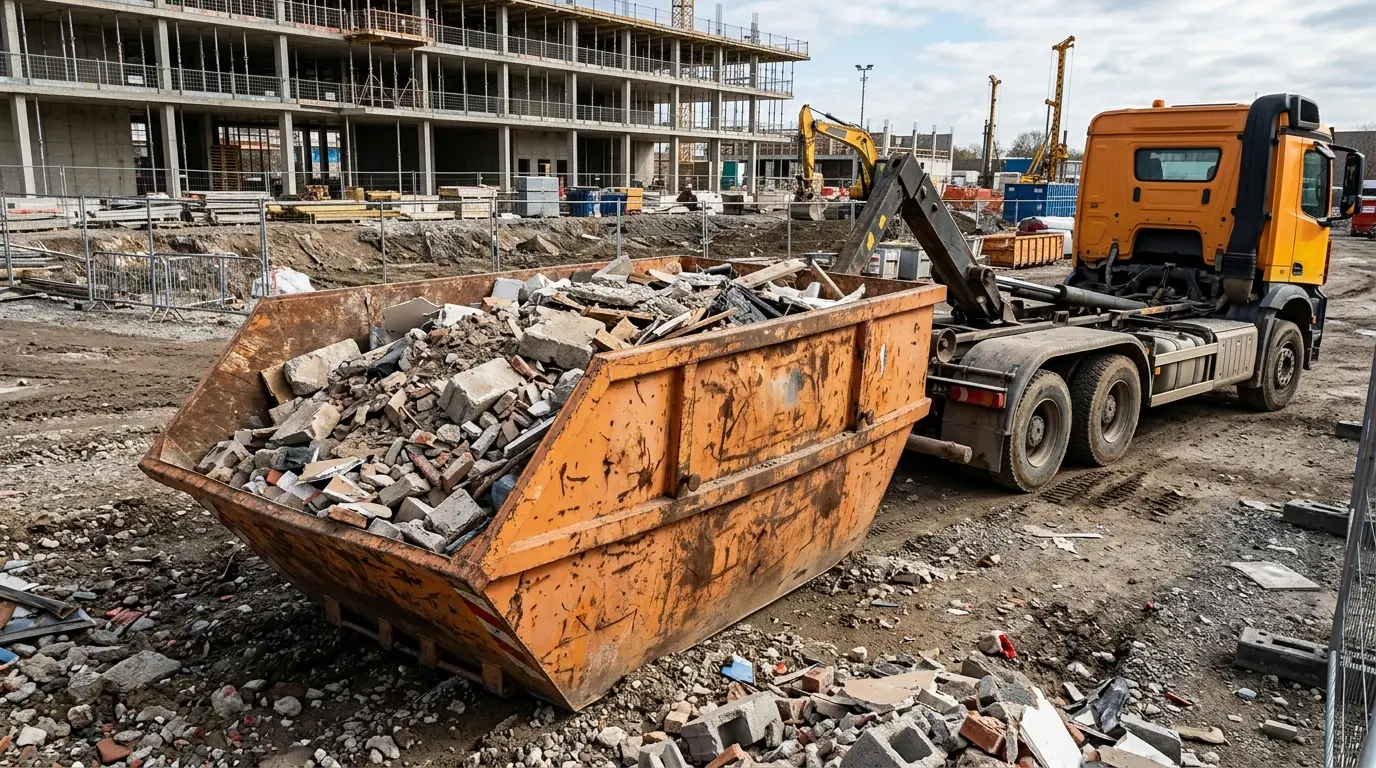
Clearing a flat, stripping a bathroom or redesigning a garden always raises the same questions: which container fits, what may go inside, and what does it really cost? The answer depends less on volume than most people assume – waste type, weight and the purity of the load drive the bill. This guide explains both common systems and shows where money can be saved.
Skip container or roll-off container?
The two systems differ mainly in how the body gets onto the truck. A skip container (German: Absetzcontainer) is lifted vertically by a skip loader using two hydraulic arms with chains or lifting brackets, and set down almost straight from above. That needs headroom but very little manoeuvring space – ideal in tight courtyards or narrow driveways. Skips typically hold roughly 3 to 10 m³, come open or with a lid or hatch, and have low side walls, which makes loading by hand easier.
A roll-off container (German: Abrollcontainer) is pulled backwards off the truck along a roller bed by a hook lift. It needs a straight approach and several metres of clear length behind the vehicle, but allows much larger volumes – usually around 7 to 40 m³. Many roll-off bodies have rear wing doors, so a wheelbarrow or sack truck can be pushed straight in at ground level. On demolition and clearance jobs that saves a great deal of time.
| Feature | Skip container | Roll-off container |
|---|---|---|
| Vehicle | Skip loader (chains/brackets) | Hook-lift truck |
| Usual sizes | approx. 3–10 m³ | approx. 7–40 m³ |
| Loading | over the side wall, mostly from above | rear door / wing doors, ground level |
| Space required | little length, plenty of height | straight approach, plenty of length |
| Typical use | heavy waste, tight sites | bulky waste, green waste, large volumes |
| Body types | open, lidded, hatched | open, with doors, partly enclosed |
Rule of thumb: heavy, dense waste goes into small skips, voluminous and light waste into large roll-off bodies. A 30 m³ container full of rubble would be far overweight long before it looked full.
Sizes and capacity
Dimensions vary by manufacturer and supplier; the values below are practical averages for orientation.
| Volume | Typical dimensions (L × W × H) | System | Suitable for |
|---|---|---|---|
| 3 m³ | approx. 2.6 × 1.7 × 0.8 m | Skip | excavated soil, concrete, heavy rubble |
| 5 m³ | approx. 3.4 × 1.8 × 1.0 m | Skip | rubble, tiles, mortar residue |
| 7 m³ | approx. 3.7 × 2.0 × 1.2 m | Skip/Roll-off | rubble, small amounts of mixed site waste |
| 10 m³ | approx. 5.7 × 2.3 × 1.2 m | Roll-off | bulky waste, waste wood, renovation debris |
| 20 m³ | approx. 5.8 × 2.3 × 1.8 m | Roll-off | mixed site waste, house clearance, green waste |
| 30–40 m³ | approx. 6.5–7.0 × 2.4 × 2.0–2.6 m | Roll-off | light bulky waste, green waste, packaging |
With mineral waste, weight matters more than volume: a cubic metre of rubble weighs roughly 1.3 to 1.8 tonnes depending on composition, excavated soil rather 1.5 to 2.0 tonnes. That is why rubble and soil containers are almost only offered in small sizes – the permitted gross vehicle weight sets the limit, not the rim of the container.
Which size for which project?
The figures below are planning benchmarks. When in doubt, order one size up rather than paying for a second delivery – the extra trip usually costs more than the extra volume.
| Project | Typical waste | Recommendation |
|---|---|---|
| Clearing a two-room flat | bulky waste, furniture | 10 m³ roll-off |
| Clearing a house incl. cellar/attic | bulky waste, mixed waste | 20–30 m³ roll-off |
| Bathroom refit (approx. 8 m²) | tiles, screed, sanitary ceramics | 3–5 m³ skip (rubble) |
| Loft conversion / drywall | waste wood, plasterboard, insulation | 7–10 m³ each, separated |
| Garden redesign with excavation | excavated soil | 3–5 m³ skip |
| Tree and hedge cutting | green waste | 10–20 m³ roll-off |
| Removing screed, stripping walls | rubble + mixed waste | 5 m³ + 10 m³ separately |
Waste types and separation
Disposal costs depend directly on the waste fraction. Single-material loads are almost always considerably cheaper than mixed construction waste because they can be recycled without costly sorting. A single wrong item – an insulation board in the rubble, for example – can move the entire container into a more expensive category.
| Waste type | Note | Typical price bracket |
|---|---|---|
| Excavated soil | soil only, no root balls, no stones with building residue | low |
| Rubble (mineral) | concrete, brick, tiles, screed – no gypsum, wood, foil | low |
| Waste wood A I–A III | untreated to painted/coated, no wood preservatives | medium |
| Waste wood A IV | treated timber, sleepers, impregnated wood – separate | high |
| Mixed construction waste | mixed site waste below the mineral content threshold | medium to high |
| Bulky household waste | furniture, carpet, mattresses – no electrical appliances | medium |
| Green waste | branches, leaves, grass – no soil or root balls | low to medium |
| Plasterboard / gypsum fibre | must be kept strictly separate, contaminates rubble | high |
| Insulation material | mineral wool sealed dust-tight (big bag) | high |
| Scrap metal | often has resale value, sometimes collected free | very low to revenue |
| Asbestos, tar felt, hazardous waste | not in standard containers – specialist disposal only | special rate |
Asbestos-containing materials (fibre cement sheets, old floor coverings, adhesives), tar-based roofing felt, paints, solvents, waste oil, batteries and electrical appliances never belong in an ordinary container. Asbestos has its own rules on packaging, labelling and documented disposal, handled by specialist firms.
How the price is made up
A container price is rarely a single figure, but a bundle of items:
- Rental/standing time: usually a base period of 7 to 14 days included, then a daily rate.
- Delivery and collection: distance-dependent, often included in a flat rate.
- Disposal by tonnage: the biggest lever; billed against the weighbridge ticket.
- Minimum quantities: many fractions are billed at a minimum tonnage even if less is inside.
- Waiting time: if the truck is to wait while you load, you pay for its standing time.
- Contamination surcharges: wrong contents trigger re-sorting or reclassification to a costlier fraction.
- Extras: wasted trip if the site is blocked, tarpaulins, provision of big bags.
Rough orientation values for a 7 m³ container including transport and disposal: rubble approx. €200–400, mixed construction waste approx. €400–750, bulky waste approx. €350–650, green waste approx. €250–450. For a 20 m³ roll-off container with mixed construction waste, approx. €700–1,400 is more realistic.
All prices are orientation values, varying by region, waste type and disposal company, as of 2026. Only the specific quotation with weighbridge-based billing is binding.
Site and permits
On your own property, placement is generally unrestricted. Watch the surface and its load-bearing capacity: paving, slabs and underground garage ceilings can suffer under several tonnes of point load. Timber bearers are cheaper than a new driveway.
If the container stands on public ground – pavement, parking bay, carriageway – a special use permit from the road traffic authority or public order office is required. Depending on the location, a traffic order with barriers, signage and possibly a no-parking zone is added. Fees are often in the range of approx. €30–150 plus signage costs; many suppliers handle the application for a surcharge. At night, containers in the traffic area must be visible through warning lights and retroreflective markings.
Loading it correctly
- Heavy and bulky items at the bottom so the load cannot shift.
- Fill the voids: dismantle cupboards, flatten cardboard – that saves real volume.
- Never load above the top edge. An overfilled container may not be transported; at best it is reloaded, at worst the trip is billed as a wasted journey.
- Cover dusty and light waste – load securing is the haulier’s responsibility, but safe filling is yours.
- Respect the vehicle’s weight limits: a soil container can be too heavy even with headroom to spare.
- No liquids, no pressurised containers, no hazardous substances.
Money-saving tips
- Separate by material – rubble and soil never belong in the same body as wood or foil.
- Collect metal separately – often picked up free, sometimes with a payout.
- Choose a realistic size – two deliveries cost more than one slightly larger container.
- Keep standing time short – order only when demolition actually starts.
- Compare quotes – disposal rates vary considerably by region.
- Check small quantities – for a few cubic metres, the recycling centre or a big bag is often cheaper.
Conclusion
Skip containers are the choice for heavy mineral waste and tight sites, roll-off containers for large volumes and lighter fractions. The price is not set by cubic metres but by tonnage and the purity of the load: consistent separation, a realistic size and a short standing time often cut the total by a third. And anything that even looks like asbestos or hazardous material belongs in the hands of a specialist disposal company from the start – corrections after the fact are always the most expensive route.