Technical and machinery containers
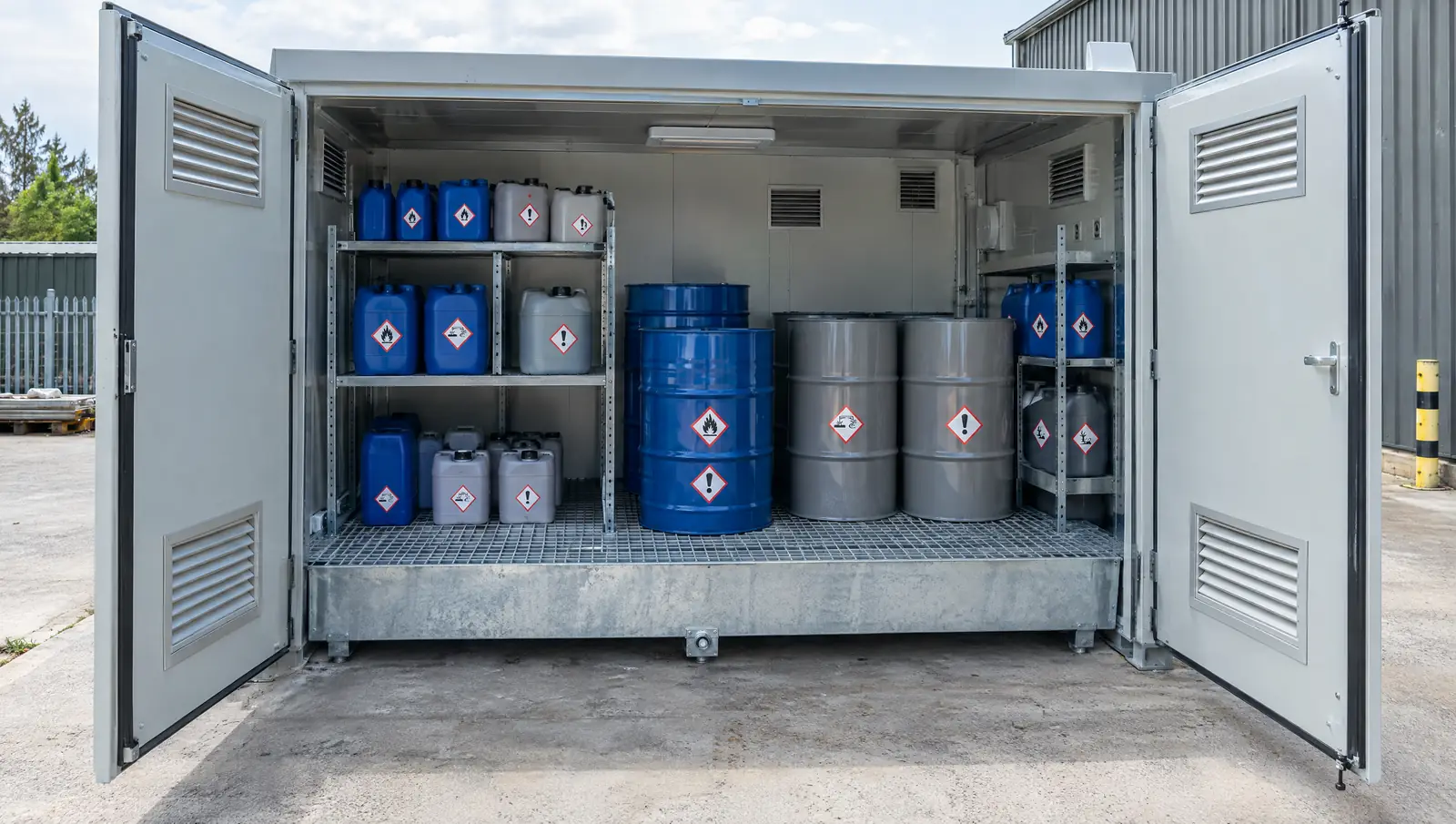
Technical and machinery containers are enclosures for equipment that needs to stand outdoors protected, locked and often sound-insulated: standby generators, combined heat and power units, compressors, pumping stations, switchgear, battery storage or complete IT and server rooms. The equipment is installed, wired and tested in the factory and arrives on site as a finished unit.
But a plain steel container with a machine inside is not yet a technical container. The real engineering lies in what is hardly visible from outside: airflow for waste heat, silencers and insulation, fire protection and suppression, a base frame that takes point loads and vibration, and clean cable and pipe penetrations.
Typical uses
- Standby power for hospitals, data centres and businesses
- Combined heat and power unit or heating plant in container form
- Battery storage for solar and wind parks
- Compressor and compressed air plant next to production halls
- Pumping, metering and control stations in water management
- Modular switchgear and transformers
- Server and network rooms as a modular data centre
Sizes and dimensions
| Area (example) | Immission guide value by day | at night |
|---|---|---|
| Industrial area | 70 dB(A) | 70 dB(A) |
| Commercial area | 65 dB(A) | 50 dB(A) |
| Mixed and village area | 60 dB(A) | 45 dB(A) |
| General residential area | 55 dB(A) | 40 dB(A) |
| Purely residential area | 50 dB(A) | 35 dB(A) |
Outdoor immission guide values under the German TA Lärm, for orientation – they apply at the relevant receptor, usually the neighbouring building, not at the container. They show why a generator near housing needs substantial sound insulation at night.
✓ Advantages
- Factory-built and tested before delivery
- Short installation on site, no construction of a plant building
- Relocatable if the site changes
- Protects equipment from weather and unauthorised access
! Points to consider
- Waste heat, noise and fire safety require specialist design
- High point loads – foundation and transport need careful design
- Maintenance access quickly becomes a bottleneck in a narrow container
- Approvals depending on the plant (emission control, water law)
Equipment and options
- Intake and exhaust louvres, often with silencer splitters
- Acoustic insulation on walls and ceiling
- Base frame or reinforced floor, anti-vibration mounts
- Sealed cable and pipe penetrations
- Fire detection and, where needed, suppression system
- Air conditioning for electronics, lighting, sockets for maintenance
- Spill sump where fuel or oil is stored
Price guide
- Container shell
- a small share of total cost
- Enclosure with acoustics and ventilation
- project-specific, often several times the shell
- Design
- budget for specialist acoustic, fire and electrical design
Rough orientation values without guarantee; prices vary by region, condition and market.
What to look out for
- Think about noise at the neighbour, not at the container: the level at the nearest receptor is what counts.
- Calculate waste heat realistically – generators and batteries produce considerable heat that must be removed safely.
- Plan aisles and doors so filters, batteries and engines can be reached without dismantling.
- Give point loads to the structural engineer before the foundation is designed.
- Where fuel is stored in the container, clarify spill sump and water protection requirements early.
Frequently asked questions
Can I simply put a generator into a used container?
For a trial run perhaps, for continuous operation no. Without designed intake and exhaust the generator overheats, without acoustic insulation it becomes a problem for neighbours, and without a spill sump fuel storage quickly breaches water law.
Which noise limits apply to a technical container?
In Germany the TA Lärm serves as orientation, with immission guide values by area type to be met at the relevant receptor. At night they are considerably lower in residential areas than by day. That determines how much sound insulation is required.
Related guides
Planning with technical and machinery containers?
Compare sizes, costs and buying vs. renting in our guides.